Team Accountability for AI Spend: A Practical Guide
Build team accountability for AI spend with clear ownership, KPIs, and reporting. Cut LLM costs and stop surprise OpenAI and Anthropic bills.
You know the scene. Finance pings you on Monday morning, there's a big OpenAI invoice on the table, and nobody can say which feature caused the spike, which product team owns it, or why the bill climbed while usage looked “about the same.” That's not a tooling problem first. It's a team accountability problem, and in AI spend, that usually means nobody owns tagging, nobody owns attribution, and nobody owns the weekly number until the invoice already hit. If your org runs OpenAI, Anthropic, or both, this is the exact kind of mess that turns a promising AI rollout into an avoidable budget fire.
Table of Contents
- The Moment Finance Asks Who Owns the AI Bill
- What Team Accountability Really Means for AI Spend
- Governance Models, Roles, and KPIs That Actually Hold Up
- The Implementation Playbook From Tagging to Investigations
- How SpendLens AI Features Map to Each Accountability Step
- A Realistic 30-60-90 Day Rollout Plan
- Common Objections and How to Handle Them Honestly
- The One Number That Proves Accountability Is Working
The Moment Finance Asks Who Owns the AI Bill
The finance director opens the invoice, sees the damage, and walks into engineering with a simple question, who owns this? The answer is usually a shrug, because six teams are using Anthropic for summarization and three are on OpenAI for chat and embeddings, but no one has a clean line from usage to feature to team. The work was real, the launch was real, and the bill is real. The ownership isn't.
That's why this problem lands harder than standard cloud FinOps. A VM has a project tag, a cluster tag, maybe a cost center. LLM calls don't arrive with that kind of meaning attached. They're token-based, provider-specific, and often reused across workflows, so the accounting trail disappears exactly where executives expect certainty.
Practical rule: if finance can't name the owner of a cost spike within one business day, the accountability model is broken.
Your first move is not to debate model quality or prompt strategy. It's to decide who owns the workload, who owns the tags, and who has to explain the bill on the weekly review call. If you want the cost-management side of this to fit into a broader IT finance motion, keep the operating model aligned with your existing financial controls, not with ad hoc reporting. SpendLens AI's IT financial management guidance fits that mindset, because it treats spend ownership as an operating discipline, not a sentiment.
What Team Accountability Really Means for AI Spend
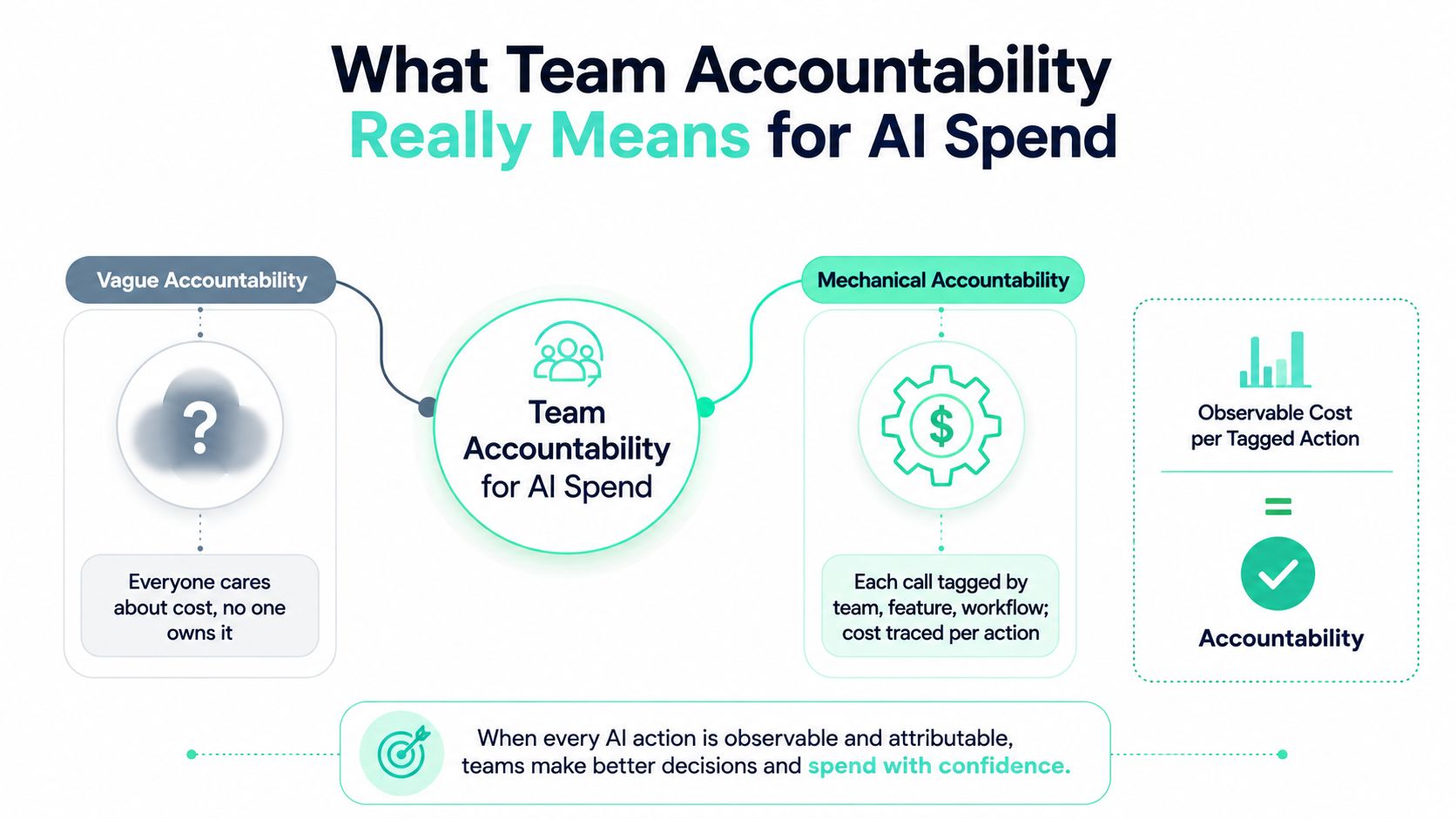
Team accountability for AI spend means one named owner is answerable for a workload's cost, one tagging standard connects calls to that workload, and one cadence forces variance to be reviewed before the month closes. That's the operational definition. Anything softer turns into a culture poster that nobody uses when the invoice arrives.
Accountability is ownership, observability is proof
These are different things, and teams often mix them up. Accountability says who owns the outcome. Observability says whether you have the data to prove what happened. If the tags are missing, if the prompt path is inconsistent, or if the dashboard can't separate workload, provider, and model, then accountability is just a title with no evidence behind it.
That distinction matters because LLM usage is messy in ways normal cloud spend isn't. A prompt can be reused across features. A response can be cached. A small prompt change can shift token behavior without changing user volume. So you need a system that traces cost per tagged action, not just a finance report that groups invoices after the fact.
The practical standard is simple: every workload gets one accountable owner, every call gets a consistent tag, and every variance gets reviewed on a fixed cadence. A chargeback model helps because it makes the owner see their own number, not a blended corporate average. Once the team sees cost by project, provider, model, and workload, accountability stops being abstract and starts being measurable.
Put the definition in one sentence
Use this sentence in your wiki and don't get cute with it, team accountability for AI spend is the practice of assigning one named owner to each workload, tagging every call to that workload, and reviewing cost variance on a fixed cadence. That definition forces real behavior. It also gives finance a clean answer when the bill moves.
If the owner changes every week, the metric won't stabilize. If the tags change every sprint, the trend won't mean anything.
A FinOps motion that just produces reports is incomplete. A FinOps motion that produces decisions, such as model swaps, prompt changes, or scope cuts, is accountable. That's the standard you want.
Governance Models, Roles, and KPIs That Actually Hold Up
The governance model determines whether accountability stays real after the first dashboard demo. Centralized ownership, federated ownership, and a hybrid model all work, but they fail in different ways. The right choice depends on product complexity, process simplicity, and team size, which is exactly why a single process won't fit every org. The underlying research points in that direction, too, because structural factors shape whether accountability becomes institutionalized or breaks down, and the answer is usually clearer ownership boundaries and simpler handoffs rather than more ceremony, as noted in the earlier research on structural predictors.
A centralized model puts the platform team in charge of LLM instrumentation and routing. That's clean, but it can bottleneck product teams and turn every optimization into a ticket. A federated model gives each product team its own spend and optimization responsibility, which is fast, but it breaks if tagging rules drift. The hybrid model is usually the best fit for AI spend, because a small Center of Excellence can set tagging policy, reporting standards, and review rhythm while product teams own the actual spend.
The roles that matter
- FinOps lead: owns the weekly spend review, budget variance, and chargeback reporting.
- Platform owner: owns instrumentation, tagging standards, and the dashboard pipeline.
- Product owner: owns the workload result, the workload budget, and the decision to optimize.
- Model reviewer: checks when a lower-cost model can replace a more expensive one without breaking quality.
- Finance partner: validates allocation logic and pushes back when the tags don't map to a real business owner.
The KPI list should stay short and operational. Track cost per successful task, cost per active user, cache hit rate, prompt waste rate, and budget variance. Those numbers tell you if the team is learning or just spending differently. If you want a broader cloud governance pattern for comparison, this governance guide is the closest adjacent structure, but AI spend needs tighter ownership because the unit economics move faster.
Decision rule: if one team can't explain its variance without asking another team for permission, the accountability model is too weak.
Single-threaded ownership beats broad RACI charts for AI workloads because decisions happen daily, not quarterly. RACI still has a place for handoffs, but it won't save you when a prompt change doubles your bill and nobody knows who approved it. Use one accountable owner per workload, then back that owner with a lightweight review chain, not a committee.
The Implementation Playbook From Tagging to Investigations
Start with tagging, because without attribution the rest of the process is theater. Every call needs a consistent tag tied to team, feature, and workflow. If engineering ships a summarization feature, the tag should show the product area, not just a generic service name. If the same service serves three teams, each call still needs to point to the right owner.
Step 1, tag the call before you argue about the dashboard
Instrument every request so the cost trail survives the provider boundary. Once that's in place, route event data into a single dashboard that breaks out spend by project, provider, model, and workload. That dashboard is where finance and engineering stop arguing about anecdotes and start looking at the same numbers.
The second move is chargeback. If product owners only see a pooled enterprise bill, they'll treat AI as shared overhead. When they see their own variance, they start asking better questions. That's when the right discussions show up, such as whether a feature should use a cheaper model, whether caching is working, or whether a prompt needs to be cut down.
Step 2, review weekly or don't bother pretending
Run a weekly cost review with a fixed agenda, top movers, anomalies, savings opportunities, and prompt waste. Make the meeting boring on purpose. The job is not to debate AI strategy every week. The job is to catch drift before it becomes a surprise invoice.
A good investigation path separates first-line and second-line work. First-line review checks trends, variance, and obvious outliers. Second-line forensics digs into per-call behavior when the spike needs a root cause. If a summarization workload suddenly pushes more output tokens after a prompt change, you want to see that in minutes, not after month-end close.
Step 3, make investigations a runbook, not a rescue mission
Every bill spike needs an owner and a response clock. The person who owns the workload should be the first person who answers. If the issue touches platform instrumentation, the platform owner joins. If it's a model-routing choice, the model reviewer gets pulled in. That's how you keep the process from becoming a blame chase.
If you want a practical cost-allocation pattern to pair with this playbook, the cost allocation methods guide fits cleanly because it forces the question of who pays for what before the invoice lands. And if you're using a platform like SpendLens AI, the basic sequence is still the same, tag, attribute, review, investigate, fix.
How SpendLens AI Features Map to Each Accountability Step
The tool only matters if it supports the operating model you already chose. For tagging and attribution, @spendlensai.observe, track(), and client.tag() give you the metadata layer you need to tie calls to workflows, tasks, features, or endpoints. That produces the first artifact of accountability, a tagged call that finance can allocate.
For reporting, the dashboard breakdown by project, provider, model, and workload gives product owners and FinOps the same view of the bill. That matters because accountability falls apart when every stakeholder sees a different summary. With one dashboard, the conversation shifts from “what happened?” to “what do we do next?”
Where the tool fits in the workflow
The platform also supports automated workload classification, which helps compare similar operations across releases and environments. That's useful when the same feature starts drifting toward a more expensive model path or when cache behavior changes the economics without changing the user experience. Cache-token visibility matters here because it exposes wasted opportunity, not just raw usage.
For optimization, savings recommendations and migration risk ratings help teams prioritize the next test instead of guessing. Prompt waste signals flag large templates, excessive context, repeated instructions, and long outputs that inflate token consumption. The daily executive summary, with the top cost driver and highest-impact recommendation, gives leaders a chargeback-ready artifact they can read without opening a spreadsheet.
If you want a deeper look at the monitoring layer itself, this endpoint monitoring guide is the right companion piece, because the spend story starts at the call boundary. SpendLens AI is one option here, and the reason it fits this topic is simple, it adds lightweight instrumentation to existing code and surfaces spend drivers, cache efficiency, and model-switch opportunities without forcing a proxy into the request path.
Rule of thumb: if a feature can't produce a tag, a chart, or a recommendation, it isn't helping accountability yet.
A Realistic 30-60-90 Day Rollout Plan
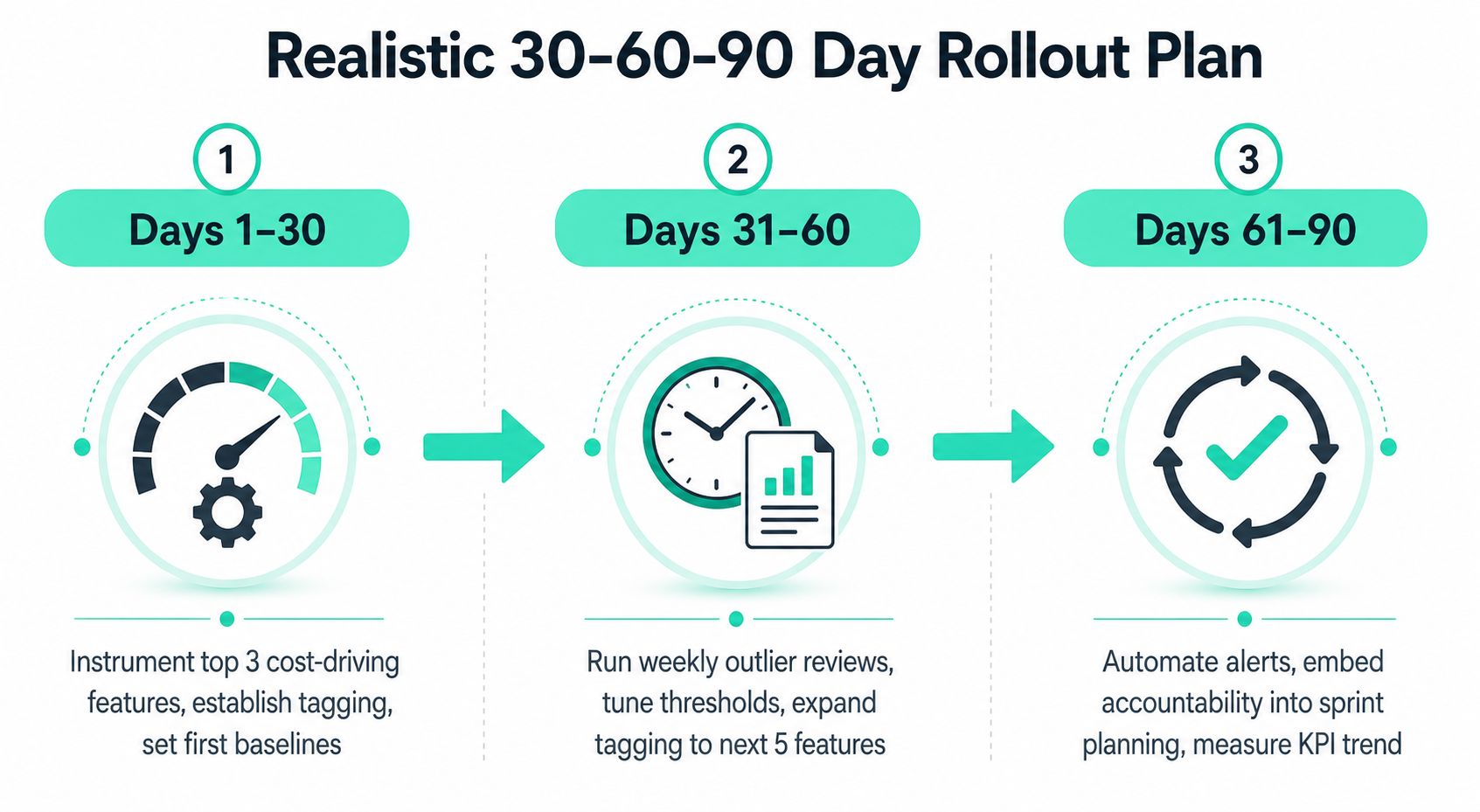
Days 1 to 30 should be about instrumentation, not politics. Pick the top three cost-driving workloads, wire in @observe, define the tagging taxonomy, and publish a baseline for cost per workflow. Don't try to fix every workload at once. The point is to prove the model on the calls that matter most.
Days 31 to 60 are about operational rhythm. Start weekly cost meetings, send chargeback reports to product owners, and route prompt waste signals to the platform channel. At this stage, you're not chasing perfection. You're teaching the org to read the same signal the same way, every week.
What done looks like by day 90
Days 61 to 90 is where accountability becomes routine. Test savings recommendations against your quality rubric, ship a monthly executive summary, and run a tabletop bill-spike drill against the investigation runbook. If the owner can't explain the spike and the next action in one conversation, the rollout isn't finished.
- Definition of done for month one: the top workloads are tagged and a baseline exists.
- Definition of done for month two: teams are reviewing their own variance weekly.
- Definition of done for month three: investigations are repeatable, and leadership gets a consistent summary.
The leading indicator I trust most is simple, the time between spike detection and owner acknowledgment. If that shrinks, the org is learning. If it stays long, your tags may exist, but accountability still isn't real.
Common Objections and How to Handle Them Honestly
“Our teams are cross-functional, so no one owns the outcome.” That's a weak excuse. Cross-functional work still needs stewardship-style ownership and a single-threaded leader. If the outcome crosses boundaries, name one person who coordinates the boundary and one person who answers for the spend. Shared work doesn't mean shared avoidance.
“Charging back will hurt innovation.” Not tracking spend hurts innovation faster. Once finance pulls back the budget, vague enthusiasm won't save the project. Chargeback forces product owners to choose. That usually improves prioritization, because teams stop funding low-value experiments with invisible money.
“This will feel like surveillance.” It only feels that way if you run it as punishment. The better model is safe, non-blaming, and answerable for common actions, which lines up with the accountability research on shared expectations and psychological safety from the earlier section. People speak up when they know the goal is correction, not public shaming. If you need a practical framing, lead by example and call in rather than call out.
“Multiple providers make this impossible.” They don't. Use metadata-only tracking, direct provider calls, and standard SDKs so you keep your existing client setup intact. That avoids a proxy in the request path and keeps the implementation lightweight. The point is to preserve the app's behavior while making the spend visible.
The One Number That Proves Accountability Is Working
Use cost variance against the agreed weekly budget as the number you watch first. If the team can't hit a budget it helped set, no dashboard will rescue the ownership problem. That's the cleanest signal that accountability is real, because it forces one owner, one budget, and one review rhythm.
Week one should be brutally practical. Name the FinOps lead, agree on the tagging taxonomy, instrument the top three cost drivers, set the baseline per tagged action, define alert thresholds, and schedule the weekly review. That list is enough to get out of the spreadsheet and into the operating room.
The three leading indicators that tell me the variance will stay controlled are cache hit rate, prompt waste rate, and time to investigate a bill spike. If those are moving the right way, you're building a tighter operation. If they aren't, the bill will tell you before leadership does.
If you want a tighter grip on AI spend, SpendLens AI gives you the tagging, attribution, dashboards, and savings recommendations needed to make ownership visible instead of assumed. Use it to connect workload-level cost to the people who can change it, then visit SpendLens AI and put your next AI invoice on a much shorter leash.