Governance in the Cloud: A Practical Guide
Discover how engineering teams implement governance in the cloud with this concise, actionable guide for secure and compliant operations.
Your cloud bill doesn't usually explode because one team got reckless. It explodes because product, engineering, and finance all made reasonable local decisions without a shared control plane. A new AI feature goes live, usage climbs, and the first time anyone sees the shape of the problem is when the monthly invoice lands and nobody can explain which workload drove it.
That's where governance in the cloud stops being a compliance phrase and starts acting like an operating layer. It gives platform teams, FinOps, security, and product owners the same vocabulary for spend, access, data handling, and exceptions, so the conversation moves from blame to action. If you're already dealing with opaque AI usage, multi-cloud sprawl, or slow approvals, you're probably not missing more policy. You're missing visibility that turns usage into decisions.
Table of Contents
- Why Governance in the Cloud Now Matters More Than Ever
- What Governance in the Cloud Means
- How FinOps Controls Map to AI and LLM Workloads
- Implementing Governance in the Cloud Step by Step
- A Worked Example of Chargeback for AI Workloads
- Metrics That Prove Your Governance Program Is Working
- Common Pitfalls and How to Avoid Them
- Putting It All Together and Your First 30 Days
Why Governance in the Cloud Now Matters More Than Ever
A team ships a support summarization feature on Friday. By Monday, customer usage has doubled, the model choice hasn't changed, and the finance lead is staring at a bill that no one can tie back to a product feature. The engineers aren't careless, they don't have the controls to see whether the feature is spending efficiently or whether the prompts are bloated, cached poorly, or routed to the wrong model tier.
That's why cloud governance has moved from back-office hygiene to a business operating priority. In Flexera's 2026 State of the Cloud reporting, 75% of organizations said compliance is a top cloud challenge, with 76% for enterprises and 70% for SMBs, and 53% said security and compliance risks associated with cloud-based AI are their number-one challenge when scaling AI workloads, while 58% said data residency and sovereignty shape data-placement decisions [Flexera 2026 cloud governance data]. Those numbers tell the story, governance isn't just about keeping auditors calm, it's now how teams manage AI risk, jurisdiction, and spend together.
Practical rule: if you can't answer who owns a workload, which data it touches, and what it costs, you don't have governance yet, you have hopes.
For platform teams, that means governance becomes the visibility layer that turns invisible usage into accountable trade-offs. For finance, it means a charge can be traced to a product, feature, or workflow instead of landing in a generic cloud bucket. For engineering, it means fewer surprise incidents and fewer late-night debates about whether a model or region was the wrong choice.
The value is practical, not abstract. Good governance shortens the time it takes to find waste, assign ownership, and stop repeat mistakes, which saves money and time because people stop doing manual reconciliation after the fact. If IT financial management is already part of your operating model, this pairs well with practical IT financial management patterns that make cloud usage reviewable before the invoice arrives.
What Governance in the Cloud Means
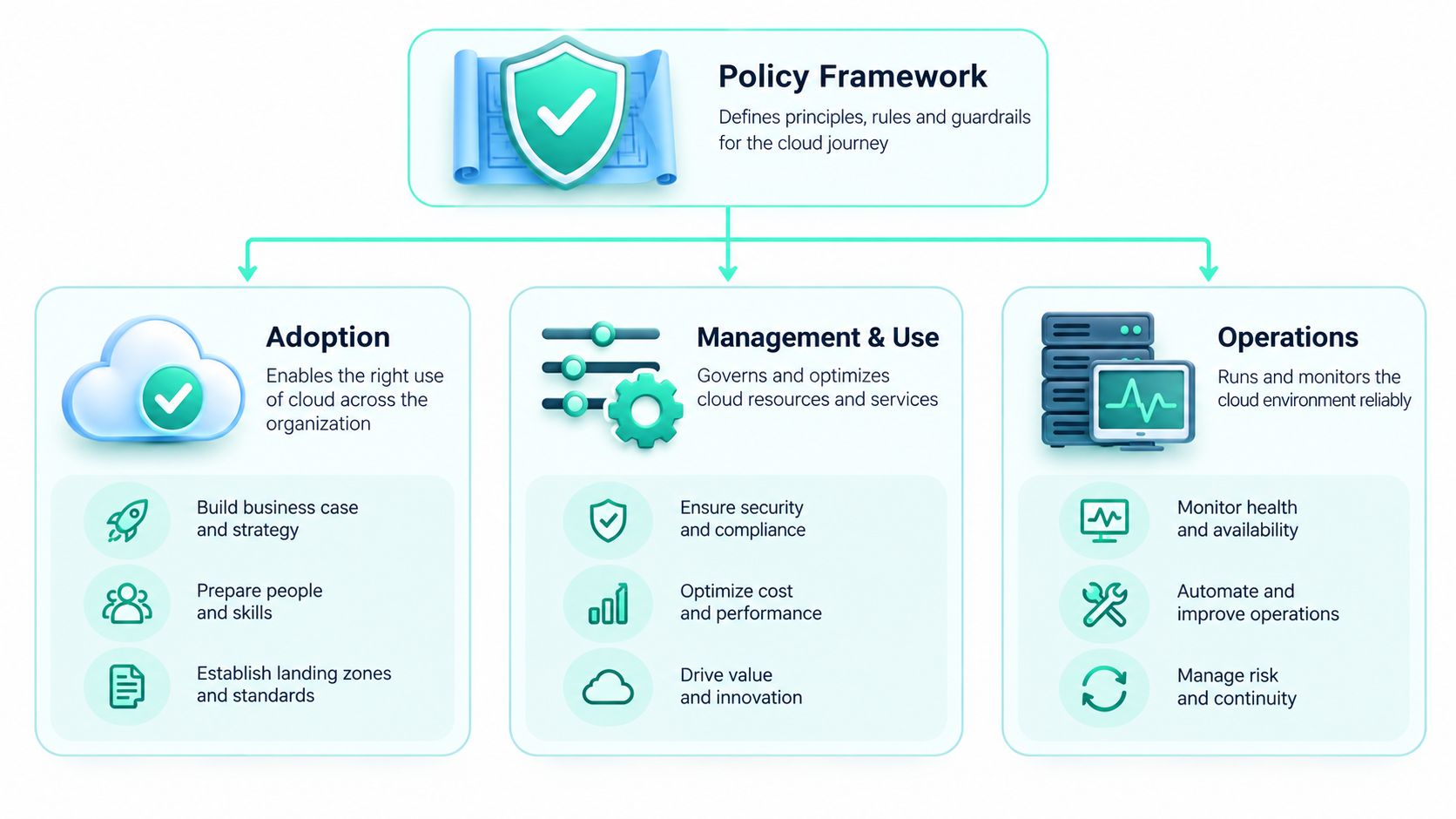
IBM defines cloud governance as the policy framework that steers how enterprises adopt, manage, use, and run cloud services [IBM cloud governance definition]. That definition matters because it is broader than access control and narrower than “all the things we wish were managed.” In practice, governance is a set of decisions, guardrails, and enforcement points that keeps cloud behavior aligned with business intent.
The six pillars that make it real
CloudQuery breaks the concept into six pillars, cost governance, security governance, compliance governance, operational governance, data governance, and access governance [IBM cloud governance definition]. In a real platform environment, each pillar has a different job. Cost governance is tagging and attribution so a team can see what it spent on a model endpoint or batch workflow. Security governance is IAM boundaries, encryption, and review paths. Compliance governance keeps workloads inside the right policies and regions. Operational governance covers service quality, onboarding, and exception handling. Data governance is audit logs, lineage, retention, and data handling rules. Access governance is who can touch what, and under which conditions.
A running example makes the difference clear. Suppose a product team launches a summarization API for customer tickets. Cost governance should let finance trace each call back to a feature or customer cohort. Data governance should tell you whether prompts include PII or internal records and where that data traveled. Access governance should make sure only approved services can call the model endpoint. Operational governance should catch policy exceptions before they turn into production drift.
A policy document does not govern anything by itself. Enforcement through tags, alerts, approvals, and logs is what makes the policy visible to engineers.
A useful working definition
Governance in the cloud is the measurable policy system that keeps cloud use, data movement, access, and spend aligned with organizational rules and business outcomes. If a rule cannot be enforced, observed, or reviewed, it is not governance yet. It is just text.
For implementation thinking, cost allocation methods worth standardizing early often determine whether your governance model becomes a reporting layer or a working control surface.
How FinOps Controls Map to AI and LLM Workloads
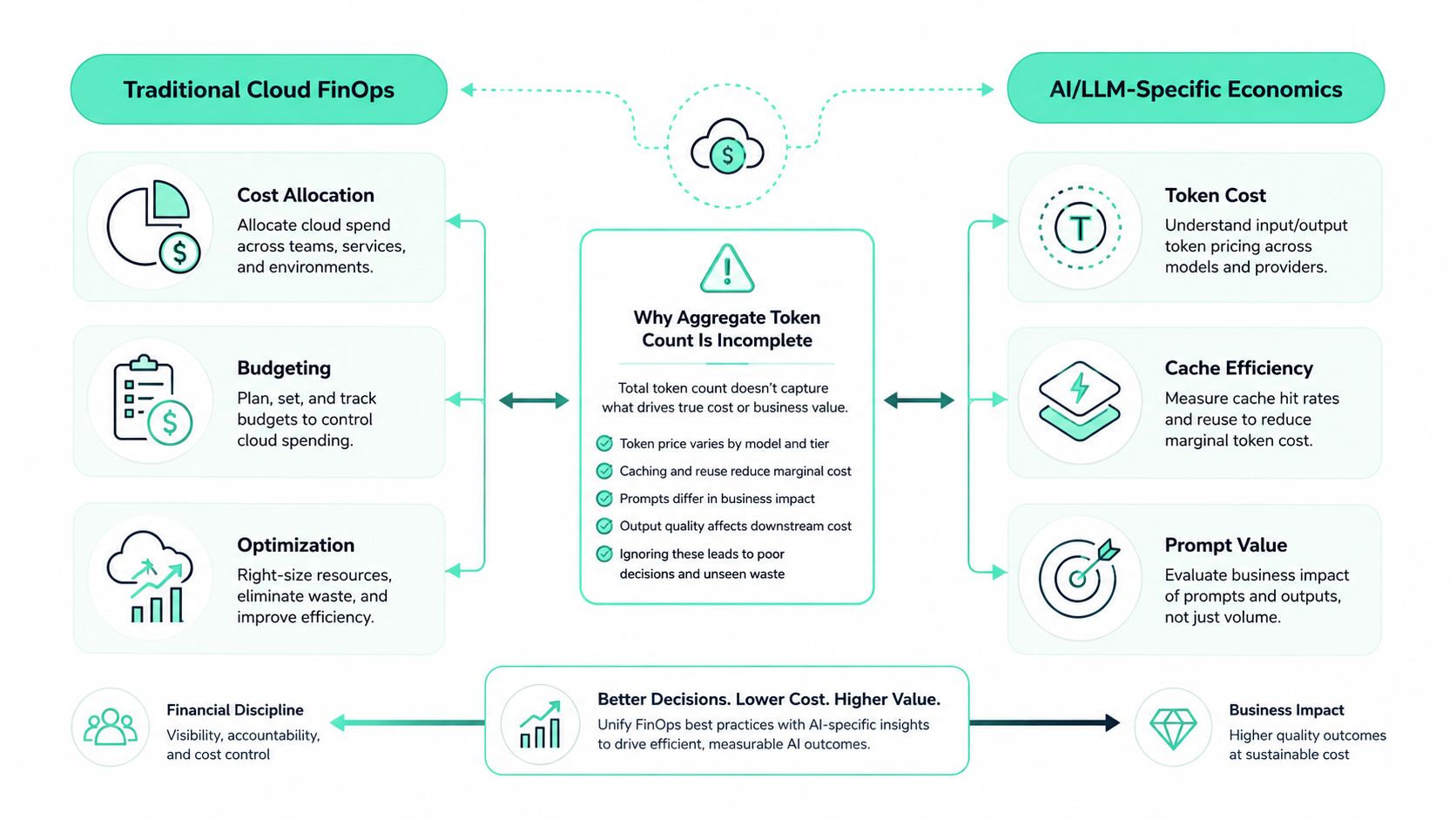
Traditional cloud FinOps already tracks budgeting, resource utilization, and spend variance. The Object Management Group's cloud governance guide identifies the ratio of planned versus actual cloud services and the frequency of exceptions to policies as core governance KPIs, and CloudBolt adds operational metrics such as actual vs. expected consumption, resource utilization, spend-versus-budget gaps, and reported incidents [OMG cloud governance guide]. Those instincts carry over to AI, but they stop short of what LLM workloads need.
Why token totals mislead
A total token count tells you volume, not efficiency. Two workflows can consume a similar number of tokens and still produce very different economics because one has long prompts, poor cache behavior, or a model choice that is far more expensive than the job requires. Governance has to track the workload, the model, and the prompt pattern, not just the aggregate bill.
A support summarization flow on a large model is a common example. If the output is short, repetitive, and easy to verify, the same flow may be easier to justify on a smaller model. The governance question is whether the selected path is the cheapest safe path for the job.
Operational insight: if prompt size keeps climbing while output stays stable, you are probably paying for repeated instructions, not better results.
The controls that move the bill
Model allowlists, cache-required policies, and workload classification turn abstract spend concerns into enforceable rules. If a workflow must use a smaller approved model unless an exception is recorded, the team gets a clear decision point instead of a surprise. If cached responses are available and not being used, the gap shows up in telemetry instead of hiding in the month-end summary.
Cross-provider tooling matters here. I have seen teams adopt a simple observability layer for OpenAI and Anthropic usage so they can compare spend by workload, not by vendor invoice line. AI cost anomaly detection patterns help teams spot unusual drift early, before finance closes the books.
For the product side, an AI spend tool can fit naturally. SpendLens AI, for example, adds lightweight instrumentation to OpenAI and Anthropic calls so teams can attribute spend to workflows, see cache efficiency, and compare model choices without changing provider clients. That setup matters because governance only works when it lives close to the call path, not in a spreadsheet after the fact.
Implementing Governance in the Cloud Step by Step
Start with the simplest thing that forces clarity. A tagging taxonomy should name the project, environment, feature, and customer or cohort wherever that makes sense. If teams can't tag a workload consistently, they won't be able to report, block, or charge back consistently either.
Build telemetry before you build bureaucracy
The first instrumentation should be lightweight enough that engineers won't resist it. A decorator pattern around workflow calls can attach tags without rewriting SDK clients, which is the difference between adoption and shelfware. Once the calls are visible, policy-as-code can start enforcing the obvious rules, such as blocking unapproved models, requiring tags, or flagging missing ownership.
That sequence matters. If you start with approvals, you create a queue. If you start with telemetry, you create evidence. Evidence is what lets teams debate trade-offs without turning every change into a meeting.
Add guardrails in the order that unlocks the next decision
Policy-as-code tools should be used to prevent drift before production, not to explain drift after it ships. In cloud governance work, that usually means enforcing naming, tagging, and approved services at deploy time, then tightening IAM and exception handling once the basic path is stable. If a rule isn't automatable, it needs a human escalation path, not a permanently open exception list.
The next layer is IAM and accountability. The person or team that can trigger AI usage should also be visible in the reporting layer that owns the cost. That sounds obvious, but many programs fail because finance sees the bill while engineering sees only infrastructure metrics.
Practical rule: automate the first rejection, document the second review, and reserve manual approval for true exceptions.
For planning the work, a budgeting process for cloud programs helps structure rollout so governance doesn't get stuck as a side quest. The fastest payoff usually comes from tags plus telemetry, because those two pieces make every later control easier to enforce and easier to explain.
A Worked Example of Chargeback for AI Workloads
A mid-sized SaaS company I worked with had the same problem. Multiple product teams were using AI features, finance had a single monthly cloud line item, and nobody could say how much of it belonged to onboarding, support, or internal tools. The first move was attribution at the call site, because without that, every chargeback conversation turns into guesswork.
The team added tagging to each AI workflow, then grouped similar operations so the monthly report rolled up comparable calls across providers and features. That gave finance a usable ledger and gave engineering a way to compare workloads without arguing over provider invoices. Once the owner of each workflow could see the cost driver, the discussion shifted from “who spent this?” to “what should we change?”
What changed after attribution landed
The finance team stopped doing manual reconciliation across spreadsheets and provider exports. That removed a lot of repetitive work each month, because they no longer had to ask engineers to explain every spike by hand. More important, product owners got a clean report that showed which feature was responsible for which share of spend, so budgeting and prioritization stopped relying on guesswork.
The first model-switch recommendations were modest on paper, but they were practical. Several summarization and extraction jobs moved to lower-cost models where quality stayed acceptable, and a few prompts were shortened because the report exposed repeated instructions and wasted context. Over the next quarter, the team saw a lower spend after those recommendations were applied, and every dollar had a documented owner.
The value of chargeback isn't punishment. It's decision-making. Once a team sees its own cost center, it starts asking better questions about model choice, cache use, and prompt design.
As noted earlier, cost governance covers spend control and cost attribution as part of the governance system. In practice, that means chargeback is not a finance add-on. It is part of how the platform is run.
The team did not need to refactor provider clients to get there. It needed consistent tagging, workload ownership, and a report that matched the way the business used AI. That combination turns an opaque invoice into a management tool.
Metrics That Prove Your Governance Program Is Working
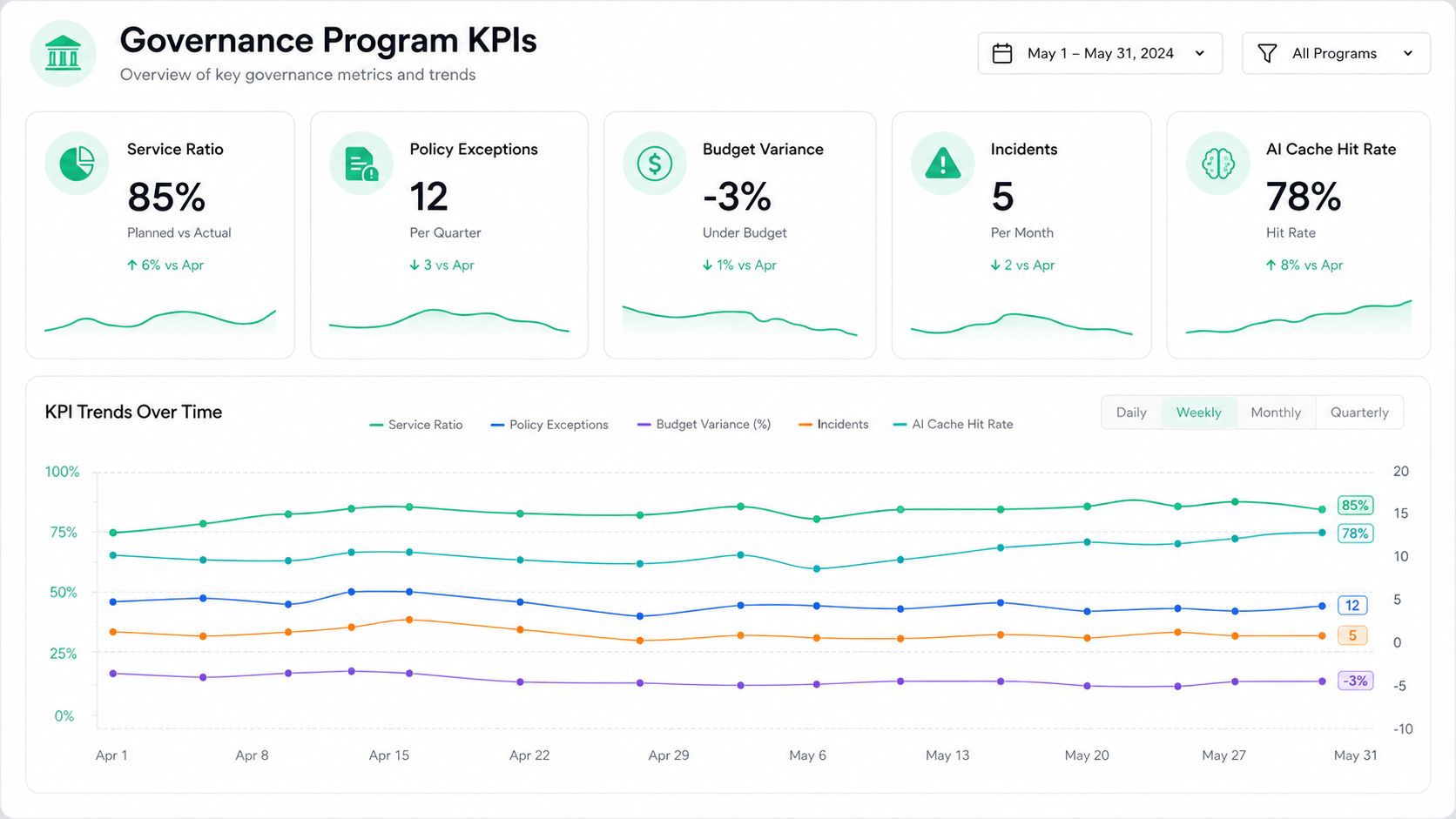
Governance only matters if it changes what teams do next. A tidy policy library does not tell you whether platform controls are working, but a small set of operating metrics usually does. The dashboard should show whether teams are shipping the services they planned, where exceptions are piling up, whether spend is drifting, and whether AI workloads are staying inside the guardrails you set.
The first metrics I'd wire up
- Planned versus actual service ratio: This shows whether teams are delivering what they said they would deliver, or drifting into one-off exceptions that never got reviewed.
- Policy exception frequency: A rising count usually means the policy is off, the implementation path is too hard, or both.
- Budget variance: If spend keeps moving away from plan, the governance model is not catching drift early enough.
- Incident count: Incidents tied to access, misconfiguration, or data handling usually point to weak guardrails.
- AI cache hit rate: If cached responses are available and still miss often, prompt patterns or client behavior need review.
Each metric needs a clear response. A rising exception count should trigger a policy review, not another approval form. A falling cache hit rate should send the team back to prompt templates and request patterns. A widening budget gap should push FinOps and platform engineering to inspect workload mix, model choice, and request routing before the next billing cycle closes.
Weekly review is usually enough if the dashboard drives action. I would rather have five metrics that get discussed and acted on than twenty that nobody uses. The point is to correct drift quickly, while the workload is still small enough to fix without a cleanup project.
Common Pitfalls and How to Avoid Them
Most governance programs stumble for the same reasons. Teams write policy before they build telemetry, then wonder why no one follows the policy. They also treat AI workloads as special cases that somehow sit outside governance, which is how spend and risk escape the perimeter.
The failure modes I see most often
- Tag sprawl: Teams invent slightly different labels for the same concept, so reporting breaks the moment anyone tries to compare workloads.
- Manual approval queues: Engineers wait on humans for routine decisions that should have been automated at deploy time.
- Chargeback reports nobody reads: Finance gets a tidy file, but product and engineering can't act on it because it lacks ownership and workflow context.
- Cross-provider reporting chaos: OpenAI, Anthropic, and Gemini can all bill differently, so teams need a single observation layer if they want comparable reporting.
The fix is not more policy. It's better sequencing. Enforce tags at deploy time, not through reminders. Build telemetry first, then layer policy. Use a single reporting layer that normalizes provider differences so you can compare workloads rather than invoices.
What not to overdo
Don't turn governance into a ticket factory. If every exception requires a meeting, engineers will route around the process. Don't make cost controls so rigid that teams can't experiment, either. Governance should shrink the space for avoidable waste, not block legitimate product learning.
The other mistake is thinking internal controls are the whole story. Governance debates also touch access, fairness, and who gets excluded when cloud concentration meets regional constraints. The Carnegie Endowment's work on cloud policy points to market access, consumer protection, and human rights concerns that standard enterprise guides often skip, which is a useful reminder that governance is bigger than one company's chart of accounts.
Putting It All Together and Your First 30 Days
The cleanest governance program is the one where engineering, platform, security, and FinOps each own a piece of the path. Engineering defines the workload and tags it. Platform builds the guardrails and telemetry. FinOps reviews the spend and flags drift. Security and compliance decide what can run, where it can run, and under what conditions.
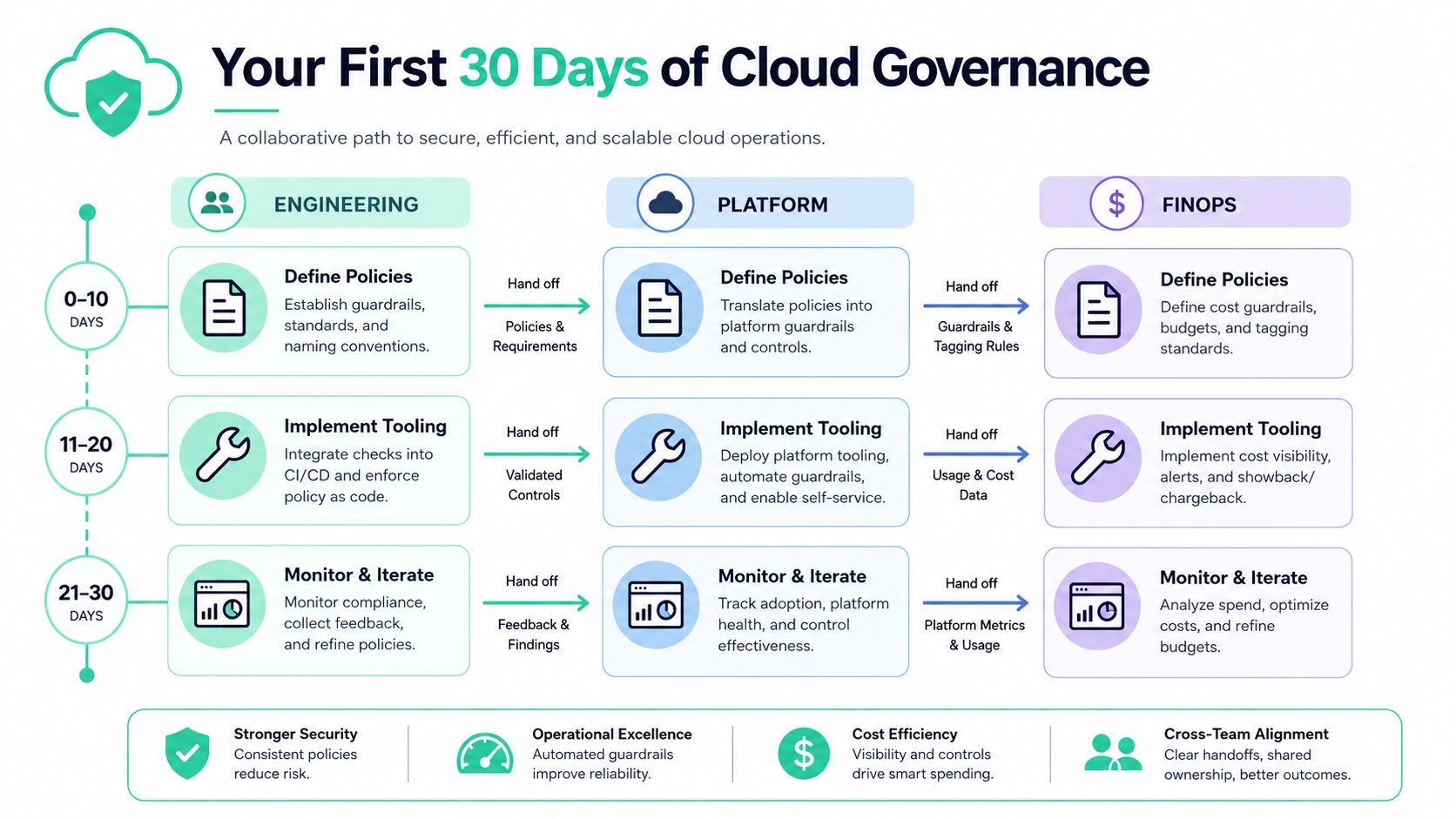
Wiz's governance guidance recommends defining governance scope, creating policies and standards, assigning ownership, selecting enforcement tools such as AWS Organizations, Azure Policy, and Google Cloud Policy Engine, and defining escalation procedures for violations [Wiz cloud governance guide]. That sequence is a solid foundation because it forces the team to decide who owns what before the rules multiply.
A practical 30-day starter plan
- Pick three tags: Choose the fields that will make attribution possible, usually project, environment, and feature.
- Instrument one workload: Start with a high-visibility AI workflow so the payoff is obvious.
- Write one policy-as-code rule: Block one unapproved model or require one mandatory tag.
- Ship one weekly report: Make spend, exceptions, and ownership visible to the people who can act on it.
That's enough to expose the bottlenecks. Once you can see the workload, the owner, and the cost path, the rest of governance becomes a series of controlled improvements instead of a blank-sheet initiative. If your team is wrestling with AI bill spikes, attribution gaps, or multi-provider reporting chaos, SpendLens AI is built to make those costs visible at the workflow level, so you can govern them without changing provider clients. Visit SpendLens AI and start with the workload you can't explain today.