
8 Essential AI Cost Allocation Methods for 2026
Discover 8 essential cost allocation methods to manage your LLM/AI spend. Learn how to track, attribute, and reduce costs with practical examples and tools.
Your OpenAI or Anthropic invoice tells you what you spent, but not why. That single total is a symptom, not a diagnosis. For teams trying to ship features without breaking the bank, that blind spot turns into surprise bill spikes, debates over ownership, and weak ROI conversations. Cost allocation methods solve that problem by turning shared AI overhead into measurable unit economics. Once spend is tied to a project, feature, customer, endpoint, model, or time window, leaders can stop guessing and start steering.
The usual advice says to “just watch the bill.” That's not enough. Finance needs chargeback logic, engineering needs actionability, and product needs a way to compare AI spend against usage and revenue. The right allocation method gives each group a clean line of sight to the same numbers, and that's what makes optimization decisions stick.
Table of Contents
- 1. Direct Cost Allocation by Project/Workspace
- 1. Direct Cost Allocation by Project/Workspace
- 2. Activity-Based Cost Allocation for Token Usage
- 3. Feature-Level Cost Allocation with Usage Attribution
- 4. Customer/Tenant-Level Cost Allocation for Multi-Tenant SaaS
- 5. Time-Based Cost Allocation for Hourly and Daily Bucketing
- 6. Experiment/Variant-Level Cost Allocation for A/B Testing
- 8. Model/Provider-Level Cost Allocation for Cross-Platform Optimization
- 8. Model/Provider-Level Cost Allocation for Cross-Platform Optimization
- 8-Method Cost Allocation Comparison
- From Allocation to Action Building a Cost-Aware AI Culture
1. Direct Cost Allocation by Project/Workspace
The cleanest starting point is direct allocation, and it works best when a project or workspace is the primary consumer. Assign the AI cost there and keep the path from source expense to the team that used it as short as possible. That approach follows standard allocation practice, where organizations identify cost objects, build cost pools, choose a base, calculate a rate, and apply it consistently to each object, because the goal is to measure the true cost of an activity instead of burying it inside overhead NetSuite's cost allocation overview.
A SaaS company can set this up with separate API keys for each AI feature, then map each key to its own workspace in SpendLens AI. When a feature starts consuming more than its share of spend, product and engineering do not need to infer where the money went. They can open the workspace, review the daily summary, and change the model or prompt before the month closes. A sample SpendLens AI report makes that kind of review concrete for both engineering and finance leaders.
SpendLens AI's multi-project support is the practical layer that keeps attribution clean. Use client.tag() at service initialization so downstream calls inherit the project label, and keep those tags stable enough that finance can trust the reports. Daily summaries and budget alerts matter because direct allocation only works when the owner sees the cost early, while there is still room to reduce waste and protect ROI.
1. Direct Cost Allocation by Project/Workspace
The cleanest starting point is direct allocation. If a project or workspace is the actual consumer, assign the AI cost there and keep the path from source expense to consuming team as short as possible. That lines up with standard allocation practice, where organizations identify cost objects, build cost pools, choose a base, calculate a rate, and apply it consistently to each object, because the point is to measure the true cost of an activity rather than bury it in overhead NetSuite's cost allocation overview.
A SaaS company can do this with separate API keys per AI feature, then map each key to its own workspace in SpendLens AI. When a feature starts consuming a disproportionate share of spend, product and engineering don't have to guess where the money went. They can open the workspace, review the daily summary, and make a model or prompt change before the month gets away from them.
For this setup, SpendLens AI's multi-project support is the practical layer that keeps attribution clean. Use client.tag() at service initialization so downstream calls inherit the project label, and keep the tags stable enough that finance can trust the reports. The strongest habit is simple, review daily summaries and set alerts when a project crosses your internal budget line, because direct allocation only works if the owner sees the cost early.
Practical rule: If you can name the project that owns the API call, start there before inventing a more complex allocation rule.
A sample report layout is useful here, especially when stakeholders want one place to verify the numbers, and the SpendLens AI sample report gives teams a concrete model for what that daily visibility can look like. In practice, that kind of reporting can save hours of manual reconciliation each week because owners no longer need to chase logs across multiple services. It also helps avoid wasted spend by making overages visible within a day, not at month-end.
2. Activity-Based Cost Allocation for Token Usage
Direct allocation starts to fail when one feature mixes low-cost and high-cost work in the same call path. Activity-based costing handles that problem by assigning shared costs to the drivers that create them, instead of relying on broad proxies like revenue or output. That reduces arbitrary cross-subsidization and gives finance and engineering a cleaner basis for pricing and product decisions. In AI systems, the drivers that matter most are usually prompt tokens, completion tokens, and cache hits.
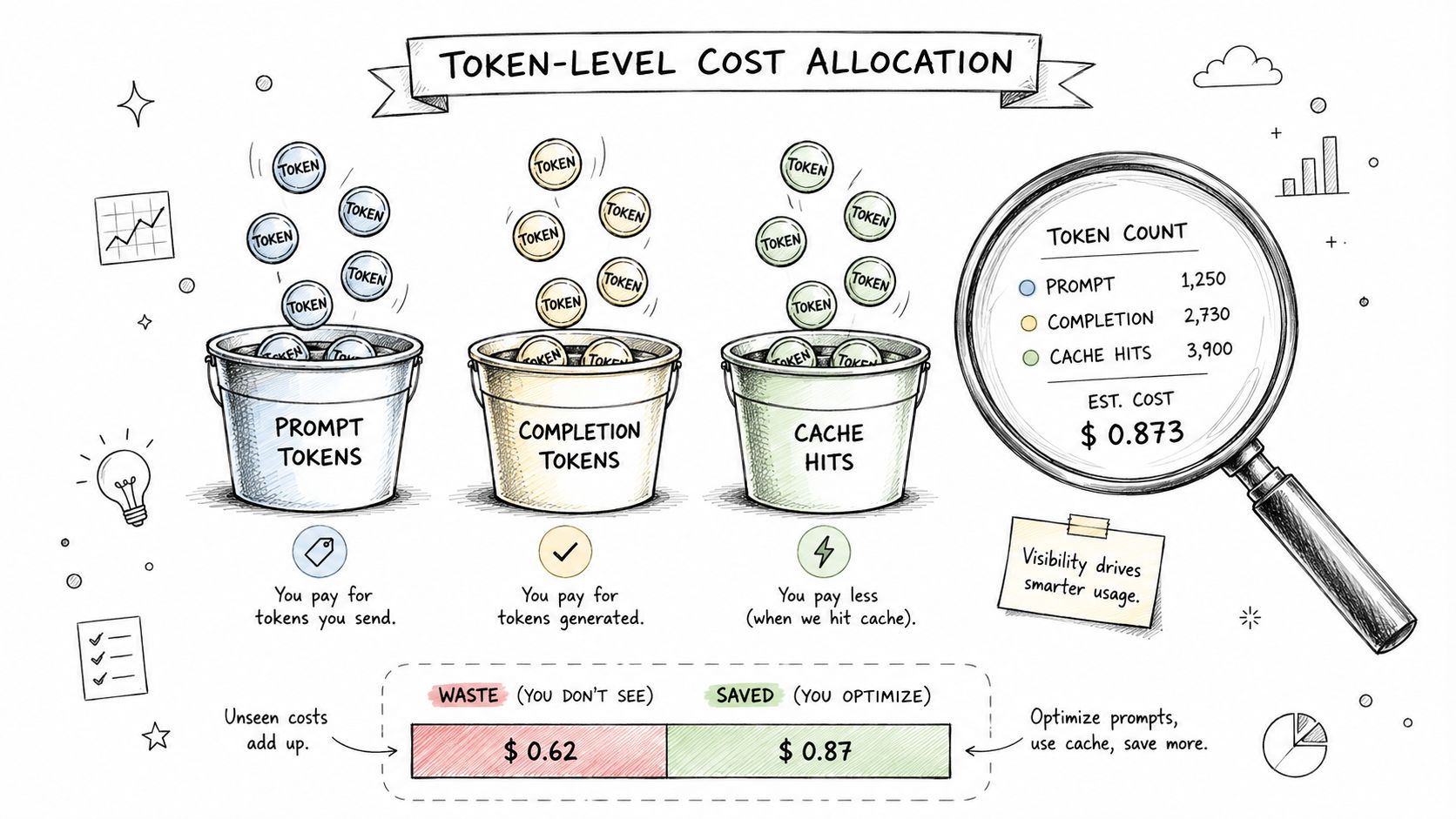
A chatbot that repeats heavy context benefits from this method because the cost story becomes visible at the token level instead of the request level. SpendLens AI's Prompt Waste Signals help teams spot oversized templates and unnecessary context, then compare input and output token ratios across workloads. That makes it easier to find where token bloat is hiding value and where the team is paying for words that do not change the outcome.
The practical win shows up quickly. If your team turns on prompt caching where providers support it, cache hits can cut repeated input-token spend and make recurring workflows cheaper. Model routing is another clear example. An e-commerce team can send simpler generations to a lower-cost model and keep quality intact, which usually does more for unit economics than a broad “reduce usage” directive ever will.
Teams that need to defend the allocation logic can use ABC data as a stronger input for A/B testing. SpendLens AI can use that data to support savings recommendations and confidence-driven comparisons, which makes it easier to justify a prompt rewrite or a model change. The discipline only works if the team reviews token metrics weekly and keeps the allocation basis current.
When token costs are separated from the rest of the bill, the easy wins usually show up fast, repeated context, wasteful templates, and mismatched model choices.
For a deeper look at why token totals alone can mislead teams, the discussion in SpendLens AI's note on token counts is a useful companion to this method.
3. Feature-Level Cost Allocation with Usage Attribution
Feature-level allocation gives product leaders the answer they usually need most, which capability is expensive, and whether it earns its keep. It fits the accounting idea that shared overhead should be assigned to the unit that created it, and it is more useful for roadmap decisions because it ties spend to the user-facing feature that caused the cost NetSuite's cost allocation overview.
A clean taxonomy matters before rollout starts. If a product has an Email Assistant, a summarizer, and a search helper, each needs a stable label from day one. Use client.tag() at the gateway so downstream calls inherit the feature tag, then review feature-level costs alongside product usage each week. Without that discipline, teams end up comparing unrelated calls and calling it analysis.
One feature can consume more spend than the rest of the product and still deserve the investment, but only if the numbers support it. A SaaS platform can move that feature to a lower-cost model and keep quality steady elsewhere. Another startup can compare feature-level AI cost with conversions and decide whether a premium feature deserves its price point or needs to be redesigned. The goal is not to cut every expensive feature, it is to identify which features create enough business value to justify their cost.
SpendLens AI makes this practical by connecting usage metadata with cost drivers, so PMs can compare spend by feature and spot uneven economics. A feature may be popular but inefficient, or it may have low adoption and still burn budget. Using real usage data and a clear decision threshold usually saves more money than a broad mandate to optimize AI. Teams also spend less time debating anecdotes because the allocation is tied to the feature that triggered the cost.
Example from practice: feature-level tagging often shows that one polished capability carries a much larger share of cost than the rest of the product, which changes roadmap priorities quickly.
The business value is clarity. Instead of treating AI as one amorphous platform expense, teams can see which capability deserves more investment, which one needs a cheaper model, and which one should be retired.
4. Customer/Tenant-Level Cost Allocation for Multi-Tenant SaaS
Customer-level allocation is the method that turns AI spending into chargeback, usage-based pricing, and profitability analysis. It also aligns closely with the core allocation principle of assigning indirect costs to the object that receives the benefit, in this case a tenant or customer account Cost allocation methods overview. For multi-tenant SaaS, that's often the most finance-friendly view because it connects cost directly to revenue.
The implementation path is straightforward. Tag tenant context at the API gateway, let SpendLens AI's track() log the tenant ID with each call, and review “Top Customers by LLM Cost” reports on a regular cadence. Once that's in place, outliers show up quickly, and those outliers are where pricing and architecture decisions become obvious.
A B2B platform may find that a small share of customers accounts for an outsized share of LLM spend without generating enough revenue to justify it. The response isn't always to raise prices immediately. Sometimes the better move is a document preprocessor, tighter prompt templates, or a lower-cost model for routine tasks. A fintech team can make the same move at the cohort level and use customer-specific cost data to improve margin discipline before billing changes go live.
Finance gets leverage only when customer cost is visible enough to compare against revenue, support burden, and retention.
SpendLens AI supports that workflow by pairing spend breakdowns with exports that can be used for pivot analysis and invoice generation. That makes it easier to produce billing for usage-based pricing without a separate manual reconciliation step. In practice, that can save a real chunk of finance time every month because the billing team isn't rebuilding customer attribution from logs and spreadsheets.
For leaders, the payoff is confidence. Once tenant cost is traceable, product and finance can talk about profitability using the same dataset, not two different spreadsheets with different assumptions.
5. Time-Based Cost Allocation for Hourly and Daily Bucketing
Time-based allocation answers a different question, when did the cost spike, and what changed right before it? That matters because a lot of AI cost waste is temporal, a bad deploy, a prompt change, a traffic burst, or an experiment that ran longer than expected. Modern allocation practice already recognizes that a cost basis should reflect usage or benefit, and time is often the cleanest proxy when direct consumption is hard to observe UCSF cost allocation methodology guidance.
Hour-by-hour or day-by-day cost buckets help teams spot anomalies early. If a deployment lands with a prompt regression, the cost graph will usually show it before the invoice does. SpendLens AI's daily summaries and anomaly alerts are useful here because they let teams compare current spend with a baseline instead of waiting for end-of-month surprises.
An email platform can catch a bad deploy that adds excessive token load per call and roll it back quickly. A content platform can observe weekday peaks, move low-priority generation into quieter periods, and reduce cost pressure without changing the product itself. Those moves work because the team is looking at timing, not just volume.
To make the model defensible, create a baseline window and tie it to deployment timestamps. Then review repeating anomalies weekly and ask whether they line up with release cycles, traffic patterns, or batch jobs. That kind of discipline saves money by making the source of waste obvious, and it saves time because teams stop re-litigating the same spike every month.
If a cost spike repeats on the same day or after the same release, treat it like a product bug, not a finance issue.
Time-based allocation is often the fastest way to move from “we spent more” to “this change caused the increase.”
6. Experiment/Variant-Level Cost Allocation for A/B Testing
A/B tests should measure cost, not just quality, because some variants win on user experience while losing on unit economics. That's why variant-level allocation matters. It lets teams compare the business impact of a prompt, routing rule, or model choice before a global rollout locks in the wrong economics.
Use track() to capture experiment_id, variant_id, and cohort metadata, then run tests long enough to catch weekly patterns and traffic swings. SpendLens AI can keep the cost data attached to the experiment so product and engineering can review cost alongside quality metrics instead of arguing about them after the test ends.
A support platform might find that one variant trims cost without hurting quality and can then roll it out in stages. A writing platform can test prompt changes incrementally and preserve acceptable output while reducing waste. Those are the cases where cost allocation directly changes rollout strategy, because the team can see the trade-off instead of guessing at it.
Here, the implementation path matters more than the theory. Staged rollouts, central experiment logs, and a requirement for statistically credible savings before full release help prevent false wins. A variant that looks cheaper for two days can still become expensive once traffic normalizes, so the test window has to be long enough to matter.
Practical rule: Don't ship a cheaper variant just because it looked good in one cohort, one day, or one traffic pattern.
The money and time savings come from avoiding bad rollouts. Teams waste far less engineering effort when the experiment platform already contains the cost evidence needed for a decision.
8. Model/Provider-Level Cost Allocation for Cross-Platform Optimization
Model-level allocation is where finance, platform engineering, and architecture choices meet. If a team uses multiple providers or model families, separate spend by model and provider so it is obvious where the expensive calls live. That fits the broader cost allocation framework because the model itself is a real cost object, and it should be measured that way.
SpendLens AI can compare OpenAI, Anthropic, and other supported model families, then surface lower-cost substitutions when task complexity allows it. That makes model selection more operational and less political. A cheaper model can handle filtering or simple extraction, while a more capable model stays on reasoning-heavy work. For teams building around OpenAI call patterns, the OpenAI completions API cost breakdown helps frame where those request-level costs usually come from.
A platform that routes simple queries to a less expensive GPT variant can reduce monthly spend while keeping quality stable. A multi-model stack can also rebalance usage across premium and mid-tier models to cut cost without forcing a single-provider strategy. Provider-level allocation pays off because the team can see whether consolidation, substitution, or selective routing makes the most sense.
Practical rule: Optimize the model mix by task type, not by habit.
The best practice is to test model swaps on a small slice of traffic before full rollout, then watch both cost and output quality. Teams that do this avoid paying premium rates for work a smaller model can handle, and they avoid the hidden cost of a weak model that creates more retries, edits, or human review. SpendLens AI gives that comparison a place to live, so platform and finance teams can review the trade-off without rebuilding the analysis every time the stack changes.
A simple implementation path is to tag each request with model, provider, endpoint, and workflow context, then roll those tags into a shared cost view. That lets leaders see whether a routing rule saves money or just moves spend around. If the allocation model is accurate, the savings show up in both reduced inference spend and fewer hours spent arguing over which provider should own the workload.
8. Model/Provider-Level Cost Allocation for Cross-Platform Optimization
Model-level allocation is where finance, platform engineering, and architecture choices finally meet. If a team uses multiple providers or model families, separate the spend by model and provider so it's obvious where the expensive calls live. That fits the broader cost allocation framework because the model itself is a real cost object, and it should be measured as such CostPerform's allocation taxonomy.
SpendLens AI can compare OpenAI, Anthropic, and other supported model families, then highlight lower-cost substitutions when the task complexity allows it. That makes model selection less emotional and more operational. A cheap model can handle filtering or simple extraction, while a more capable model can stay on reasoning-heavy work.
A platform that routes simple queries to a less expensive GPT variant can save meaningful monthly spend while keeping quality stable. A multi-model stack can also rebalance usage across premium and mid-tier models to cut cost without forcing a single-provider strategy. That's where provider-level allocation pays off, because the team can see whether consolidation, substitution, or selective routing makes the most sense.
Practical rule: Optimize the model mix by task type, not by habit.
The best practice is to test model swaps on a small slice of traffic before full rollout, then watch quality metrics alongside spend. Keep an eye on provider pricing updates too, because a recommendation that made sense last month may need a recalculation after pricing changes. For teams trying to save both money and time, this method is usually the fastest way to find a safer lower-cost mix without rewriting the whole application.
8-Method Cost Allocation Comparison
| Method | 🔄 Implementation Complexity | ⚡ Resource Requirements | 📊 Expected Outcomes / Impact | 💡 Ideal Use Cases | ⭐ Key Advantages |
|---|---|---|---|---|---|
| Direct Cost Allocation by Project/Workspace | Low, per-project API keys / tagging; simple setup | Low, separate API keys, basic tagging/dashboard | Immediate per-project visibility; saves 3–5 hrs/wk; prevents $10K–$50K/mo overspend | Clear project boundaries; multi-project chargeback | 100% accuracy; instant anomaly detection; simple chargeback |
| Activity-Based Cost Allocation (ABC) for Token Usage | Medium, token counts, structured logging, analytics | Medium, detailed API token data, cache metrics, instrumentation | Reveals true cost drivers; 25–40% savings ($5K–$20K/mo); saves 5–8 hrs/wk | Token-heavy workloads; prompt trimming & caching | Granular token-level insight; direct $ impact correlation |
| Feature-Level Cost Allocation with Usage Attribution | Medium, consistent feature taxonomy & tagging discipline | Medium, tagging at entrypoints, linking to product metrics | Enables 15–30% cost reduction; 4–6 hrs/wk saved; feature ROI visibility | Product ROI, feature prioritization, pricing decisions | Direct ROI per feature; quickly identifies low-value/high-cost features |
| Customer/Tenant-Level Cost Allocation for Multi-Tenant SaaS | High, tenant isolation, secure tag propagation | High, tenant ID propagation, billing reconciliation, security checks | Consumption typically falls 20–35%; saves $10K–$30K/mo; 6–10 hrs/wk saved | Usage-based billing, chargeback, customer profitability analysis | Enables per-customer billing; detects unprofitable or abusive customers |
| Time-Based Cost Allocation (Hourly/Daily Bucketing) | Low, time-series aggregation and timestamp sync | Low, timestamped logs, deploy/release correlation | Rapidly isolates regressions; prevents $15K–$50K/mo via quick rollback; saves 3–5 hrs/wk | Detecting cost spikes, deployment regressions, seasonal patterns | Fast root-cause isolation; real-time anomaly alerts |
| Experiment/Variant-Level Cost Allocation for A/B Testing | Medium, experiment metadata, randomization & power | Medium, experiment tagging, statistical and cost tracking | Validates cost impact; 20–35% cumulative savings over time; saves 8–12 hrs/experiment | A/B testing, staged rollouts, cost-vs-quality validation | Prevents blind rollouts; quantifies cost vs quality per variant |
| Endpoint/API-Level Cost Allocation for Fine-Grained Tracking | Medium, endpoint tagging across microservices | Medium, instrumentation, integration with API metrics | Drives 15–25% reduction via targeted fixes; saves 4–7 hrs/wk | Microservices cost ownership; per-endpoint SLOs and optimizations | Enables per-endpoint optimization; supports cost-aware rate limits |
| Model/Provider-Level Cost Allocation for Cross-Platform Optimization | Low–Medium, model/provider tagging & benchmarking | Low–Medium, cross-provider metrics, trend analysis, tests | Typical 25–50% savings from model optimization; saves 5–10 hrs/month | Cross-provider optimization, model consolidation, routing strategies | Reveals high-cost models; automated recommendations for cost-efficient swaps |
From Allocation to Action Building a Cost-Aware AI Culture
Cost allocation isn't an accounting chore, it's a management capability. Once AI spend is broken down by project, activity, feature, customer, time, experiment, endpoint, or model, teams stop arguing over a single invoice total and start making decisions from shared evidence. That changes the conversation from “Why did the bill jump?” to “Which workload changed, who owns it, and what should we do next?”
The practical value is hard to miss. Engineering can spot prompt waste, product can retire low-value features, finance can build chargeback rules, and leadership can compare AI spend against revenue with far more confidence. The benefit isn't only better reporting, it's better behavior, because ownership becomes visible and teams respond faster when their own work has a cost attached to it.
A mature AI organization usually starts simple and adds sophistication as the architecture grows. Direct project allocation works when the structure is clean. ABC, tenant-level, endpoint-level, and model-level allocation become more useful as the product matures and the cost drivers multiply. The common thread is consistency, because every allocation method only works when the basis is stable enough for people to trust.
SpendLens AI fits that operating model because it maps spend to features, workflows, customers, and models with lightweight instrumentation, which helps teams reduce cost without changing provider clients. That kind of visibility can save hours of manual analysis and prevent expensive misallocations from surviving another billing cycle.
Start with one method that matches your biggest blind spot, then expand once the team trusts the data. The first win is usually the most important one, not because it solves everything, but because it proves the organization can control AI cost instead of just reacting to it.