Cloud Cost Optimization Services: A Buyer's Guide
Compare cloud cost optimization services with this practical guide covering evaluation criteria, playbooks, ROI metrics, and AI workload savings examples.
A SaaS team can have a healthy revenue quarter and still face an uncomfortable infrastructure review. Engineering has added new regions, product has launched an AI feature, and finance sees cloud and model invoices rising faster than the business. The team knows some waste exists, but nobody can say which service, customer workflow, or prompt change caused it.
That's the problem cloud cost optimization services are meant to solve. They combine FinOps advisory work, managed operating processes, and software that turns provider invoices into attributable workloads, actionable recommendations, and measurable business decisions. The discipline now extends beyond compute and storage to databases, containers, and LLM usage, where token pricing, caching, model choice, and prompt design create a different kind of cost exposure.
The category exists for engineering leaders, FinOps analysts, finance partners, platform teams, and product owners responsible for AI features. The right buyer framework should answer two questions at once: where is money being wasted, and what business value does each workload create?
Table of Contents
- Why Cloud Bills Keep Outrunning Forecasts
- What Cloud Cost Optimization Services Actually Do
- Service Models Side by Side
- Five Evaluation Criteria That Predict Real Results
- A 90-Day Implementation Playbook
- Common Pitfalls That Quietly Kill Cost Programs
- Reporting That Survives an Executive Review
- Choosing and Launching the Right Service
Why Cloud Bills Keep Outrunning Forecasts
A familiar review starts with a forecast variance. A SaaS company expected infrastructure spending to track product adoption, but the cloud and AI bill accelerated while revenue grew more slowly. The engineering team points to traffic, finance points to missing allocation data, and the AI team points to a new feature whose usage is still difficult to isolate.
Nobody necessarily made a reckless decision. A staging cluster remained available after a launch, a database retained more capacity than its workload required, and an AI workflow used a costly model for tasks that didn't need its full capability. Each choice looked small in isolation. Together, they produced a bill that outpaced the forecast.
Practical rule: A rising bill isn't automatically a problem. An unattributed bill is.
The scale explains why this has become an operating discipline rather than an occasional cleanup exercise. The FinOps Foundation's 2024 survey covered more than 1,200 IT practitioners across more than 1,000 companies, representing an average cloud bill of $44 million per year and $55 billion in combined annual cloud spend in the sample, as reported by BigDataWire's coverage of the survey. Reducing unused or wasteful resources remained the top priority across cloud-spend tiers, while storage, databases, and containers joined compute as major optimization concerns.
That shift changes who needs a service. Platform engineering may own resource configuration, finance may own forecasts, and product may own an AI feature's economics. A useful program gives all three groups a shared view, such as cost per workflow, cost per customer operation, or spend by model and environment.
The market pressure is persistent. Industry reporting tied to Flexera data placed recoverable or wasted cloud spend at around 27% in 2024, compared with 28% in 2023, according to Tech Insider's reporting. A separate 2025 projection estimated that 21% of enterprise cloud infrastructure spend, equal to $44.5 billion, would be wasted on underutilized resources. Those figures describe an optimization surface, not permission to cut indiscriminately. The useful question is which spend supports growth and which spend reflects weak ownership, poor utilization, or an avoidable implementation choice.
What Cloud Cost Optimization Services Actually Do
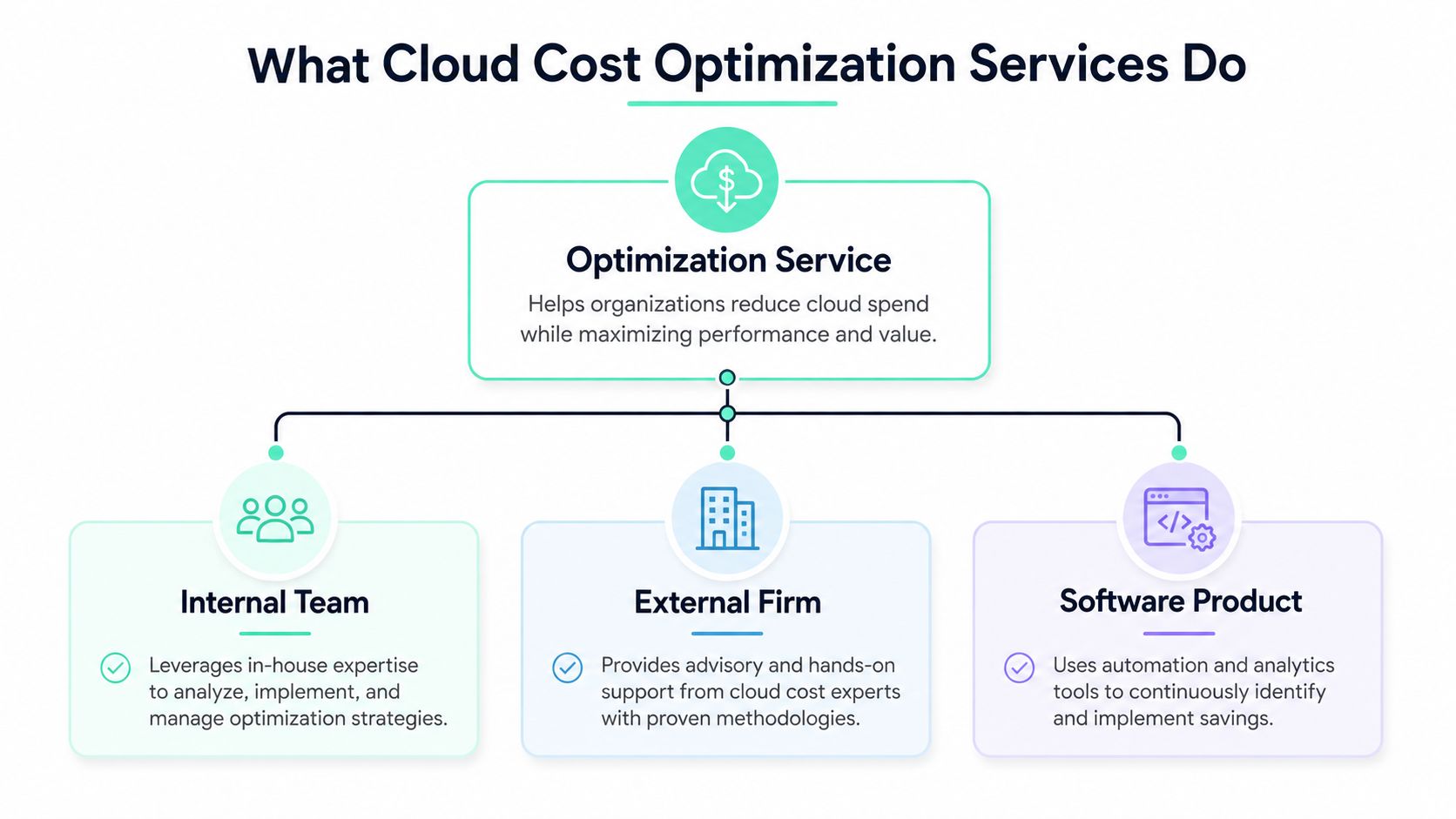
Cloud cost optimization services are offerings that help a company see, explain, reduce, and govern cloud spending without sacrificing required reliability or product performance. They can come from an internal FinOps team, an external consultancy, a managed provider, or a software platform.
The deliverable isn't a colorful dashboard. It's a repeatable operating loop:
- Establish visibility. Ingest billing, usage, resource, and workload data.
- Assign ownership. Map spend to teams, services, environments, features, or customers.
- Find opportunities. Identify idle capacity, poor commitment coverage, inefficient storage, and expensive workload choices.
- Prioritize action. Rank recommendations by estimated value, confidence, risk, and effort.
- Verify results. Compare actual post-change spend and performance with the baseline.
Advisory engagements
A consulting engagement is useful when the organization needs a focused assessment or lacks specialized knowledge for a major change. A firm might inspect resource utilization, pricing commitments, tagging, workload placement, and governance, then deliver a prioritized roadmap. For example, after a platform re-architecture, a team could commission an assessment of commitment exposure and database sizing before making long-term purchasing decisions.
Consulting is usually strongest when the problem has a clear boundary. It becomes less effective when recommendations sit with an internal team that has no time or ownership to implement them.
Managed FinOps services
A managed service takes responsibility for the ongoing program. The provider may operate cost allocation, anomaly review, recommendation queues, budget reporting, and recurring stakeholder meetings. This can fit a company where finance needs dependable chargeback reporting but engineering lacks a dedicated FinOps operator.
The trade-off is governance dependency. The client must define decision rights, escalation paths, and access boundaries, or the service can become an outsourced reporting function rather than a mechanism for engineering change.
Software products
Software instruments the environment and surfaces opportunities continuously. A product might tag or map Kubernetes workloads, detect idle resources, compare commitment coverage, or associate an LLM call with a feature and model. Teams still need owners to approve changes, but automation reduces the manual work required to locate and prioritize them.
A useful guide to managing cloud cost should lead to action, not just invoice inspection. Choose this model when your team can operate the process but needs better data, repeatability, and scale.
Service Models Side by Side
There isn't one universally correct service model. The right choice depends on whether your immediate problem is a defined architecture decision, a missing operating function, or insufficient instrumentation.
| Service Model | Time to First Savings | Internal Effort | Best Fit |
|---|---|---|---|
| Consulting engagement | Fast for a bounded assessment, slower if implementation depends on internal teams | High during handoff and execution | Re-architecture reviews, commitment assessments, complex one-time decisions |
| Managed FinOps service | Moderate, with savings continuing through recurring operations | Moderate, focused on decisions and approvals | Teams needing ongoing reporting, governance, and cross-functional coordination |
| Software tooling | Fast when integrations and ownership already exist | Moderate at setup, lower for repeatable analysis | Engineering-led programs needing daily visibility, recommendations, and automation |
Consulting works best at inflection points
Use consulting when a decision has a defined start and finish. A 12-week engagement, for example, may make sense after a major platform redesign if the organization needs independent analysis of service sizing, storage tiers, and commitment risk. The value comes from expertise and speed, but the recommendation only creates savings after someone implements and measures it.
Managed services create continuity
Managed FinOps is a better fit when the work never ends. Quarterly chargeback reporting, budget reviews, anomaly triage, and commitment decisions require continuity because workloads and business priorities keep changing. The service can save internal time by owning the recurring workflow, but engineering still needs to approve changes that affect reliability or developer experience.
Tooling compounds operational leverage
Software is strongest when the team wants a system of record for cost data and recommendations. It can monitor changes daily, connect spend to workloads, and support automated workflows. It won't resolve unclear ownership or a political dispute over chargeback by itself.
Mature buyers often combine models. A team might use software for daily allocation and anomaly detection, then add a quarterly managed review for commitment strategy. A consultancy can handle a migration assessment while internal operators use tooling to maintain the resulting controls. Judge the combination by time saved, verified savings, and decision quality, not by how many features appear in a product demo.
Five Evaluation Criteria That Predict Real Results
A vendor can demonstrate excellent charts and still fail to reduce spend. Evaluate the service by whether it helps people make safe, attributable decisions.
Attribution must reach the workload
Good attribution connects a bill to a service, environment, team, feature, customer journey, or experiment. For LLMs, that may mean associating an OpenAI or Anthropic call with a feature flag, workflow, model, and project. A weak system shows total provider spend without explaining which product behavior created it.
Ask to see an example of a recommendation moving from provider invoice to owner. If the answer stops at account or subscription level, the service won't support effective accountability.
Automation should move work forward
A dashboard that tells an engineer an instance is oversized is useful once. A stronger system creates a recommendation with an owner, estimated value, confidence, and implementation path. Automation may open a ticket, trigger a review, apply a safe schedule, or execute a change under a defined policy.
Don't confuse automatic detection with automatic savings. The latter requires controls, rollback procedures, and performance checks.
Security determines usable visibility
Cost data can contain sensitive resource names, customer identifiers, prompt metadata, or provider credentials. Good services explain what they collect, where it goes, how access is controlled, and whether raw prompts or model responses are retained.
For an LLM program, metadata-only tracking and limited template sampling can reveal token and model patterns without exporting full user content. A product that demands unnecessary raw prompts creates security and compliance work that may outweigh its analytical value.
Provider coverage must normalize differences
AWS, Azure, and Google Cloud expose different billing structures. LLM providers add another layer of variation through input tokens, output tokens, cache behavior, model families, and changing pricing units. A multi-provider service should normalize data while preserving the original provider details needed for reconciliation.
A poor comparison says one model is cheaper because its per-token rate is lower. A useful comparison considers the workload, output quality, latency requirements, cache behavior, and migration risk.
ROI must connect spend to value
Track more than total spend. Useful measures include cost per transaction, cost per active workflow, cost per successful support resolution, or the margin contribution of an AI feature. The FinOps Foundation's 2025 report describes workload optimization and waste reduction as leading priorities, while AI/ML spend management and unit economics were among the priorities moving upward. That direction matters because cutting usage can damage a valuable feature.
A simple scorecard can rate each provider from weak to strong across attribution, automation, security, provider coverage, and ROI. Require a concrete demonstration for every strong rating, such as an attributed model call, a reversible recommendation, or a savings result finance can reconcile.
A 90-Day Implementation Playbook
A rollout should produce useful evidence before it attempts broad automation. The sequence below protects engineering velocity by starting with observation, then adding ownership and controlled action.
Weeks 1 through 2 establish the baseline
Ingest provider bills and usage records. Inventory accounts, subscriptions, projects, clusters, databases, storage, and AI providers. Define the allocation fields that matter to the business, such as team, service, environment, product, customer segment, and feature.
Don't promise savings before you know the baseline. The first useful output is a reconciled view of spend, an ownership map, and a list of resources that lack the metadata required for attribution. The most common setback is legacy infrastructure with inconsistent tags or shared services that nobody has agreed to allocate.
Weeks 3 through 6 instrument workloads
Connect spend to actual workloads rather than relying only on account-level billing. For Kubernetes, map namespaces, services, and environments. For AI, capture provider, model, project, workflow, token usage, cache signals where available, and relevant release or experiment metadata.
This phase creates the evidence needed for unit economics. A product owner can compare the cost of an AI-assisted workflow with its usage and outcome, while an engineering manager can distinguish a traffic-driven increase from a resource-sizing problem.
Weeks 7 through 10 act on safe recommendations
Start with reversible changes. Clean up idle resources, resize consistently underused capacity, improve storage lifecycle rules, enable appropriate caching, and schedule non-production environments. For LLMs, test prompt templates, reduce redundant context, and evaluate a lower-cost model on a controlled workload.
Use AWS cost reduction guidance as a practical reference for provider-specific work, but keep the operating principle provider-neutral. Every change should have an owner, an expected value, a performance guardrail, and a verification date.
Weeks 11 through 13 scale governance
Only after the team trusts the data should it expand into commitment discounts, anomaly detection, executive reporting, and policy automation. Benchmarking helps separate a genuine efficiency problem from a workload-mix difference. The practical method is to establish internal baselines first, then compare them with external norms, as described in FinOps benchmarking guidance.
AWS Cost Optimization Hub provides a daily Cost Efficiency score from 0 to 100%, measuring the share of optimizable spend that is already well optimized, according to AWS's explanation of the metric. That gives leaders a progress indicator beyond total bill size.
A mature benchmark across 400-plus enterprise cloud programs reported optimized organizations reaching waste rates below 8%, with 80% or higher commitment coverage and 34% to 45% discounts versus on-demand pricing. A separate study reported 26.4% average cost reduction after FinOps adoption alongside 31.8% higher workload volume, as summarized in the FinOps benchmark report. Treat these as benchmark findings, not a promise for your environment.
Common Pitfalls That Quietly Kill Cost Programs
The first failure is a shared dashboard with no named owner. Everyone can see the bill, but nobody has responsibility for deleting an idle resource, testing a model change, or explaining a forecast variance. The countermeasure is simple: every recommendation needs an owner, an estimated value, a risk classification, and a date for verification.
A second failure is treating total spend as the primary success metric. A lower invoice can hide a product regression if usage fell, a feature was disabled, or customers received a slower experience. Pair spend with workload volume, service quality, adoption, and business outcomes.
A lower bill isn't proof of efficiency unless you can explain what changed.
Proxy layers can create another problem for LLM teams. A proxy may promise centralized visibility, but it can add latency, create a routing dependency, and complicate retries or provider configuration. If the objective is attribution rather than request control, lightweight instrumentation that preserves direct provider calls can be a safer design.
Security mistakes are less visible but more expensive to unwind. Exporting raw prompts when metadata and template sampling would answer the cost question increases privacy exposure. Store only what the analysis needs, hash credentials, restrict access, and document retention.
Stop doing these things this week
- Stop approving recommendations without owners: Route each action to the team that controls the resource or workflow.
- Stop reporting only account totals: Break spend down by service, project, feature, model, provider, and environment.
- Stop buying commitments from a peak month: Validate the stable baseline and model the downside if usage changes.
- Stop storing prompts by default: Use metadata and controlled sampling unless full content is necessary and approved.
- Stop calling a cleanup a program: Establish recurring reviews, anomaly alerts, and post-change verification.
Governance should support delivery rather than block it. A practical cloud governance approach defines guardrails for security, access, allocation, and automation while leaving teams enough autonomy to ship.
Reporting That Survives an Executive Review
Executives don't need a catalogue of resources. They need a concise explanation of what changed, why it changed, what someone did about it, and how the result affects the business.
A useful daily summary might contain:
| Report Field | Example Content |
|---|---|
| Yesterday's spend | Actual spend reconciled to provider data |
| Top cost driver | A production service, database, model, or feature |
| Highest-impact recommendation | The action with the strongest estimated opportunity |
| Savings realized | Verified post-change reduction |
| Target variance | Progress against the approved operating target |
| Risk or constraint | Performance, reliability, compliance, or migration concern |
Daily reporting beats a monthly slide deck when teams need to catch a deployment-related spike quickly. It also creates a traceable history. Finance can verify savings by comparing the relevant workload before and after the recommendation, while engineering can confirm that latency, error rates, and throughput stayed within agreed limits.
The report should distinguish realized savings from forecast savings. A recommendation to switch a model or resize a service is an opportunity until the team implements it and observes the result. This distinction prevents inflated business cases and gives leaders a more credible view of execution.
For LLM workloads, SpendLens AI applies this same discipline to OpenAI and Anthropic usage without proxying requests. Its Python SDK can use @spendlensai.observe, track(), and client.tag() to associate calls with workflows, tasks, features, experiments, or endpoints, while dashboards break spend down by project, provider, model, and workload. Recommendations can propose lower-cost model alternatives with estimated monthly savings, confidence, and migration-risk ratings.
Teams spending $2K to $50K per month on OpenAI and Anthropic often find prompt waste before they find an architectural issue. Large templates, repeated context, excessive instructions, and long outputs can inflate token use. A practical review tests whether the same outcome can be achieved with shorter context, better caching, or a model whose capability matches the task.
The broader FinOps gap is value attribution. IT financial management guidance is useful only when it connects technology cost to the product decisions that create or consume it. A daily report should help a product owner decide whether an AI workflow earns its cost, not merely announce that tokens were expensive.
Choosing and Launching the Right Service
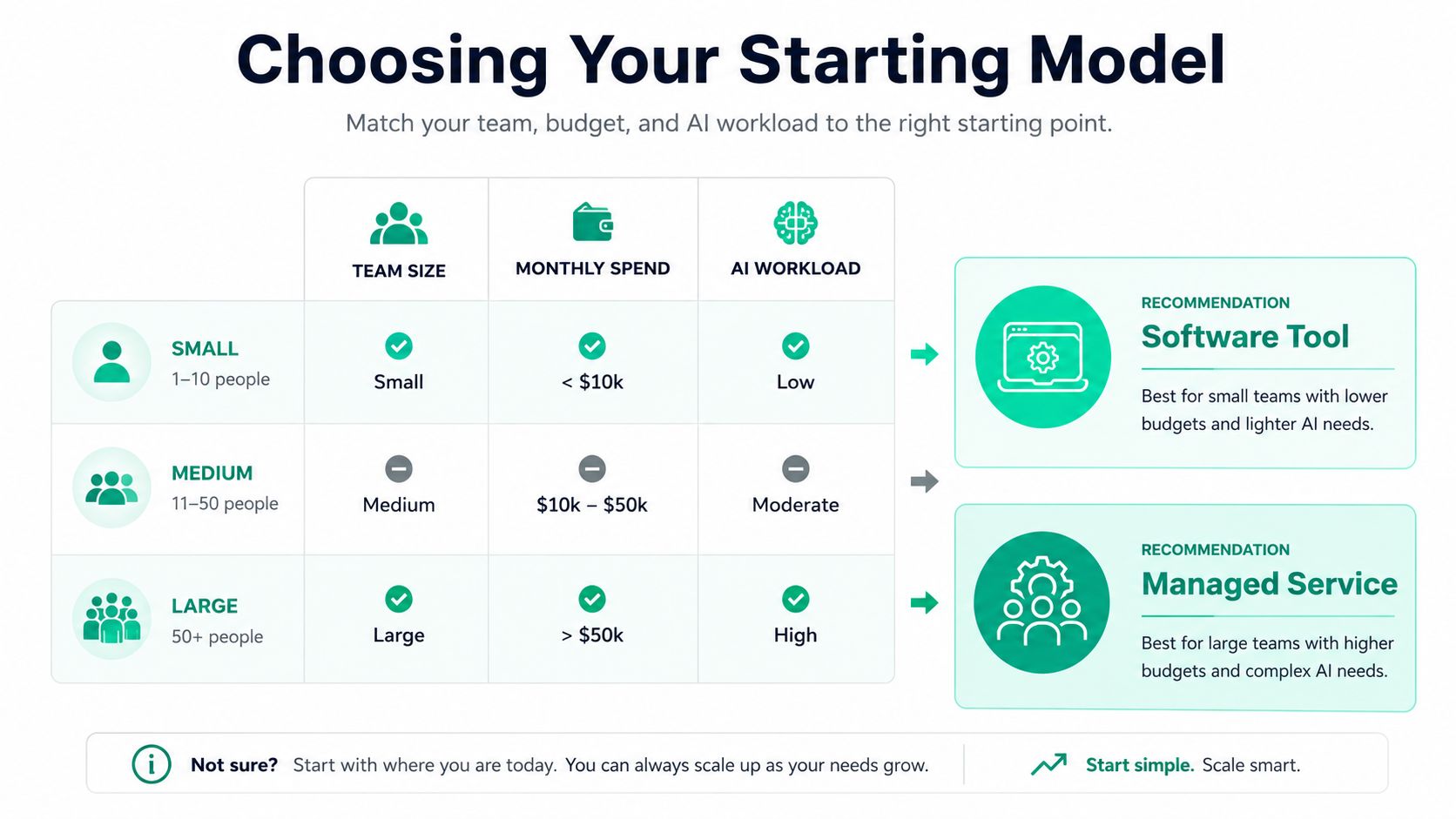
Start with operating reality, not vendor category. A small team with limited cloud spend and a modest AI footprint usually benefits from software first, because it needs visibility without adding a new operating function. A larger organization with substantial spend, multiple providers, and a high AI workload share may need managed FinOps supported by automation and internal engineering ownership.
Use a simple decision matrix:
- Small team, below $10K monthly spend, low AI workload: Start with a software tool and establish tagging, ownership, and a recurring review.
- Growing SaaS team with mixed cloud and LLM usage: Combine daily tooling with a quarterly managed review focused on commitments, workload economics, and model choices.
- Large enterprise, above $50K monthly spend, high AI workload: Use a managed program with provider normalization, automated recommendations, governance, and executive reporting.
The thresholds above are a starting framework, not a guarantee. Spend concentration, regulatory requirements, architecture complexity, and the cost of internal time can justify a different model.
Before signing, define four things:
- Attribution scope: Which services, features, customers, and AI workflows must be visible?
- Pilot model: Which service model can demonstrate value without disrupting delivery?
- 90-day target: Which savings, time saved, or forecast improvements will count as success?
- AI boundary: Which providers, models, environments, and experiments are included from the start?
The next generation of FinOps will need stronger cross-provider normalization, unit-economics reporting, and AI-aware controls. Token spend belongs in the same management conversation as compute, storage, and databases, but the objective remains business value, not blind reduction.
SpendLens AI adds lightweight attribution, workload-level LLM visibility, prompt-waste signals, and confidence-scored model recommendations to existing OpenAI and Anthropic integrations without proxying requests. Visit SpendLens AI to instrument a pilot workload, identify its real spend drivers, and turn your next cost review into an action plan.