AI Development Services Explained with Real Costs
Learn what AI development services cover, how pricing works, and how to evaluate ROI and LLM spend with real examples and cost controls.
A familiar scene is playing out in product teams right now. Your AI feature is live, users are getting value, support tickets are manageable, and leadership is pleased. Then finance asks a simple question: which workflow is driving the bill, and is it worth the cost?
Engineering often can't answer that cleanly. You know total provider spend. You might even know which model you call most often. But when someone asks whether summarization is profitable, whether retry storms caused last week's spike, or whether a long system prompt is wasting money on every request, the room gets quiet.
That gap is why AI development services matter. They aren't only about connecting to OpenAI, Anthropic, or a vector database. They're about turning an AI prototype into an operated system that saves time for users, saves money for the business, and stays understandable after launch. In practice, the strongest service partners help with design, delivery, monitoring, and the economics of production usage.
That timing isn't accidental. Enterprise demand is rising fast. One market estimate put the global AI Development Service market at USD 11.92 billion in 2024, rising to USD 13.46 billion in 2025 and projected to reach USD 45.0 billion by 2035, a 12.9% compound annual growth rate over 2026 to 2035, according to Pertama Partners research on enterprise generative AI. Growth at that scale usually means more production workloads, more teams shipping model-backed features, and more need to track where money goes.
Adoption is moving in the same direction. A 2025 Capgemini survey reported GenAI adoption rose from 6% in 2023 to 30% in 2025, while 93% of organizations were exploring or enabling GenAI capabilities. Wharton also reported that 82% of business leaders use GenAI at least weekly, 46% use it daily, and 88% expect budget increases over the next 12 months, with 62% expecting increases of 10% or more in that period, as detailed in the Wharton AI Adoption Report.
If you're trying to understand where AI development services fit, start with this idea: the job is no longer just "build the feature." The job is "build the feature so you can run it economically." If you need a baseline on where bills usually come from, this guide to the cost of AI systems is a useful companion.
Table of Contents
- Introduction Why AI Development Services Matter Now
- What AI Development Services Actually Cover
- Core Service Pillars From Consulting to MLOps
- Vendor Versus In House and Hybrid Tradeoffs
- How to Choose a Partner Pricing Models and Selection Criteria
- Measuring ROI and Controlling LLM Spend in Production
- Putting It All Together and Next Steps
Introduction Why AI Development Services Matter Now
A lot of teams first meet AI development services when internal capacity runs short. Product wants an assistant, support wants auto-drafting, sales wants call summaries, and engineering already has a full roadmap. Bringing in help sounds like a delivery decision. After launch, it becomes an operating decision.
The pressure after launch is different from the pressure before launch. Early on, you care about whether the feature works. Later, you care about whether the feature keeps working at an acceptable cost, with enough reliability to trust it in customer-facing flows.
The moment where teams get stuck
Suppose a SaaS company ships three AI features in one quarter:
- Support summary generation: Agents save time after each ticket.
- Search answer drafting: Users get faster answers from docs.
- Sales note cleanup: Reps spend less time editing CRM updates.
All three can look successful from the outside. But only one might be driving most of the bill. If nobody tagged requests by feature, model, owner, and workflow, finance gets one provider invoice and engineering gets one more mystery to solve.
Practical rule: If you can't attribute cost to a workflow, you can't defend that workflow's ROI.
AI development services earn their keep. A good partner helps your team avoid wasted time in two ways. First, they shorten build time by bringing patterns, integrations, and evaluation habits your team doesn't need to invent from scratch. Second, they reduce money wasted after launch by adding the observability and controls that keep an AI feature from becoming an opaque monthly expense.
Why this category is changing
There's also a larger market shift behind this. Short-term spending expectations are climbing as enterprises move from experimentation to custom application development. Gartner's 2026 forecast says global AI spending will reach $2.7T in 2026, and the growth outlook for AI application development platforms was revised from 28% to 39%, according to Communication Today coverage of the Gartner forecast. That doesn't tell you which vendor to hire. It does tell you the operating problem is getting bigger, not smaller.
For engineering leaders, that means AI development services should be judged less like design agencies and more like production engineering partners. Can they help you ship faster? Yes. Can they help you answer which features save time, which features save money, and which features should never scale beyond a pilot?
What AI Development Services Actually Cover
Think of AI development services like building a commercial property. You don't start with paint colors. You start with drawings, utilities, structural work, then the systems that keep the building functioning after people move in.
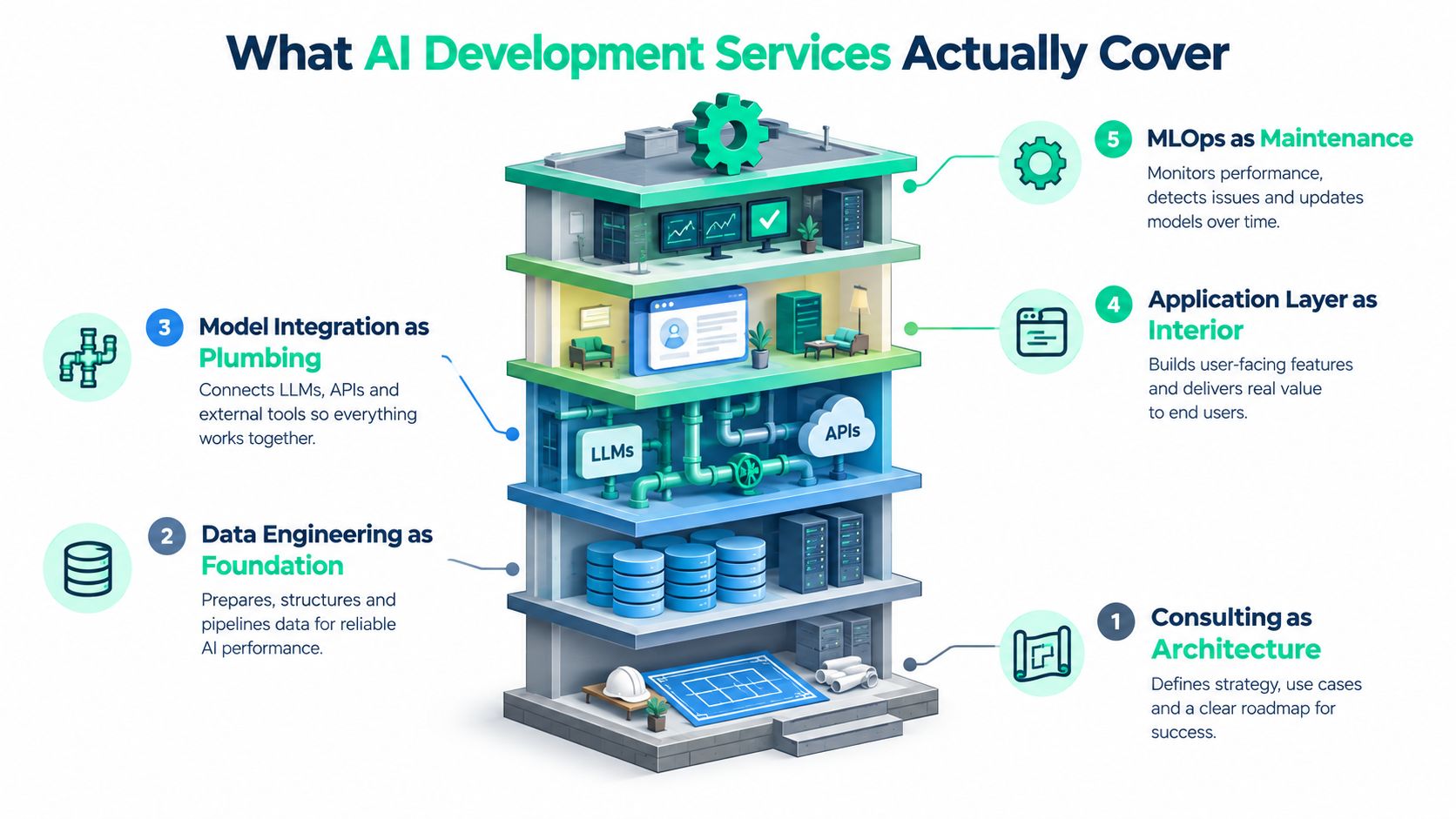
Strategy is the blueprint
At the top of the buying journey is consulting. A team decides what problem AI should solve, what success looks like, what data is available, and what failure modes are unacceptable. If a provider skips this and jumps straight to model demos, you're probably buying speed at the cost of rework later.
A useful strategy phase usually answers questions like these:
- Use-case fit: Is the task generation, extraction, classification, retrieval, or orchestration?
- Workflow placement: Should AI assist a human, automate a step, or produce a draft for review?
- Economic fit: Is the value per request high enough to justify production usage?
A logistics or telecom team, for example, may need very different workflows than a marketing SaaS company. If you want a grounded example of how service firms frame vertical delivery work, this overview of services for logistics and telecom shows how implementation usually changes by domain rather than by model alone.
Data and integration are the foundation and plumbing
Once the blueprint is clear, the next layers are less glamorous and more important. Data engineering prepares what the model will see. Integration work connects your application to model APIs, vector stores, queues, auth systems, and internal services.
Here's where many leaders underestimate scope. A demo chatbot can run on a few prompts and a clean sample dataset. A real customer feature needs:
- Data preparation: cleaning, chunking, labeling, access control
- Application integration: SDKs, retries, fallbacks, rate handling
- Evaluation setup: test prompts, expected outcomes, review loops
Without those layers, teams burn time debugging avoidable issues like stale context, malformed tool calls, or outputs that look fine in staging and fail in real traffic.
The app is only one layer
The visible part is the feature itself. Maybe that's a support assistant inside your product, an internal review tool, or an AI-powered search flow. Users see this layer. Most of the work that determines cost and reliability lives below it.
Good AI development services don't stop at "it works on my laptop." They include the pieces that keep it stable when real users, retries, and billing arrive.
MLOps and governance are the maintenance team
After launch, the work shifts again. Models change, prompts drift, providers update pricing, and traffic patterns evolve. Modern AI development services now include monitoring, prompt management, evaluation pipelines, and governance controls because maintenance is where a lot of time and money are either saved or lost.
A simple way to consider it.
- Consulting defines the plan
- Data engineering prepares the inputs
- Model integration connects the systems
- Application work creates the experience
- MLOps keeps the result usable and affordable
If a provider only offers the middle of that stack, you may still need another partner or internal team to handle the rest.
Core Service Pillars From Consulting to MLOps
When buyers ask for AI development services, they're usually buying one or more distinct pillars. The problem is that proposals often blur them together. That makes it hard to compare vendors and harder to know where value comes from.
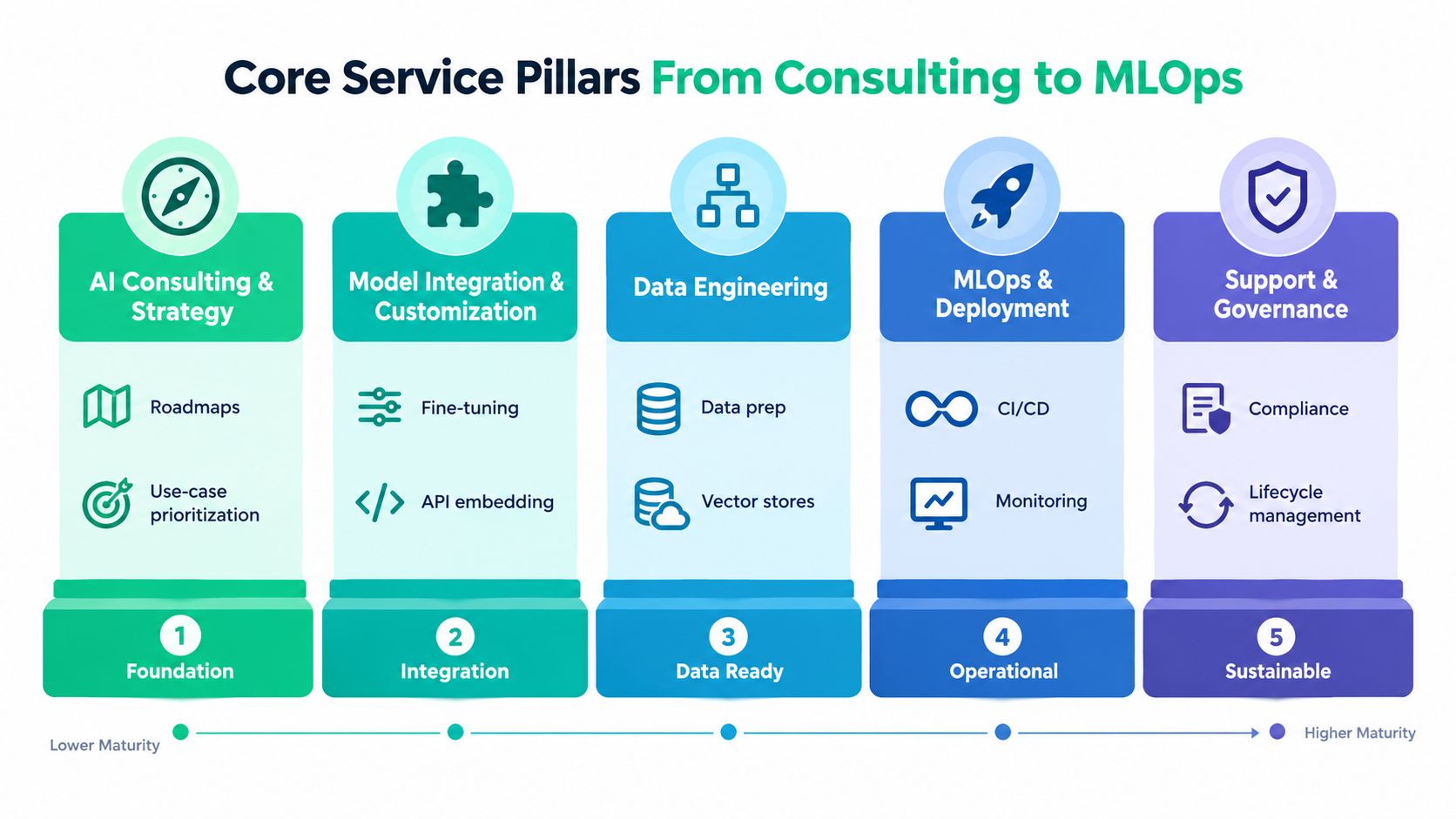
AI consulting and strategy
This pillar decides what should be built first and what shouldn't be built at all. Good consultants narrow scope, identify dependencies early, and stop teams from spending months on a use case that had weak economics from the start.
Typical deliverables include roadmaps, risk reviews, use-case prioritization, and reference architectures. The time saved here comes from avoiding dead-end projects and reducing redesign later. If a feature needs human review to be safe, the strategy should say that before engineering builds a fully automated workflow.
Model integration and customization
Services teams wire your app to models and shape behavior. It may include prompt design, tool calling, schema validation, guardrails, fine-tuning decisions, or multi-model routing logic.
A common example is splitting work by difficulty. A team might send simple classification to a cheaper model and reserve a stronger model for complex reasoning. That can save money without cutting product value, but only if someone has designed the routing rules and measured quality after the switch.
Data engineering
This pillar turns scattered data into usable context. That can mean retrieval pipelines, chunking rules, vector indexing, document refresh jobs, metadata filtering, and permissions-aware access.
If you're evaluating self-managed infrastructure or training-heavy workloads, this is also where hardware planning appears. For leaders comparing infrastructure paths, the AvenaCloud GPU rental guide is a practical resource for understanding the kind of hosting choices teams face when they move beyond API-only experimentation.
MLOps and deployment
This is the difference between "we built a feature" and "we can operate the feature." It includes deployment workflows, test harnesses, rollback plans, monitoring, tracing, and issue response.
The current operating challenge is getting harder as systems become more agentic and multi-model. McKinsey's 2026 tech trends coverage identifies agentic software development as an emerging trend and points to a broader move toward agentic AI, multi-model routing, and custom evaluation in the McKinsey top trends in tech report. That matters because a single benchmark doesn't tell you how a workflow will behave once it chains tools, retries, and model handoffs.
A useful related read is this guide to AI infrastructure monitoring, especially if your team already has features in production and needs better runtime visibility.
The video below gives a broader look at how AI systems move from build to operation.
Prompt engineering and retrieval design
This work sounds small until you see the bill. Prompt structure affects latency, output quality, and token usage. Retrieval design affects whether the model sees the right context or a bloated pile of text.
Examples where teams save time or money here include:
- Shortening repeated instructions: If the same long system prompt appears in every request, trimming it or caching it can reduce waste.
- Cleaning retrieval results: Fewer irrelevant passages means fewer input tokens and less model confusion.
- Controlling output length: When tasks don't need long answers, shorter completions save money and review time.
Cost and performance optimization
This pillar is where AI development services are changing fastest. Production optimization isn't just about model choice. It's about finding the expensive parts of the workflow and proving whether they're necessary.
A 2026 FinOps playbook notes that Anthropic cache reads on Sonnet 4.6 cost $0.30 per million tokens versus $3.00 per million uncached, which implies a 90% reduction on repeated context. The same playbook says prompt caching can cut 40% to 90% of repeated-prefix input spend, making cache-hit instrumentation one of the highest-ROI controls in production, as described in the AI inference cost optimization FinOps playbook.
Buying advice: Ask every provider how they measure prompt waste, cache efficiency, and per-workflow cost after launch. If they can't answer, you're buying code without operational accountability.
Vendor Versus In House and Hybrid Tradeoffs
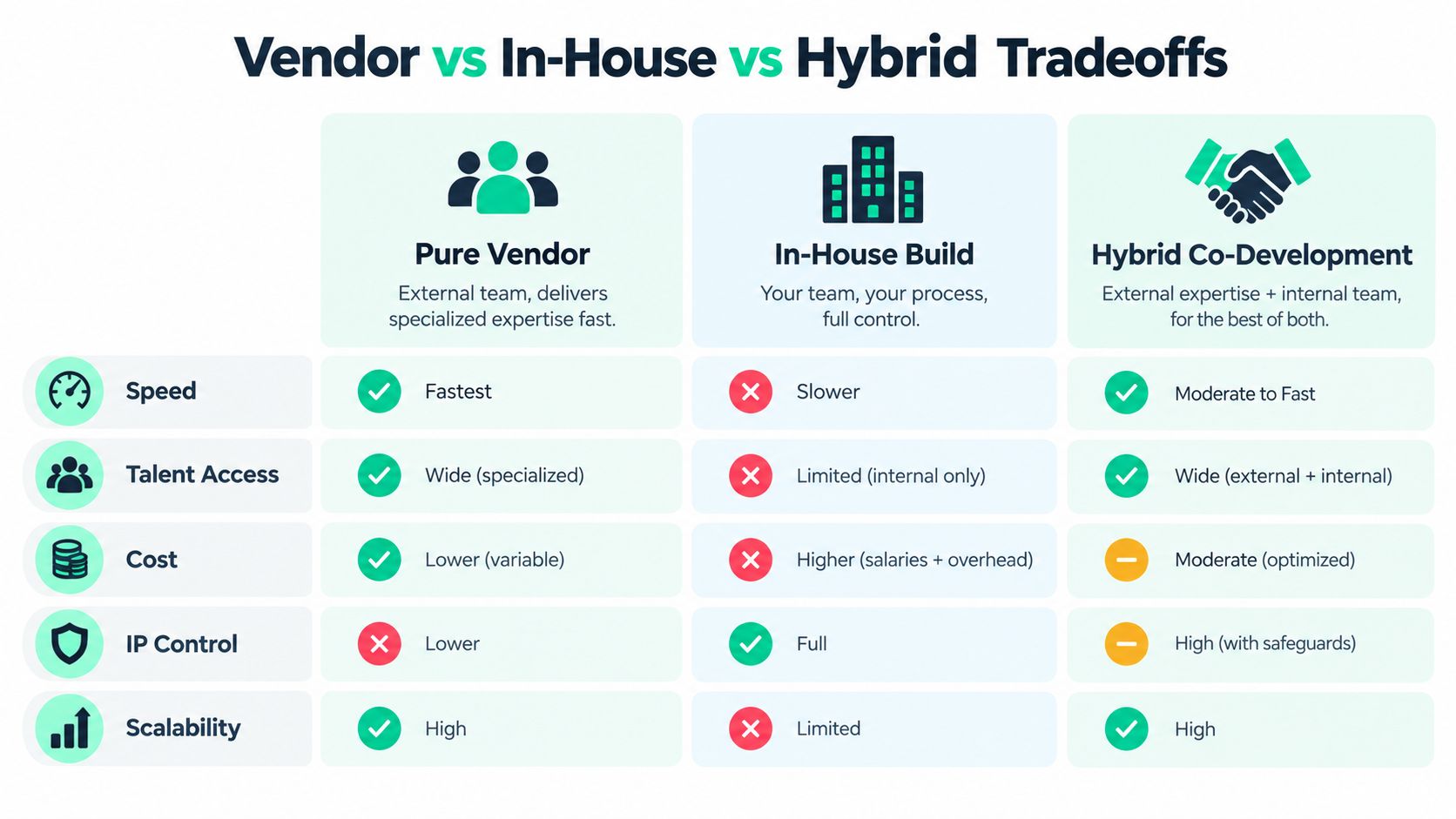
Some teams shouldn't hire a vendor. Some shouldn't build entirely in-house. Most end up somewhere in between.
The right answer depends less on ideology and more on what problem you're solving right now. Are you trying to validate whether an AI feature can save time in one workflow? Are you trying to scale five AI features across multiple teams while keeping security, cost control, and model governance consistent?
Three operating models
| Model | Where it helps | Where it hurts |
|---|---|---|
| Pure vendor | Fastest route to a working system when your internal team is stretched | Lower day-to-day control, weaker knowledge transfer if the contract is thin |
| In-house build | Strongest ownership of architecture, IP, and engineering standards | Slower if you lack applied AI experience, costly if every lesson must be learned from scratch |
| Hybrid co-development | Good balance of speed and capability transfer | Requires clear ownership boundaries, or decisions get messy fast |
When vendor-led delivery makes sense
Startups and mid-market teams often use vendors to compress time to launch. That can save months of hiring and onboarding. It also gives the team a way to test whether users get enough value before committing to a larger internal buildout.
This can save money in a very direct sense. Instead of hiring a full specialist team before product-market fit is clear, you buy focused delivery and learn whether the workflow deserves long-term investment.
When in-house ownership pays off
Larger product companies usually benefit from owning the core workflow logic, instrumentation, and release process. If AI is embedded across multiple surfaces in your product, you don't want cost attribution living in a consultant's spreadsheet or a disconnected vendor dashboard.
In-house ownership also matters when prompts, policies, or retrieval logic are tightly coupled to product behavior. That doesn't mean doing everything yourself. It means owning the parts that determine customer experience and long-term economics.
Why hybrid often wins
Hybrid models work well because they separate acceleration from dependency. An external team can help with architecture, first implementation, and operating patterns. Your internal team keeps your SDKs, observability, and business logic in place.
This is especially useful when the hidden problem isn't coding speed but fragmented instrumentation. A hybrid setup can add governance and cost visibility without forcing a rip-and-replace of existing clients or request paths.
The most expensive model isn't always the strongest model. The most expensive sourcing choice is the one that leaves you with a system nobody can explain six months later.
How to Choose a Partner Pricing Models and Selection Criteria
Choosing a partner is less about finding the firm with the strongest AI branding and more about finding the team that asks the right operational questions early. If a partner only talks about models, they may still be thinking like a prototype shop.
What to test in the first conversations
Listen for specificity. Strong partners usually probe for workflow boundaries, approval steps, telemetry, prompt volatility, and post-launch ownership. Weak partners rush toward demo output.
A practical checklist:
- Discovery quality: Do they ask what outcome needs to improve, who owns the workflow, and how success will be measured?
- Evaluation method: Can they explain how they'll compare outputs across prompts, models, or releases?
- Security defaults: Do they preserve your existing provider clients and privacy controls where possible?
- Operating plan: What happens after launch when quality drifts or spend rises?
- Cost visibility: Can they support chargeback, budgeting, and workload-level tracking?
If cost accountability is part of the project, this guide to AI cost governance is a useful lens for partner evaluation.
Pricing model fit matters more than people admit
The wrong pricing model creates waste even when the technical work is solid. Here's a simple way to evaluate the common options.
| Pricing Model | Best For | Value and Risk |
|---|---|---|
| Time and materials | Evolving projects where scope will change as the team learns | Flexible and often the most realistic for early AI work. Risk is weak cost control if goals stay vague. |
| Fixed price | Narrow builds with stable requirements and limited integration uncertainty | Easier budgeting. Risk is that vendors cut corners or push change requests once edge cases appear. |
| Dedicated team | Ongoing AI roadmap work that needs continuity | Strong knowledge retention and faster iteration over time. Risk is paying for capacity you aren't directing well. |
| Outcome-based | Projects with a measurable operational target and agreed baselines | Aligns incentives when the outcome is genuinely measurable. Risk is confusion when attribution is weak or external factors affect results. |
Red flags worth taking seriously
Some warning signs show up early:
- They can't explain post-launch instrumentation. That usually means you'll get a feature but not a manageable service.
- They rely on vague attribution. If no one can connect spend to workflows, ROI reviews become opinion battles.
- They insist on proxying all traffic without a clear reason. That can add routing risk and latency you may not need.
- They avoid discussing cache behavior, retries, and prompt changes. Those details often drive real production cost.
A good partner should help you save time by reducing rework and save money by exposing unnecessary spend. If they only promise speed, they're only solving half the problem.
Measuring ROI and Controlling LLM Spend in Production
Once the system is live, the central question changes. It isn't "does the feature work?" It's "which workloads are worth scaling, and which ones only look successful because nobody can see their full cost?"
Start with call-level attribution
For AI development services, detailed attribution is no longer optional. An industry FinOps guide recommends tagging each inference call with workflow or task type, model, provider, retries, token data, latency, and owner metadata, then reconciling that telemetry against the vendor bill so daily reporting can reach roughly ±2% agreement at the bill level, according to the AI project FinOps playbook. The same guidance says token fields should be split into cache read, cache write, and non-cached input components whenever the provider exposes them.
That structure gives you answers that finance and engineering can both use. Which feature got more expensive after a prompt update? Which team is responsible for retry-heavy workflows? Which customers generate the highest AI serving cost?
Measure cache efficiency, not just total tokens
Many teams leave money on the table. If your workflow repeats long instructions, schemas, or tool definitions, caching can cut spend and save time.
OpenAI says prompt caching can reduce input token costs by up to 90% and latency by up to 80% for long prompts, with supported API calls automatically benefiting when prompts exceed 1,024 tokens. OpenAI also gives a concrete example where GPT‑4o input tokens cost $2.50 per million uncached versus $1.25 per million cached, in the OpenAI prompt caching announcement.
OpenAI also documents that responses include a cached_tokens field in usage.prompt_tokens_details, which gives teams a direct way to measure cache hit rates and wasted context in the OpenAI prompt caching cookbook example. For newer model families, OpenAI states that cache writes for GPT‑5.6 and later cost 1.25× the uncached input token rate, which creates a tradeoff between initial cache creation cost and later savings, as noted in the OpenAI prompt caching guide.
Anthropic-style economics are similarly important. A Flexera breakdown notes that a 5-minute cache write costs 1.25× the base input rate, a 1-hour cache write costs 2×, and cache reads are billed at 0.1× the base input rate. The same example shows a repeated 3,000-token system-prompt workload dropping from about $9.00 to about $0.91 per 1,000 requests, saving roughly $8.09, in this prompt caching breakdown.
Turn telemetry into ROI decisions
Instrumentation only matters if it changes decisions. Useful dashboards should help a team do four things quickly:
- Find the top cost driver: Which workflow consumes the most spend today?
- Spot prompt waste: Are repeated instructions, oversized context, or long outputs inflating cost?
- Compare model options: Could a lower-cost model handle the same workload acceptably?
- Report clearly upward: Can engineering explain yesterday's bill in plain language?
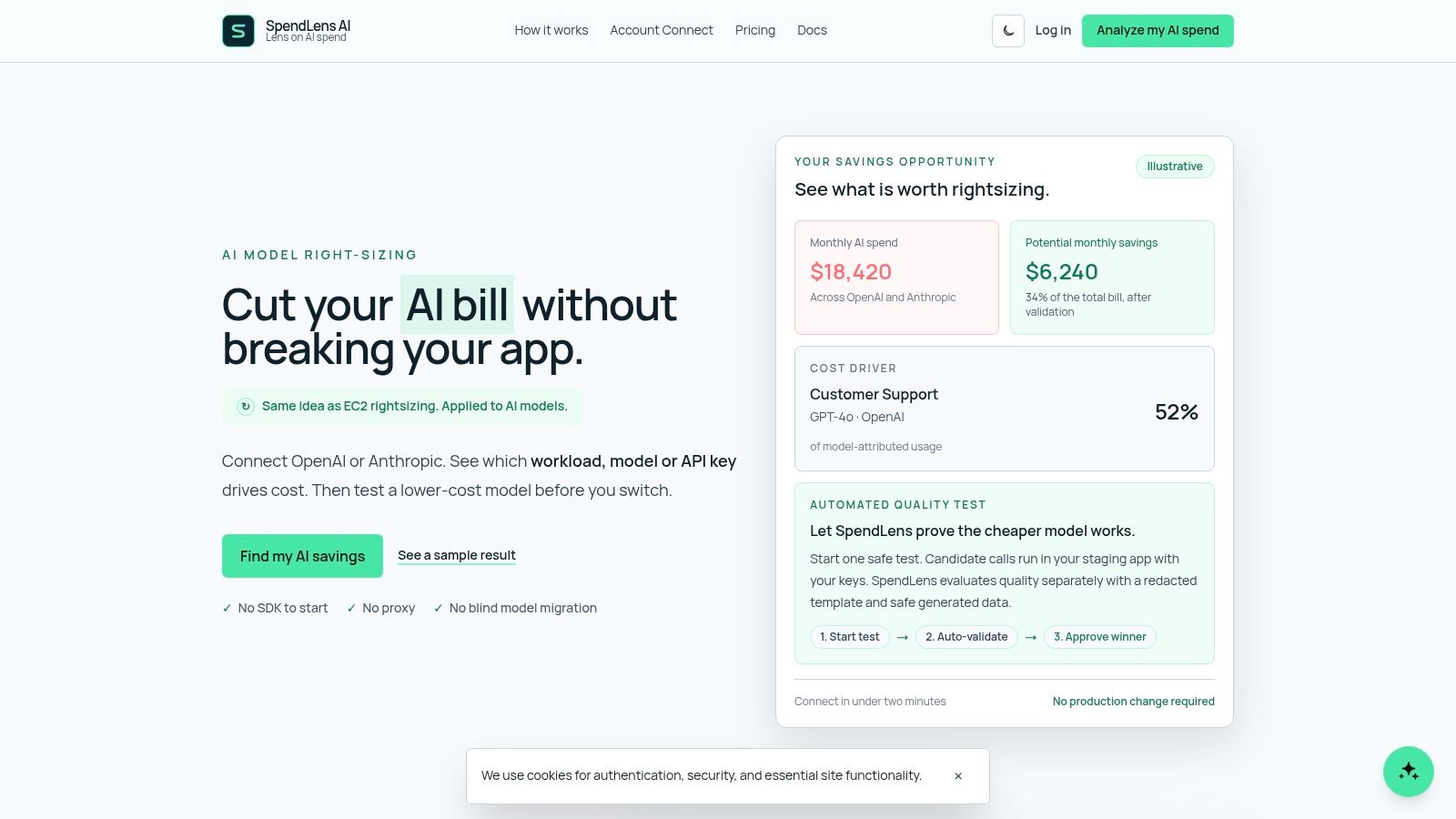
One option in this category is SpendLens AI, which adds lightweight instrumentation to existing OpenAI and Anthropic code paths, surfaces spend drivers and cache efficiency, and helps teams compare model-switch opportunities without proxying requests. If you're building internal forecasting around this data, a cost planning framework like this guide to AI cost estimation can help connect workload metrics to budgeting.
Operational habit: Review LLM costs like you review cloud costs. Daily enough to catch drift, granular enough to assign ownership, and specific enough to test a fix.
Putting It All Together and Next Steps
The useful way to think about AI development services isn't as a one-time implementation category. It's a lifecycle capability. You define the use case, decide who should build it, choose a delivery model, and then prove the workload deserves to stay in production.
That last part is where many teams underinvest. They pay for model access, delivery help, and launch work, then leave cost attribution vague. The result is predictable. The feature stays live, usage grows, and no one can say with confidence which requests save time, which requests save money, and which requests are just expensive habit.
A practical next-30-day plan
If you're already running AI features, do these next:
- Audit live workloads: List every model-backed workflow, owner, and business purpose.
- Add lightweight tags: Track calls by workflow, model, provider, and team.
- Check repeated context: Look for long prompts, tool schemas, or instructions that may benefit from caching.
- Run one model comparison: Pick a simple workflow and test whether a lower-cost option preserves acceptable quality.
- Create an executive summary: Give finance and product a short view of spend, top driver, and next optimization move.
If you're earlier in the process, use these same ideas as buying criteria. Ask partners how they'll help you save engineering time during delivery and how they'll help you save money after launch. Those are different promises, and you should expect both.
The teams that get the most from AI development services usually aren't the ones with the flashiest demos. They're the ones that can explain, in plain language, what each AI workflow does, what it costs, and why it's worth running.
SpendLens AI helps teams instrument OpenAI and Anthropic workloads without changing provider clients, then shows spend drivers, cache efficiency, and model-switch opportunities in one place. If you're trying to connect AI development services to real production economics, visit SpendLens AI to see how lightweight attribution and LLM cost monitoring can make those decisions easier.