AI Cost Governance Framework That Actually Controls Spend
Learn AI cost governance frameworks, roles, metrics and tooling to attribute LLM spend, enforce budgets and prove ROI across engineering and FinOps.
An AI feature ships, usage climbs, and the next invoice arrives with a number nobody expected. Finance asks which team caused the increase, whether a customer or internal workflow drove it, and whether the spend was approved. Engineering opens several provider dashboards, checks a few logs, and still can't produce a reliable answer.
That situation isn't usually caused by one expensive model. It comes from invisible usage, missing ownership, and fragmented billing across APIs, cloud infrastructure, agents, tools, and internal workflows. A workable AI cost governance system turns each request into an accountable business event, so teams can see who spent the money, whether they were entitled to spend it, and what value the workload produced. The result is less time spent investigating invoices and earlier opportunities to prevent waste. For a useful framing of the problem, see why invisible AI usage creates the real cost problem.
Table of Contents
- Why AI Bills Feel Invisible Until They Hurt
- What AI Cost Governance Really Means
- The Core Framework for Governing AI Spend
- Who Owns What Across Engineering Product and FinOps
- How Attribution Chargeback and Budgets Work in Practice
- Tooling Options and Where SpendLens AI Fits
- Putting Governance Into Action and Proving Value
Why AI Bills Feel Invisible Until They Hurt
A provider invoice can tell you that an account used a certain amount of input tokens, output tokens, or hosted capacity. It usually can't answer the questions a finance review asks: which feature generated the requests, which team owns it, which customer benefited, and whether the workflow was allowed to spend at that rate.
Consider a support assistant that uses one API key across several services. A product team launches a richer answer format, an automation team adds document retrieval, and a developer increases the context window during troubleshooting. The provider sees one growing stream of calls. Finance sees a larger bill. Without workload metadata, nobody can separate planned product usage from an experiment, a runaway job, or an agent repeating the same action.
That creates two kinds of loss. The first is direct financial waste, such as unnecessary prompt tokens, unsuitable models, duplicated inference, or unbounded agent activity. The second is investigation time. Engineers, FinOps analysts, and finance partners spend hours reconciling exports and asking teams to explain charges after the money has already left the budget.
The invoice is only one part of the cost
A full AI cost view includes more than hosted model usage. Governance may need to reconcile:
- Provider inference: OpenAI, Anthropic, and other hosted model charges.
- Infrastructure: GPUs, cloud services, storage, networking, and on-premise capacity.
- Supporting systems: Data platforms, retrieval tools, orchestration, observability, and developer tooling.
- Human work: Operations, review, rework, prompt maintenance, and incident response.
A finance team that looks only at provider invoices can understate the cost of a feature and misprice the product. It can also blame the wrong owner. Product AI used in a customer-facing workflow may belong in product margin analysis, while workflow AI used by an internal operations team may belong in departmental budgeting.
Practical rule: If a request can't be mapped to a workload, owner, and purpose, it isn't ready for reliable chargeback or forecasting.
The value of governance is therefore practical. It helps a team identify waste before month-end, shorten variance investigations, and protect a budget without freezing useful experimentation. The rest of the framework starts with visibility, then adds entitlement, enforcement, and business-value review.
What AI Cost Governance Really Means
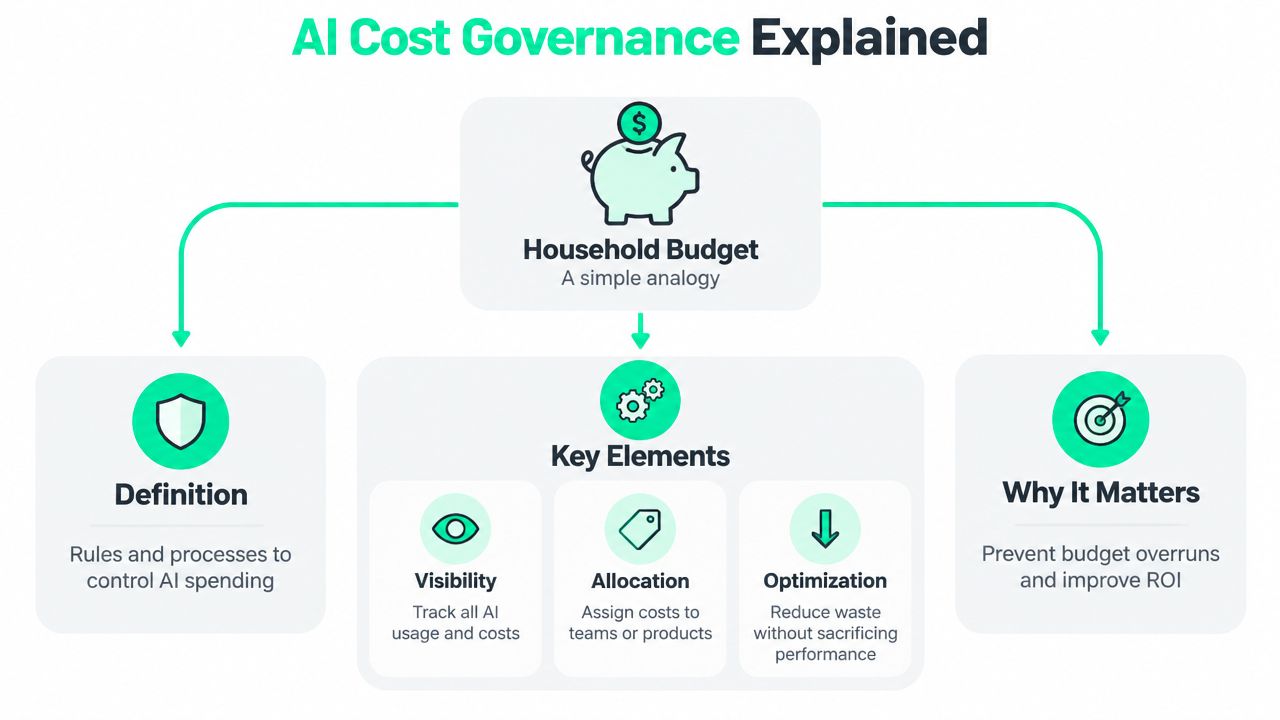
Think of AI cost governance as a household budget with better receipts. A household doesn't manage money by staring at one bank balance. It assigns spending categories, decides who can use a shared card, sets limits, reviews unusual purchases, and checks whether recurring expenses still make sense.
AI cost governance is the discipline of applying those controls to AI workloads. It defines what teams may run, how they identify the owner, how budgets are enforced, and how leaders connect spend to business outcomes. Optimization is one part of that discipline, but optimization alone isn't governance.
Start with four questions
A mature control system answers four questions for every meaningful workload:
- What was used? Model, provider, tokens, GPU time, tools, retrieval, and supporting services.
- Who owns it? Team, product, service, API key, agent, workflow, and accountable human owner.
- Was the usage permitted? Budget, model policy, environment, contract, approval status, and threshold.
- Was it worthwhile? Revenue contribution, margin effect, customer outcome, productivity result, or another agreed business measure.
Token reduction answers only part of the first question. Cutting a prompt may lower an individual request's cost, but it doesn't tell you whether the request belonged to an approved feature or whether an agent was entitled to call a model repeatedly. Governance has to cover identity and permission, not just consumption.
The cost base also extends beyond tokens and API calls. Guidance for finance and technology leaders includes tools, orchestration, operations, labor, rework, hybrid infrastructure, public cloud, hosted LLMs, data platforms, GPUs, agents, and developer tools in the governance conversation. That broader view matters when charges are split across systems with different billing models or when no single provider invoice represents the product's full economics.
For a cloud FinOps comparison, this guide to AI FinOps practices offers a useful companion perspective. The mental model is simple: visibility creates evidence, ownership creates accountability, entitlement creates control, and value measurement tells you whether continued spending is justified.
The Core Framework for Governing AI Spend
A practical framework connects policy, attribution, budgets, and review. Each pillar answers a different accountability question. Policy defines who may spend and under what conditions. Attribution shows who did spend. Budgets create a point where someone must act. Review tests whether the result justified the cost.
Policy design
Policies should specify approved providers, model-selection principles, data-handling requirements, environments, and spending boundaries. A new customer-facing agent might need a named owner, an approved production model, a documented fallback, and approval before it can use a shared production key.
The difference between written policy and enforced policy is operational. A 2026 governance study reports that 73% of organizations have AI cost policies, but only 47% fully enforce them, a 26-point gap between documentation and control (Harness State of AI in FinOps 2026). A policy that triggers no alert, approval, or deployment check remains guidance rather than a guardrail.
Attribution standards
Every inference job needs consistent metadata. Teams should group spend by product, feature, environment, customer-facing workflow, internal workflow, model, and responsible owner. That context must travel with the request or remain recoverable from the application trace.
Token-level attribution makes the bill actionable. Observability guidance describes estimating per-request cost from provider pricing and token counts on LLM spans, with manual pricing overrides for custom or unsupported models (LLM cost tracking guidance). Engineers can then compare unit economics instead of debating one monthly invoice.
Attribution should also follow the full request path. A single feature may create model charges, retrieval costs, orchestration activity, GPU use, storage, and developer-tool spend across several providers. Without a shared workload identity, each invoice looks reasonable while the product's total cost remains hidden. AI spend analytics can help connect those fragmented records for review.
Budgets and alerts
Budgets belong at the level where someone can act. A company-wide limit supports executive planning, while a product, team, agent, or experiment needs its own threshold. Alerts might warn an owner, pause a nonproduction workflow, require approval, or escalate a variance.
A budget is also an entitlement record. It should answer who was allowed to spend, which workload received that permission, and what happens when usage exceeds it. Founders applying the same discipline to broader infrastructure can consult saving on cloud as a founder.
Review and adjustment
Review turns telemetry into decisions. Teams should examine unusual growth, model changes, prompt changes, cache behavior, and business outcomes. They need to decide whether to resize a workload, change its model, tighten its permission, or stop it.
Only 21% of organizations describe themselves as fully mature in AI cost management, and just 26% have a method for measuring AI business value, according to the governance study cited above. The practical risk is clear: a team may report spend accurately without proving that the resulting feature, workflow, or customer outcome earned continued investment.
Who Owns What Across Engineering Product and FinOps
Governance fails when every group is consulted but no group is accountable. A useful operating model separates decision rights from implementation work. Engineering controls how requests run, Product defines why the workload exists, FinOps makes costs comparable, and a named business owner answers for the outcome.

Role responsibilities
| Role | Primary responsibility | Example decision |
|---|---|---|
| Engineering leadership | Set technical standards and escalation paths | Require cost instrumentation before production |
| Platform and ML engineering | Implement telemetry, model routing, limits, and reliability controls | Add workload tags and enforce approved model policies |
| Product management | Define the customer or business outcome | Decide whether response quality justifies a higher-cost model |
| FinOps | Normalize costs, maintain allocation logic, and lead variance review | Reconcile provider charges with product and team budgets |
| Finance and business owners | Approve budget and assess value | Continue, resize, reprice, or retire a workload |
A centralized model gives one platform or FinOps group authority over standards and shared infrastructure. It can produce consistent reporting quickly, but a central team may not understand each product's economics. A federated model lets product teams own budgets and outcomes while a central function provides taxonomy, tooling, and controls. It improves local decisions, but only if teams use the same metadata and reporting definitions.
Agents need an owner before they spend
An agent or workflow should have a named human owner at registration, not after an invoice spike. The registration record can include its purpose, environment, product or department, approved providers, budget, escalation contact, and contract or entitlement boundary.
That changes the question from “Which API key spent this?” to “Which governed workload was allowed to use this key, under which budget, for which outcome?” It also supports accountability when one agent performs multiple model calls and tool actions across services. Recent governance guidance identifies cost visibility and attribution, along with a developer-tooling and SDLC gap, as distinct problem areas (AI cost governance accountability guidance).
Centralization and federation aren't mutually exclusive. Central teams should own the rules and data contract. Product and engineering owners should own consumption and value. FinOps should make the numbers trusted enough for showback, chargeback, and planning. Clear ownership reduces the time spent chasing spend drivers because the system already identifies the person responsible for the next decision. A practical accountability model is also outlined in this guide to team accountability for AI spend.
How Attribution Chargeback and Budgets Work in Practice
A provider invoice shows what was billed, not who was entitled to spend it or which customer outcome it supported. Attribution starts earlier, at the request. Each model call should carry enough context to connect provider usage with an application event. Capture the provider, model, input and output tokens, estimated cost, timestamp, environment, workload, team, product, and API key or service identity.
Build a tagging contract
A tagging contract gives every service the same vocabulary. Keep it small enough for developers to apply and specific enough for FinOps to report consistently.
| Tag Field | Example Value | Governance Use |
|---|---|---|
| Provider | OpenAI | Compare provider spend |
| Model | GPT-4o | Analyze model mix |
| Use-case ID | support-answer | Connect requests to a business purpose |
| Team | support-platform | Assign ownership |
| Product | customer-portal | Separate product economics |
| Environment | production | Distinguish live spend from experiments |
| Workflow type | product AI | Support margin and pricing analysis |
| Owner | service owner | Route alerts and variance questions |
| API key or service | support-api | Trace technical execution |
| Agent or workflow ID | refund-assistant | Govern autonomous activity |
A customer support request might carry support-answer, support-platform, customer-portal, production, and product AI. A nightly document-classification job would use its own use-case ID, team, owner, and workflow AI label. Finance can then decide whether each category belongs in customer margin, departmental overhead, or an experimentation budget.
The contract also establishes entitlement. A workload without an owner, approved environment, or budget should not inherit permission from a shared key. That distinction matters when one agent makes model calls and tool requests across several providers. The question becomes, “Which governed workload was allowed to spend, under which limit, for which outcome?”
Calculate cost at call level
Provider prices and token counts can produce an estimated cost for each request. Version the pricing table, record currency and assumptions, and allow manual overrides for custom models or billing terms that the system cannot calculate directly. Early estimates do not need perfect precision. They need consistent rules so teams can compare workloads, investigate variance, and act before the monthly provider export arrives.
Use showback before chargeback. Showback reports what each team would owe without changing the ledger. Owners can correct missing tags, unexpected model selection, or incorrect workload classification. After the data is trusted, chargeback can assign actual or normalized costs to products and departments. Budgets then become a documented permission boundary, not merely a warning displayed after spend has occurred.
Find savings before imposing cuts
Prompt waste is a practical first check. One 2026 analysis found production prompts often contain 20–40% unnecessary tokens. In its example, reducing an 800-token system prompt to 560 tokens across 50,000 GPT-4o calls per day saved about $900 per month in input tokens, and about $3,400 per month in total (prompt token reduction analysis). Those figures describe that scenario, not a universal forecast. Inspect templates and context before requiring a risky model change.
Caching and routing offer another control point. Production guidance reports that cache hit rates around 20–30% can reduce infrastructure costs by 20–30%, while prefix-aware routing can raise hit rates from about 25% under round-robin to 75% or higher for workloads sharing prefixes. For Anthropic-style prefix caching, cached reads receive a 90% discount versus normal input pricing (LLM inference economics guidance). Monitor cache-read share and prefix stability, then test changes against quality and latency.
Control before optimization: A cheaper request from an unauthorized workflow is still a governance failure.
Set soft caps for routine work and hard controls for runaway experiments. Review variance by owner, workload, model, and business outcome. Teams building autonomous workflows can consult this background in the agent payments article to examine how software identities interact with permissioned spending.
Tooling Options and Where SpendLens AI Fits
Tool choice should follow the risk and reporting problem. Provider dashboards are useful for confirming invoices and account-level trends, but they rarely provide enough application context for product margin or team chargeback. They work well as a billing source, not as the complete governance system.
A proxy can centralize routing, policy checks, and model access. That can suit an organization willing to place an intermediary in every request path. It also introduces another operational component, with routing, latency, compatibility, and failure-mode considerations.
Spreadsheets are fast for a small inventory, especially during an initial contract review. They become fragile when multiple providers, changing models, agents, and production releases create a constant stream of usage. Manual tracking also delays detection, so the team learns about a prompt regression after the invoice rather than near the deployment.
Match the tool to the workflow
| Approach | Useful when | Main limitation |
|---|---|---|
| Provider dashboards | You need account billing and usage confirmation | Limited feature and owner context |
| Proxy-based controls | Central routing and policy enforcement are priorities | Adds a request-path dependency |
| Spreadsheets | You are building an initial inventory | Weak freshness and automation |
| Application instrumentation | Teams need call-level cost and workload context | Requires adoption in application code |
Lightweight instrumentation can preserve existing OpenAI and Anthropic clients while adding decorators, tags, workload classification, cache visibility, and per-call telemetry. It avoids forcing every request through a proxy, which can reduce migration scope for teams with established retries and observability.
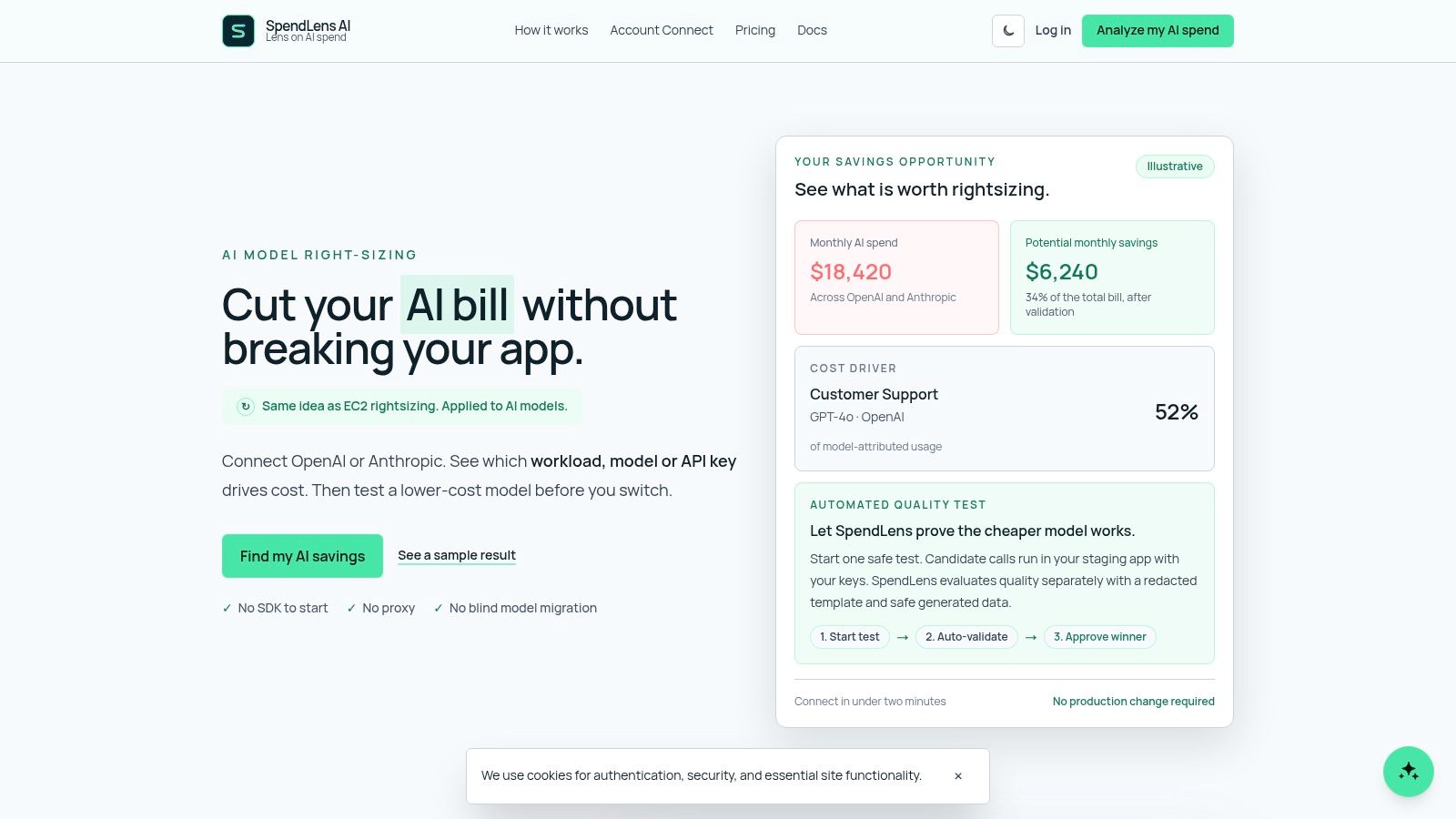
SpendLens AI is one example of that instrumentation approach. Its Python SDK supports @spendlensai.observe, track(), and client.tag() for associating calls with workflows, tasks, features, experiments, or endpoints. Its dashboard organizes spend by project, provider, model, and workload, and its recommendations can present estimated monthly savings, confidence, and migration risk for model-switch opportunities. Teams can use those outputs to prioritize a low-risk test rather than change models blindly.
A useful daily report should answer three questions: what did yesterday cost, which workload drove it, and what action has the highest expected value. That format saves review time because leaders don't have to assemble separate provider, application, and project reports before a planning meeting. It also gives engineers a short list of investigations instead of a general instruction to “reduce AI spend.”
Putting Governance Into Action and Proving Value
Governance works best when each control produces evidence before it adds friction. Start by mapping the full cost surface: providers, models, agents, tools, GPU workloads, data platforms, environments, and internal services. Record which charges come from native billing and which require application telemetry or allocation rules.
Assign every inference job a team, product or department, workflow type, owner, environment, model, and use-case ID. Unowned production workloads should be rejected or quarantined. This turns a bill into an accountability record: who was entitled to spend, for which workload, and under whose budget.
Then remove visible waste. Review large templates, repeated instructions, excessive context, long outputs, unsuitable models, and missed cache opportunities. As noted earlier, trimming a large system prompt can save hundreds per month in the cited scenario, while the broader total depends on traffic and model assumptions.
Set team and workload budgets, approval rules, anomaly alerts, and escalation paths. Begin with showback, so teams can see their share without immediate financial transfer. Move to chargeback after the allocation data is trusted.
Forecast actual usage against expected, committed, and stress scenarios. Tie each workload to a business measure, such as customer margin, completed cases, conversion, or analyst hours redirected to higher-value work. A 2025 industry report says 80% of enterprises exceed AI infrastructure forecasts by more than 25%, while 84% report gross margin declines linked to AI workloads (2025 State of AI Cost Management reporting). That makes governance a margin discipline, not only a cloud-cleanup exercise.
Use Procright real time spend insights as a reference for connecting usage with action. Review ownership, forecast variance, cache behavior, model mix, and business value on a regular cadence.
SpendLens AI adds instrumentation for OpenAI and Anthropic workloads, including attribution, spend-driver analysis, cache visibility, prompt-waste signals, and model-switch recommendations with estimated savings and risk context. Visit SpendLens AI to review its quickstart and make LLM spend visible without putting a proxy in the request path.