
AI FinOps: The 2026 Playbook for LLM Cost Control
Learn what AI FinOps is, why it matters for teams using LLMs, and how to cut OpenAI and Anthropic spend with caching, routing, and governance.
The launch looked healthy. Requests climbed, users adopted the new AI assistant, and the team's dashboard showed normal latency and error rates. Then finance forwarded the provider invoice. The forecast had called for a modest monthly bill, but the actual charge was several times higher. Nobody could answer the basic question: which feature, team, or failure mode created the spend?
That situation captures the problem with AI FinOps. Visibility is necessary, but a dashboard that reports yesterday's usage won't stop an expensive model from serving an easy task, a retry loop from repeating indefinitely, or a background job from consuming tokens while nobody's watching. Effective control requires attribution, automated decisions, and accountability at the point where each request is made.
Table of Contents
- The Surprise Invoice That Started a FinOps Program
- What AI FinOps Actually Means
- Where the LLM Money Actually Goes
- The Four Levers That Move AI Cost
- From AI Cost Policy to Enforced Control
- Tooling Landscape and Where SpendLens AI Fits
- A 90 Day Adoption Playbook
- KPIs and a Maturity Checklist to Close With
The Surprise Invoice That Started a FinOps Program
The incident began after a mid-sized SaaS company launched an AI-powered support feature. Product expected a manageable increase in inference spend. Engineering had already added provider dashboards, so the team believed the main operational risk was covered.
The invoice told a different story. A feature that had looked profitable in testing had become expensive in production because three unrelated behaviors multiplied each other.
First, the assistant used a lengthy reasoning prompt on every support request. Second, a background summarization job ran overnight across newly created tickets, including tickets that had already been summarized. Third, a transient provider error triggered a retry loop without a circuit breaker. A malformed response caused the same request to run repeatedly, while the monitoring system recorded the failures as application errors rather than as a rapidly growing cost center.
The team could see aggregate provider usage, but it couldn't connect that usage to a feature, tenant, prompt version, or retry reason. The bill arrived as a total rather than as a diagnosis. By then, the launch team had already moved on to its next release.
What the dashboard missed
The missing controls were operational, not cosmetic:
- Feature attribution: Calls needed metadata identifying the support assistant, overnight summarizer, and other workloads.
- Request budgets: The summarizer needed a bounded allocation rather than unrestricted background execution.
- Retry protection: The gateway needed a maximum retry policy and a circuit breaker for repeated failures.
- Forecast variance: Finance needed a forecast tied to user activity and feature volume, not a static monthly estimate.
- Owner accountability: Someone needed authority to pause, downgrade, or redesign the workload when spend moved outside its expected range.
A team can have excellent charts and still lack cost control. The engineering group in this scenario wasn't missing a reporting tool. It was missing a production control plane.
Practical rule: If an AI request can't be attributed to a feature, team, or task before it reaches the provider, the organization usually discovers its true cost after the invoice.
That pattern is common because LLM spending grows inside product code. A prompt change, an added retrieval document, or a new agent step can alter the economics without changing infrastructure capacity. AI FinOps exists to place financial controls alongside those engineering decisions, before a surprise bill turns into an incident.
What AI FinOps Actually Means
Traditional cloud FinOps connects visibility, allocation, optimization, and governance. AI FinOps keeps those principles but applies them to a workload where the meter runs at request and token level. A virtual machine may have a relatively stable hourly rate. An LLM call can vary because input context, output length, model selection, cache status, and retry behavior all change the charge.
A useful analogy is utility metering. A household doesn't manage electricity only by looking at the monthly bill. It measures usage, assigns responsibility, identifies waste, and adds controls for unusually high consumption. LLM services work similarly, except the meter sits inside application behavior. Every request can carry different payloads, and a small code change can increase consumption without adding a server.
For teams building a program, start with four connected domains:
- Model selection economics asks whether a frontier model is necessary for the task. Classification, extraction, summarization, and routing often have different quality requirements from complex reasoning.
- Prompt and context economics examines system instructions, retrieved documents, tool schemas, conversation history, and output limits. Context engineering is a cost decision as much as a quality decision.
- Traffic shaping and routing determines which model receives a request, when work is batched, whether repeated prefixes are cached, and what happens when a budget threshold is reached.
- Organizational accountability assigns spend to a feature, product, team, tenant, or experiment, then gives an owner the authority to act on the data.
This is why AI FinOps differs from generic platform monitoring. Monitoring tells you whether a service is healthy. MLOps manages training, deployment, evaluation, and model lifecycle concerns. AI FinOps asks whether a successful task creates enough value to justify its inference cost, and whether the system can enforce an economic decision before the request is sent.
Teams often begin with a narrow AI spend management framework, but the mature practice is broader. It joins finance, engineering, platform, and product around a shared unit of economics, such as cost per successful task or cost per processed document.
Where the LLM Money Actually Goes
Most LLM invoices can be traced to a small set of production decisions. The model is one, but it isn't the only one. Prompt size, retrieved context, output length, and retries can make a supposedly cheap workflow expensive.
The main cost drivers
Model choice sets the price floor. A frontier model may deliver better reasoning, but routing every classification or short extraction request to it makes the product pay for capability it doesn't use.
Prompt and system-prompt size multiply across calls. A large system prompt sent on every request becomes a recurring charge. The same applies to tool definitions, policy text, and repeated formatting instructions.
Retrieved context expands input usage. RAG systems can add long documents, duplicate passages, and irrelevant history. More context isn't automatically better. It can increase cost while making the model's task less focused.
Output length remains under application control. Generous token limits, verbose reasoning formats, and unconstrained agent responses create spend even when users need a short answer.
Retries turn failures into paid traffic. A JSON parse failure, timeout, or rejected guardrail response can cause the full prompt to be processed again. A retry policy that lacks a maximum attempt count is a cost policy failure.
The cost of AI therefore can't be understood from total tokens alone. Two workloads with identical monthly token volume may have very different invoices because one uses cached prefixes, a lower-cost model, shorter context, or fewer retries.
A pricing reference for cached context
Prompt caching illustrates the difference between raw volume and economic design. A widely used pricing example charges about $0.30 per million cached input tokens versus $3.00 per million uncached input tokens, a 90% reduction for repeated context, according to FinOps guidance on token economics. That matters when system prompts, RAG context, or tool schemas remain stable across requests.
Anthropic describes a similar relationship in its caching pricing. Claude Opus 4 cache hits and refreshes are listed at $1.50 per million tokens versus $15 per million base input tokens, while Claude Haiku 3.5 cache hits are $0.08 per million versus $0.80 per million base input tokens. Anthropic states that cache reads cost 10% of normal input pricing, which represents a 90% discount on reused context in those examples, as summarized in this LLM caching cost-control guide.
| Cost per 1M Tokens Across Common LLM Models (2025 Pricing) | Input $/1M tokens | Output $/1M tokens | Relative cost vs. smallest |
|---|---|---|---|
| Provider and model pricing varies by model, modality, and date | Verify current provider pricing | Verify current provider pricing | Compare within the workload |
The table should be populated from the provider pricing used by your application, not copied from a static article. Prices change, cached and uncached tokens may be billed differently, and output pricing often differs materially from input pricing. The useful practice is to maintain a current internal rate card, then evaluate cost per successful task, not just cost per million tokens.
The Four Levers That Move AI Cost
Visibility, routing, caching, and governance solve different problems. Treating them as substitutes is a common mistake. A dashboard can reveal an expensive workload, but only routing, caching, or an enforced policy changes what happens on the next request.
Visibility finds the leak
Visibility is the foundation. Instrument calls by provider, model, feature, tenant, prompt version, token type, latency, outcome, and retry reason. It creates the evidence needed to compare similar workloads and detect anomalies.
It breaks when teams stop at reporting. A weekly chart won't reduce spend if engineers still call the same model with the same context. Visibility has value as an investigative control, but it needs a production decision attached to it.
Routing changes the unit price
Routing sends each task to an appropriate model tier. A simple classifier might use a smaller model, while a difficult reasoning request receives a more capable model. The trade-off is quality risk. Routing needs evaluation sets, fallback logic, and outcome metrics, or teams will optimize price while damaging task completion.
Telemetry is the prerequisite. Without prompt-level and outcome-level data, routing becomes guesswork.
Caching removes repeated work
Exact-match caching works well when requests repeat. Semantic caching can help when requests differ in wording but ask the same question, although it requires careful invalidation and quality checks. Stable prefixes are especially suitable for provider prompt caching because repeated system instructions, retrieved context, and tool schemas can receive discounted treatment.
Caching breaks when prompts are mostly unique, context changes frequently, or stale responses create business risk. It also requires a clear TTL and invalidation policy, not just a cache toggle.
Governance makes the decision binding
Governance defines who can spend, on which workload, and under what conditions. Soft budgets can trigger alerts or model downgrades. Hard caps can stop a runaway job. Governance fails when caps are advisory and the request path has no automated downgrade, queue, or rejection behavior.
| The Four AI FinOps Levers Compared | Typical Savings | Prerequisites | Where It Breaks | Time to Value |
|---|---|---|---|---|
| Visibility | Qualitative improvement through attribution and anomaly detection | Centralized telemetry and workload tags | Reports don't alter production calls | Early |
| Routing | Qualitative reduction by matching task difficulty to model tier | Evaluation data and reliable request classification | Quality falls when routing is untested | Early to medium |
| Caching | Highest impact on stable-prefix and repeated-context workloads | Stable inputs, TTLs, and invalidation rules | Unique or rapidly changing prompts | Medium |
| Governance | Prevents uncontrolled usage and enforces budget decisions | Owners, thresholds, gateway controls, and escalation paths | Soft caps remain advisory | Medium |
A practical sequence is simple: instrument first, route where quality data supports it, cache stable repetition, then enforce budgets across the resulting workload map. The controls stack because each one addresses a different source of waste.
From AI Cost Policy to Enforced Control
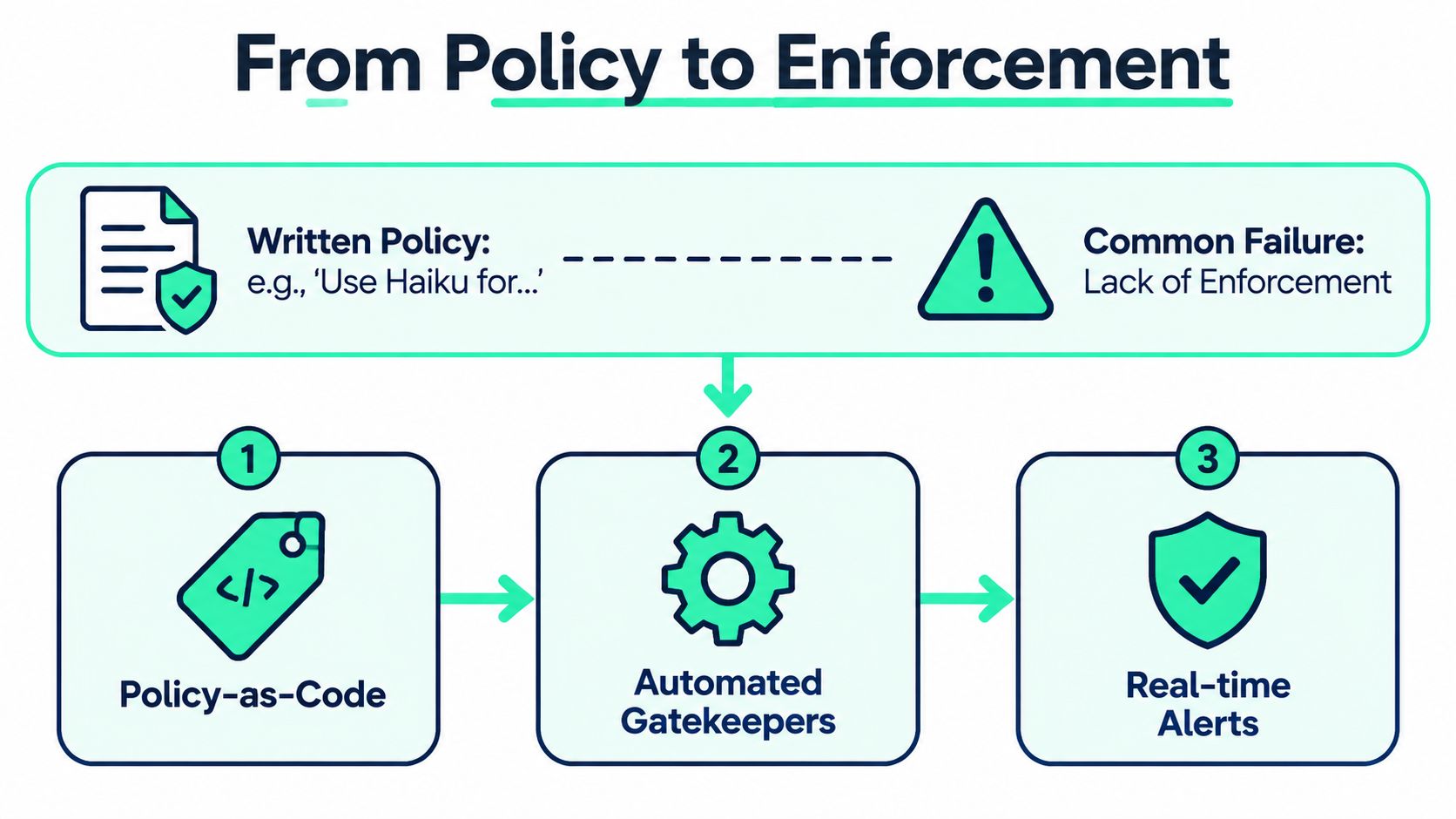
The most persistent failure in AI FinOps is the gap between policy and execution. The 2026 State of AI in FinOps research found that 73% of organizations had AI cost policies, but only 47% fully enforced them, a 26-point execution gap. That gap matters because a policy that lives in a document doesn't change a request already assembled by application code.
“Use Haiku for classification” is not a control unless the routing layer checks the workload type before sending the call. “Stay within the team budget” is not a control unless the gateway can reject, queue, downgrade, or pause traffic when the threshold is reached.
Build enforcement into the request path
A workable stack has several layers:
- Per-team budgets: Assign a monthly allocation to each team and enforce a hard ceiling at the gateway.
- Soft caps: At 80% of the budget, trigger an automatic model downgrade, tighter output limit, or approval workflow.
- Operational alerts: Send threshold events to PagerDuty and Slack while the workload is still running.
- Tag-based chargeback: Attach prompt metadata for team, feature, tenant, environment, and task so finance can allocate spend.
- Policy-aware routing: Read the applicable policy before each call, rather than relying on engineers to remember a model rule.
The verified comparison is stark. Teams with policy-only programs typically save 5% to 8%, while teams with gateway-enforced controls save 22% to 35% on comparable workloads, according to the 2026 AI FinOps reporting on policy execution. Those figures aren't a promise for every architecture. They show why enforcement changes the economics: it prevents the next expensive request instead of explaining the previous one.
The failure mode to avoid is an alert that fires after the invoice. An alert should give an owner time to act, and an automated control should protect the budget when nobody responds. Teams can document escalation paths in their team accountability model, but the request gateway still needs authority to enforce the decision.
Tooling Landscape and Where SpendLens AI Fits
The tooling choice should follow the control problem, not the number of dashboard features. A small team may get useful coverage from application logs. A multi-provider product with several AI features needs consistent attribution, model comparisons, and enforcement mechanisms.
Four practical tiers
Tier 1, in-house logging, uses OpenAI usage endpoints alongside CloudWatch or Datadog. This approach has low direct tooling cost and can establish basic visibility. It often covers only part of the answer because provider data, application metadata, retries, and business outcomes remain disconnected.
Tier 2, open-source proxies, includes tools such as LiteLLM and Portkey. These can add routing, provider abstraction, and basic budgets, but the organization owns operations, upgrades, policy design, and incident response.
Tier 3, observability platforms, includes LangSmith, Helicone, and Arize. They're useful for traces, evaluations, prompt debugging, and latency analysis. Their limitation is that tracing a request isn't the same as forecasting spend, assigning ownership, or enforcing a financial policy.
Tier 4, purpose-built AI FinOps platforms, combines cross-provider cost attribution, prompt and workload analysis, caching signals, routing opportunities, and gateway policy controls. SpendLens AI fits this category for teams that need to connect OpenAI and Anthropic usage to projects, features, workflows, tasks, experiments, or endpoints. Its AI FinOps workflow uses lightweight instrumentation and surfaces spend drivers, cache efficiency, prompt waste signals, and model-switch opportunities.
The candid threshold is organizational rather than technical. Once a team spends more than roughly $5,000 per month across multiple providers, dashboards alone often leave too much manual work between detection and action. A purpose-built platform becomes relevant when the requirement is enforcement and repeatable optimization, not a consolidated view.
A 90 Day Adoption Playbook
A rollout works better when each phase produces an artifact the next phase can use. The following sequence treats AI FinOps as a product and engineering change, not a finance reporting project.
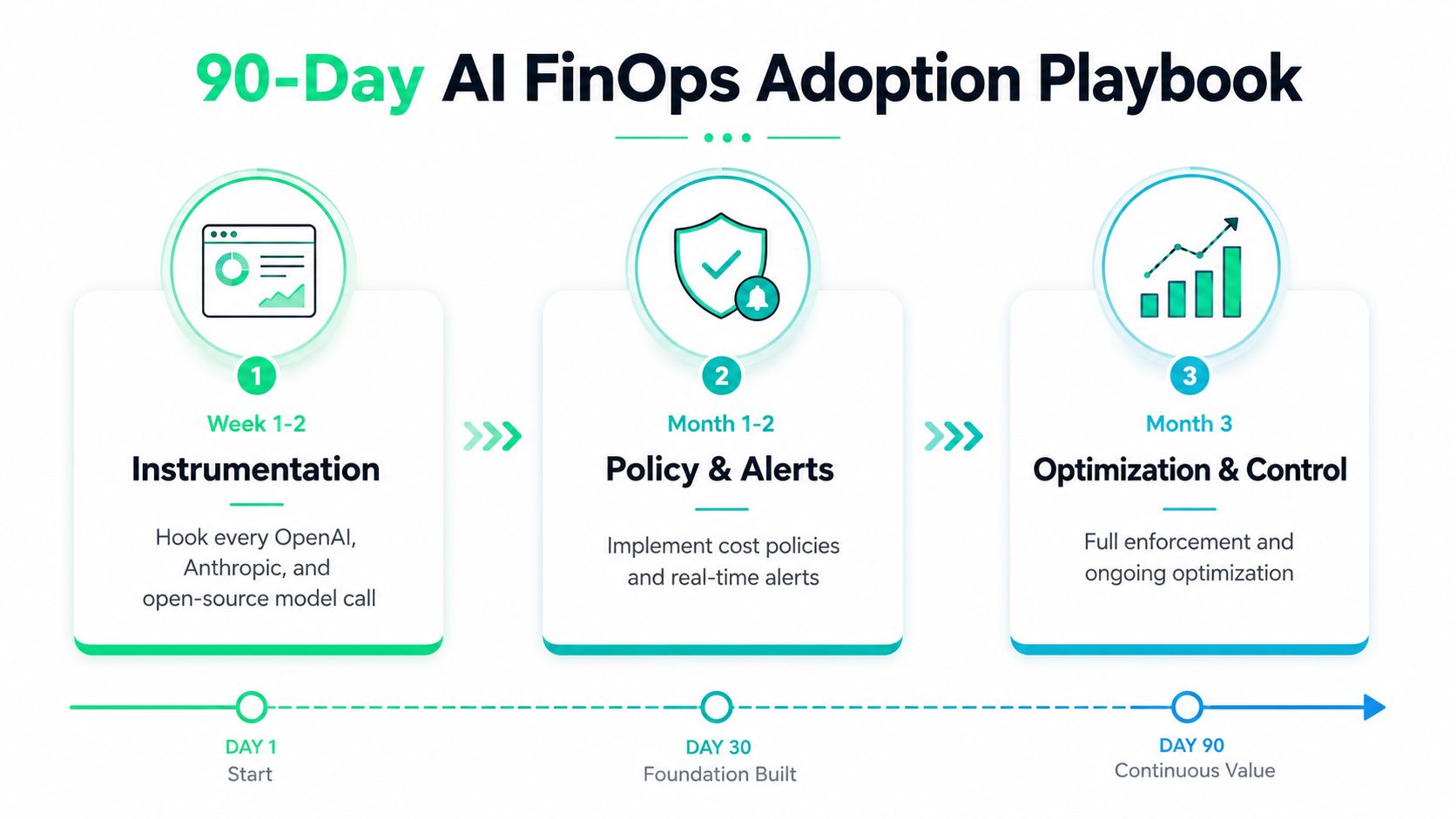
Week 1 establishes the meter
Instrument every OpenAI, Anthropic, and open-source model call through a centralized logging layer. Add tags for feature, tenant, environment, workflow, task, and endpoint. The first deliverable isn't a savings report. It's a baseline showing cost per request, input and output tokens, retry count, latency, and successful task outcome.
Keep prompt content privacy-aware. Metadata and template-level sampling are usually enough to identify repeated context, oversized inputs, and expensive paths.
Week 4 tests routing
Select representative prompts and compare GPT-4o with GPT-4o-mini, then Claude Sonnet with Haiku, using the same task set. Evaluate quality-adjusted cost, not price alone. A cheaper model that creates more retries or human review may be the wrong choice.
A production playbook recommends a sequence of measuring spend per request, routing easy work to cheaper models, caching repeated context, batching non-urgent jobs, and then compressing prompts, as described in this LLM cost optimization playbook. That order prevents teams from compressing prompts before they understand which requests matter.
Week 8 deploys caching
Start with exact-match caching on high-volume endpoints, then test semantic caching where response freshness permits it. Apply provider prompt caching to stable prefixes such as system instructions, RAG context, or tool schemas. Set TTL and invalidation rules before rollout.
Independent guidance reports that stable prompts can cut input token costs by 80% to 90% through caching, while token-efficient prompt design can save 20% to 40% on token spend when implemented well, according to this LLM cost optimization guide. Treat those ranges as workload-dependent opportunities, not guaranteed outcomes.
Week 12 builds the forecast
Project spend by feature team and connect the forecast to the product roadmap. Model expected usage from active users, successful tasks, prompt versions, and model mix. Review forecast variance weekly, then convert validated controls into policy-as-code.
KPIs and a Maturity Checklist to Close With
Healthy AI FinOps programs measure economic outcomes, not just token volume. Five KPIs expose different failure modes:
- Cost per active user reveals whether adoption is increasing faster than unit economics can support.
- Cost per successful task connects inference spend to product value and catches workflows that generate many failed attempts.
- Cache hit ratio shows whether stable context is being reused or paid for repeatedly.
- Model mix ratio identifies how much traffic reaches expensive models versus suitable lower-cost options.
- Budget variance shows whether forecasts remain useful after releases, prompt changes, and traffic shifts.
Use the checklist as a five-minute assessment. A reactive team has provider invoices and manual investigation. A visible team adds centralized attribution. A controlled team enforces routing and budgets. An optimized team ties spend to successful outcomes and revises policies from measured evidence.
| AI FinOps Maturity Checklist | Reactive (Tier 1) | Visible (Tier 2) | Controlled (Tier 3) | Optimized (Tier 4) |
|---|---|---|---|---|
| Instrumentation depth | Provider totals | Feature and team tags | Request-level cost data | Cost tied to successful outcomes |
| Routing automation | Manual model choice | Recommendations | Policy-aware routing | Continuous quality-adjusted routing |
| Governance enforcement | Written guidance | Alerts | Gateway caps and downgrades | Automated controls with ownership |
| Forecast accuracy | Invoice review | Basic trend view | Feature-level projections | Roadmap-linked forecasts and variance review |
The weakest dimension points to the next practical lever. Missing attribution calls for visibility. Excessive frontier-model use calls for routing. Repeated context calls for caching. Budget surprises call for governance.
SpendLens AI helps teams instrument OpenAI and Anthropic workloads, attribute spend by project and feature, identify prompt waste and cache opportunities, and surface model-switch options without replacing standard provider clients. Visit SpendLens AI to turn AI cost visibility into measurable, enforceable control.