
Cost of AI: A Practical Breakdown for Engineering Teams
Understand the true cost of AI across training, inference, data, and operations. Learn how to forecast, attribute, and reduce LLM spend
The most popular advice about the cost of AI is also the least useful: compare the price per million tokens, choose the cheapest capable model, and multiply by expected request volume. That calculation can be directionally helpful, but it won't explain a surprise invoice at 2 AM. Production spend also comes from prompt assembly, retrieval, retries, caching behavior, evaluations, storage, integration work, maintenance, security, and the people who review failures.
A better approach treats every AI feature as a workload with its own unit economics. Measure what each feature sends, which model handles it, how often context repeats, what happens after a failed response, and what business outcome the workflow produces. The result is less glamorous than a provider pricing comparison, but it's the level of detail engineering and finance teams need before they scale.
Table of Contents
- Why the Sticker Price Is Not the Real Cost of AI
- The Five Major Cost Drivers Behind Every AI Bill
- How Provider Pricing Models Actually Work
- Attributing Spend to Workloads and Features
- Proven Strategies to Reduce Inference Costs
- Forecasting AI Spend and Measuring ROI
- Building a Sustainable AI Cost Management Practice
Why the Sticker Price Is Not the Real Cost of AI
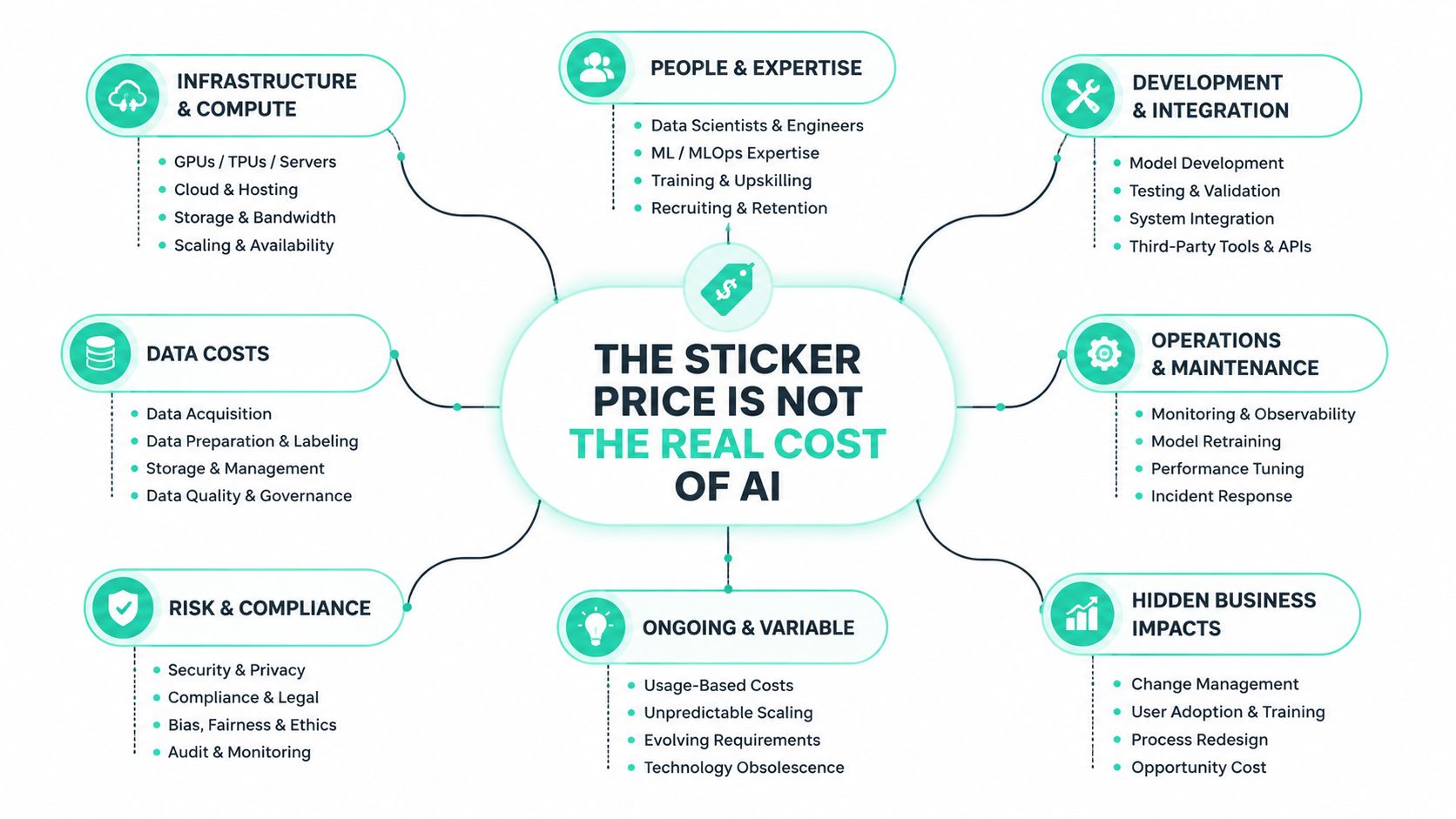
Per-token pricing is a useful input, not a budget. A customer-facing RAG feature may call an embedding model, query a vector database, assemble retrieved context, invoke a language model, retry malformed output, run a safety check, store traces, and send selected cases to a human reviewer. Comparing only the language-model line item can make an architecture look inexpensive while ignoring the services required to make it reliable.
The model call can also become cheaper while the workload becomes more expensive. A longer system prompt, broader retrieval context, verbose completion, or additional evaluation pass changes the bill without changing the number of user-facing requests. SpendLens AI's discussion of invisible AI usage captures the operational problem clearly: teams need to find the activity behind the invoice, not merely read the invoice total.
Count the systems around inference
A production cost review should include at least:
- Model usage: Input tokens, output tokens, embedding calls, retries, and secondary model checks.
- Data infrastructure: Object storage, vector indexes, database capacity, backups, and data transfer.
- Application plumbing: Queues, orchestration, API gateways, feature stores, and workflow state.
- Engineering effort: Prompt changes, evaluation suites, incident response, deployment work, and provider migrations.
- Operational controls: Logging, redaction, access management, security reviews, compliance work, and human escalation.
The hidden-cost problem is material. Recent coverage estimates that data preparation can consume 15–25% of an AI budget, while annual maintenance can add 10–30% to initial development costs. Those figures come from Dan Cumberland Labs' analysis of hidden AI project costs, and they point to a common forecasting failure: teams approve the API estimate before they price the work needed to keep the feature accurate and safe.
A workload view beats a provider view
The right question isn't “Which provider has the lowest token rate?” It's “What does one successful outcome cost for this feature?” For a support assistant, that might mean cost per resolved ticket. For document extraction, it could be cost per accepted record. For an internal coding tool, it may be cost per completed task that passes review.
Practical rule: If a team can't assign spend to a feature, workflow, or outcome, it can't reliably decide whether that feature is economical.
Stanford HAI's AI Index, using data from Epoch AI and Artificial Analysis, documented a sharp historical change in model economics. The cost of querying a model at roughly GPT-3.5-equivalent performance on the MMLU benchmark fell from about $20.00 per million tokens in late 2022 to about $0.07 by late 2024, an approximate 280-fold decline in about two years. The AI training and inference cost reference shows why a fixed long-term price assumption is dangerous. Model capability alone doesn't determine spend. Hardware, algorithmic efficiency, and competition can reshape the price-performance trade-off quickly.
The Five Major Cost Drivers Behind Every AI Bill
Every production AI bill has a different shape, but five categories account for most of the decision-making. The important distinction is between direct consumption and the infrastructure or labor that makes consumption useful.
1. Training and fine-tuning compute
Training a foundation model is a specialized undertaking, but product teams still incur compute costs through fine-tuning, evaluation runs, embeddings, indexing, and repeated experiments. A team that changes a retrieval pipeline may regenerate embeddings and rebuild indexes. A team tuning a classifier may run multiple experiments before it has a model worth deploying.
Training spend is often episodic, which makes it easy to misclassify as a one-off. Track it by experiment, dataset version, and owner. Otherwise, an exploratory run can disappear inside a shared machine-learning project while production teams inherit the resulting storage and serving obligations.
2. Inference at scale
Inference is the most visible category because providers expose token usage directly. It still requires workload-level analysis. Epoch AI reported that LLM inference prices have fallen at rates ranging from roughly 9x to 900x per year, depending on the performance milestone measured. The Epoch AI research paper shows why a single market-average assumption isn't enough. Cheaper, high-throughput tasks can experience a different price curve from demanding reasoning workloads.
Input and output mix matters too. Input tokens are typically cheaper, while output tokens can cost 3-5x more per token. The LLM inference cost optimization guidance explains why a verbose completion or oversized system prompt can dominate a request even when request volume stays constant.
3. Storage and retrieval infrastructure
RAG systems add retrieval steps before generation. Embedding creation, vector search, metadata filtering, index replication, backups, and data transfer all affect the workload cost. A lower model price won't compensate for a retrieval design that sends excessive context or keeps oversized indexes running without an owner.
Classify retrieval operations separately from answer generation. That separation tells you whether the problem is an expensive database tier, unnecessary re-indexing, poor chunk selection, or prompt bloat.
4. Tooling and middleware
Gateways, observability platforms, evaluation pipelines, guardrails, queues, and orchestration services create a second layer of AI consumption. A response may pass through a classifier, a policy checker, and a formatting validator before it reaches a user. Each component needs its own token and latency record.
For a practical explanation of the serving layer and its economics, see what LLM inference means in production. The key lesson is simple: middleware isn't free just because it doesn't appear on the model provider's invoice.
5. Human operations
Human review enters the system when confidence is low, policy risk is high, or the model output affects a consequential decision. Review queues, annotation, prompt maintenance, incident investigation, and compliance approvals create recurring labor. These costs often sit in product or operations budgets rather than cloud billing, so finance needs a shared allocation model.
| Cost Category | Example Monthly Spend | % of Total | Common Hidden Multipliers |
|---|---|---|---|
| Training and fine-tuning compute | Workload-dependent | Not comparable without internal data | Repeated experiments, re-indexing, idle capacity |
| Inference at scale | Workload-dependent | Not comparable without internal data | Output length, retries, premium model use |
| Storage and retrieval | Workload-dependent | Not comparable without internal data | Large indexes, replication, data transfer |
| Tooling and middleware | Workload-dependent | Not comparable without internal data | Evaluations, guardrails, observability |
| Human-in-the-loop operations | Workload-dependent | Not comparable without internal data | Review queues, labeling, compliance, support |
Use the table as an audit checklist, not as a generic percentage split. Your own traces should determine which category is consuming money.
How Provider Pricing Models Actually Work
Provider pricing looks simple until traffic meets production behavior. The main models are per-token usage, batch processing, provisioned throughput, and reserved capacity. Each favors a different workload shape.
Per-token pricing works well when demand is variable and latency matters. It gives a team flexibility, but it exposes the budget to prompt growth, completion growth, retries, and model changes. Input and output aren't usually priced symmetrically, so a request with a small user message can still be expensive if the application returns a long answer.
Batch APIs trade latency for lower unit cost where a provider offers that option. They fit offline summarization, indexing, evaluation, and data enrichment better than interactive chat. The financial benefit disappears if the product requires immediate responses or if batching creates duplicate processing and operational complexity.
Provisioned throughput and reserved capacity exchange flexibility for predictability. They can make sense for a steady, high-volume workload with a stable model and clear capacity requirements. They can work poorly for experimental traffic, seasonal demand, or a team still changing prompts and routing rules.
Match the pricing model to the workload
| Provider | Pricing Model | High-Volume Classification (per 1K req) | Complex Reasoning (per 1K req) | Embedding Retrieval (per 1K req) | Best Fit Workload |
|---|---|---|---|---|---|
| OpenAI | Usage-based API, batch options where available | Requires measured token and model mix | Requires measured token and model mix | Requires embedding and retrieval measurements | Product teams needing broad model access |
| Anthropic | Usage-based API, caching for repeated context | Requires measured token and model mix | Requires measured token and model mix | Requires embedding and retrieval measurements | Long-context and reasoning workflows |
| Usage-based API and managed cloud options | Requires measured token and model mix | Requires measured token and model mix | Requires embedding and retrieval measurements | Teams already operating in Google Cloud | |
| AWS Bedrock | Managed access to multiple providers | Requires model-specific measurements | Requires model-specific measurements | Requires model-specific measurements | Organizations centralizing cloud governance |
| Open-source self-hosted | Infrastructure and operations based | Requires hardware and utilization measurements | Requires hardware and utilization measurements | Requires embedding and retrieval measurements | Stable workloads with operational capacity |
The table deliberately avoids fake cross-provider prices. Effective cost per request depends on token counts, output length, caching, retries, hardware utilization, and the exact model. A provider comparison without those variables is a marketing artifact, not a forecast.
The context window is a budget variable
Long prompts can produce a silent spend shock. One independent guide states that processing a 128K-token context can cost roughly 64 times more than an 8K context, reinforcing the need for prompt trimming and routing decisions. The inference optimization guide covering caching, batching, and routing provides the relevant context for that comparison.
Before selecting a provider, replay representative requests and record input tokens, output tokens, latency, cache behavior, and quality. A cheaper model that needs longer prompts or produces more retries may cost more at the workflow level.
Attributing Spend to Workloads and Features
A provider invoice answers “how much?” It rarely answers “which customer-facing feature caused it?” That gap makes cost control reactive. By the time finance notices a change, the prompt, model, or traffic pattern may have changed several times.
Start at the gateway or shared client layer, where every call already passes. Add metadata before the request leaves your service:
- Name the workload: Use values such as
support_chat,document_extract,rag_answer,eval_run, orindexing. - Identify the product surface: Record the feature, endpoint, team, project, and environment.
- Capture tenancy carefully: Attach a customer tier or internal tenant identifier where permitted, using privacy-aware identifiers.
- Record model and provider: Store the selected model, fallback model, token counts, latency, status, and retry count.
- Connect usage to outcomes: Link the request to a ticket, transaction, accepted extraction, or other business event.
Instrument once, allocate many ways
Tools such as LiteLLM, Helicone, and custom OpenTelemetry spans can capture request metadata, token usage, latency, and model identifiers. The tool matters less than the taxonomy. If one service labels a request chat and another labels the same workflow assistant-prod, product reporting will fragment.
A durable schema separates dimensions from values:
- Feature: The user-visible capability.
- Workflow: The technical operation, such as retrieval or summarization.
- Task: The action being performed.
- Environment: Development, staging, production, or evaluation.
- Owner: Team or cost center.
- Outcome: Success, fallback, human review, or failure.
Cost allocation methods for AI workloads can help teams formalize those dimensions. Keep raw events detailed enough for debugging, then aggregate them into dashboards that product managers can understand.
Instrumentation rule: Never make engineers reconstruct a feature's cost from a monthly invoice. Attach attribution when the call is created.
Caching introduces an allocation wrinkle. A shared cached prefix may serve multiple features, while a cache hit can reduce provider charges without eliminating application work. Allocate shared context by a declared policy, such as proportional token use or owning service, and document that policy. Otherwise, caching can improve the invoice while making chargeback less trustworthy.
Proven Strategies to Reduce Inference Costs
The most reliable savings come from changing the request path, not blindly selecting the lowest-priced model. Start by finding workloads with repetitive context, unnecessary output, or a quality requirement that doesn't justify a premium endpoint.
Reduce repeated work first
Prompt caching is effective when the prefix stays stable. AWS explains that cached tokens are billed at a reduced rate, while the billing formula can account for standard input tokens, cache hits, cache writes, and cache storage duration. The AWS guidance on generative AI cost optimization also makes the trade-off clear: cache writes may cost more than uncached input for some models, so reuse frequency determines the break-even point.
A published example shows 400M daily cached-read tokens dropping from $2,000 to $200, while total input cost falls from $2,470 to $725 when caching is used. The context management and caching example demonstrates the scale possible for repeated system prompts and shared context. Don't enable caching without measuring hit rates, prefix stability, and write overhead.
Semantic caching can also deduplicate near-identical requests, but it requires careful invalidation. It works for stable knowledge queries and repeated support questions. It works poorly where answers depend on permissions, rapidly changing records, or subtle user context.
Route by task difficulty
Send deterministic classification, extraction, and formatting tasks to smaller models when they meet the quality bar. Reserve more capable models for reasoning tasks that need them. Evaluate routing on real examples, including fallback frequency and human correction, rather than relying only on public benchmarks.
Trim the request and constrain the answer
Remove repeated instructions, unused retrieved passages, stale conversation history, and verbose few-shot examples. Then cap output length and use structured outputs where the product doesn't need prose. Because output can cost 3-5x more per token than input, a concise valid response can move the bill more than reducing short user prompts. See practical methods for calculating cost savings before prioritizing an optimization.
| Strategy | Expected Savings | Implementation Effort | Quality Trade-off |
|---|---|---|---|
| Prompt caching | Workload-dependent, potentially substantial for repeated context | Moderate | Requires stable prefixes and cache validation |
| Model routing | Workload-dependent | Moderate to high | Smaller models may need fallback paths |
| Prompt trimming | Workload-dependent | Low to moderate | Removing context can reduce answer quality |
| Batching and async scheduling | Provider- and workload-dependent | Moderate | Adds latency and queue management |
| Output constraints | Workload-dependent | Low | Overly strict limits can truncate valid results |
Treat savings as an observed result, not a promised range. Run an offline evaluation, canary the change, and compare cost per accepted outcome.
Forecasting AI Spend and Measuring ROI
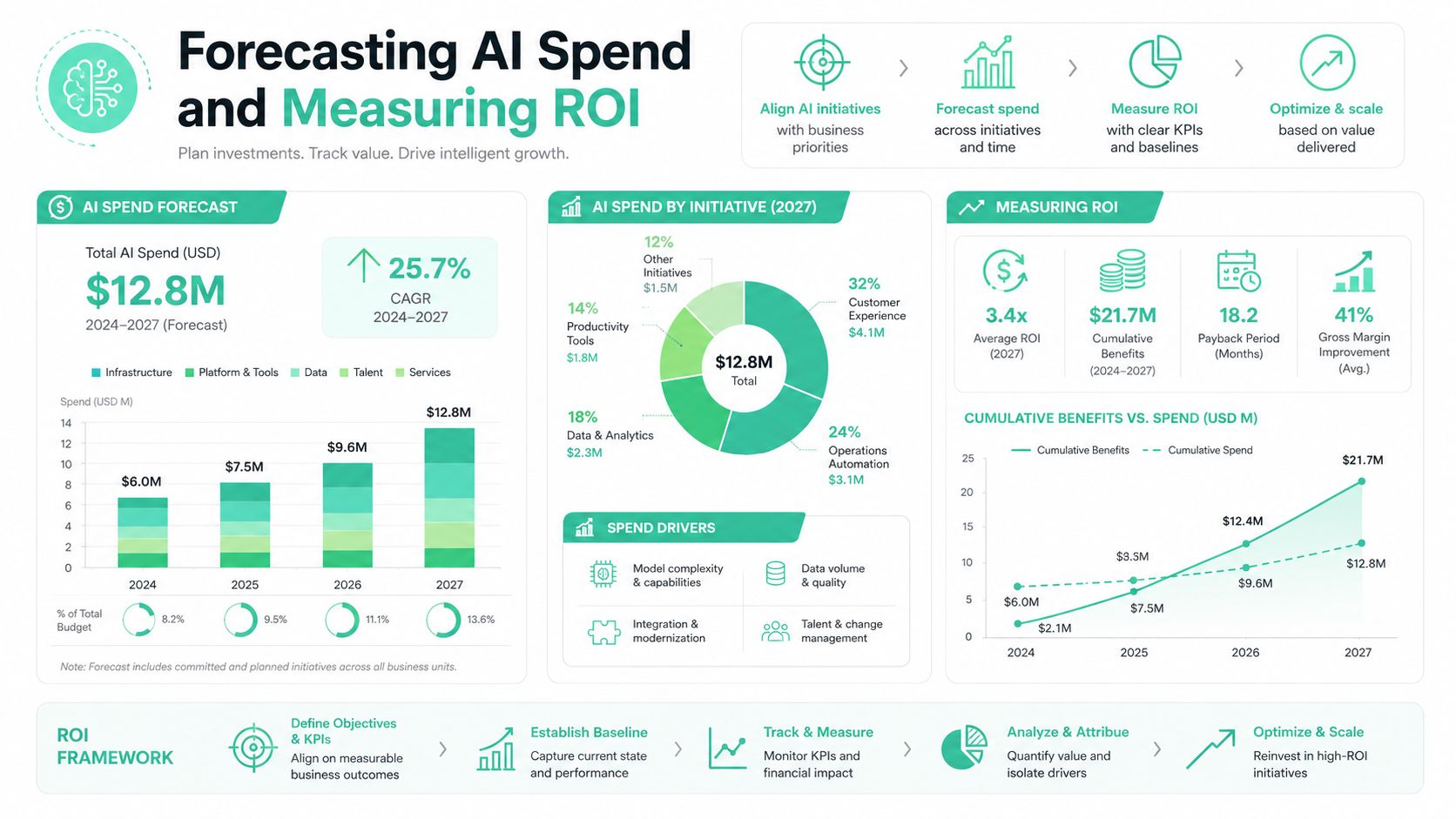
A useful forecast starts with a unit, not a monthly total. Choose cost per active user, cost per transaction, cost per completed workflow, or cost per accepted result. Then express spend as a function of active users, requests per session, tokens per request, model mix, cache behavior, retries, and supporting infrastructure.
Build the dashboard around measured distributions rather than averages alone. A small number of long-context requests can distort a mean, while a fallback model can change the cost of a supposedly simple feature. Track p50 and tail behavior for tokens and latency, then connect those values to the release that changed them.
Stress-test the variables
Create scenarios for:
- Traffic growth: More users or more interactions per session.
- Prompt growth: Larger retrieved context, longer conversation history, or new system instructions.
- Model mix: A higher share of premium calls or a new fallback path.
- Reliability behavior: Increased retries, validation failures, or human escalations.
- Provider changes: New rates, packaging, cache terms, or capacity commitments.
Recent reporting says AI-native spending grew 108% year over year in 2025, while 85% of companies miss AI forecasts by more than 10%. Those figures are reported in coverage of AI's real cost in 2026. Whether or not those market-level figures match your company, they illustrate why static extrapolation is fragile.
Connect spend to an outcome
A support assistant's ROI isn't the number of generated messages. It's the relationship between AI cost and resolved work, quality-adjusted deflection, or reduced handling effort. A document workflow needs accepted records, not merely completed generations. A developer tool needs useful code changes, not token volume.
Set alerts when cost per outcome rises, even if total spend stays flat. A growing product can tolerate a larger bill when unit economics improve. Conversely, a flat bill can hide deterioration if quality declines or human review increases.
The following video offers another perspective on the relationship between AI investment and business value.
Building a Sustainable AI Cost Management Practice
A mid-stage SaaS team ships a summarization feature and sees its AI bill triple. The first reaction is usually to blame the provider or switch models. That response often fails because the underlying change is hidden in prompt length, retrieval volume, retry behavior, or a new evaluation path.
The team regains control by treating cost like an engineering signal. It adds per-feature token tracking, separates customer traffic from internal tests, and attaches model, workflow, endpoint, and environment metadata to every request. It then adds anomaly alerts and makes cost checks part of release review, so a prompt change can't alter production economics.
Fix the largest driver in sequence
The team tests a semantic cache on repeated queries, validates that permissions and freshness remain correct, and measures cache hits by endpoint. It benchmarks smaller models on simple tasks, keeping escalation for cases that fail the quality threshold. It also reviews reserved or provisioned capacity only after traffic is stable enough to justify reduced flexibility.
This sequence matters. A reserved commitment won't fix wasted context. A model migration won't fix unallocated evaluation traffic. A cache won't solve a workflow that generates unnecessarily long answers.
Sustainable practice: Treat AI cost like latency or error rate. Give it an owner, a dashboard, an alert, and a review loop.
For the first 30 days, make the work concrete:
- Tag every workload: Include feature, workflow, environment, owner, model, and outcome.
- Set anomaly alerts: Flag sudden changes in token volume, model mix, retries, and cost per outcome.
- Benchmark one optimization: Choose caching, routing, prompt trimming, batching, or output constraints.
- Review monthly: Bring engineering, finance, and product stakeholders to the same cost and quality report.
- Document trade-offs: Record what improved spend, what changed quality, and where the team still lacks evidence.
Sustainable cost management isn't a one-time audit. Providers change pricing, prompts evolve, traffic shifts, and new features create new allocation problems. Teams that keep workload attribution close to the request path can respond before an invoice becomes an incident.
SpendLens AI helps engineering teams monitor LLM spend across OpenAI and Anthropic workloads, attribute calls to features and workflows, surface cache efficiency and prompt waste, and identify model-switch opportunities without placing a proxy in the request path. Visit SpendLens AI to connect AI usage to the engineering decisions and business outcomes that determine your real cost of AI.