
LLM Cost Optimization: A Practical Engineering Playbook
Cut LLM API spend with this practical llm cost optimization guide covering instrumentation, caching, model switching, and FinOps workflows.
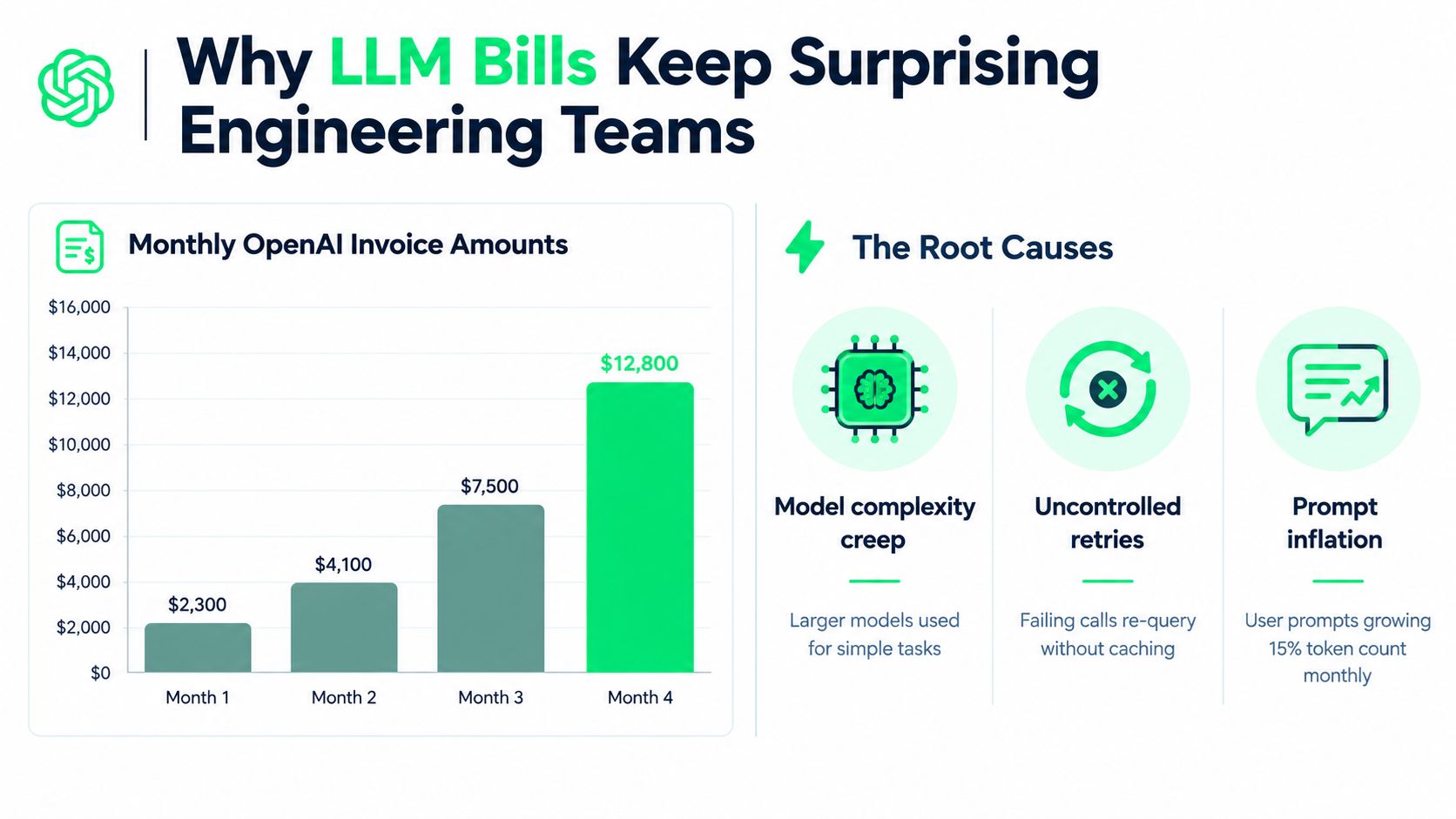
You open the monthly OpenAI invoice expecting normal usage and find a number that doesn't match the product dashboard. User growth looks flat, yet spend has climbed because retries aren't tracked, a prompt template became more verbose, and an agent now carries its entire conversation history into every tool call. The bill reflects every engineering shortcut, including the ones no dashboard owner intended to create.
LLM cost optimization works best when treated as a continuous engineering loop. Platform teams need reliable attribution, FinOps needs chargeback data, and product owners need to see what each feature costs per successful outcome. The practical question isn't how many tokens the system used. It's which model processed them, whether the input was cacheable, how much output was generated, why the request ran, and whether the resulting task succeeded.
Table of Contents
- Why LLM Bills Keep Surprising Engineering Teams
- Instrumenting Spend With Tagging and Attribution
- Cutting Token Waste Through Prompt Engineering and Caching
- Choosing the Right Model for Each Workload
- Running Automated Experiments That Prove Savings
- Monitoring, Governance, and Closing the FinOps Loop
Why LLM Bills Keep Surprising Engineering Teams
A platform team can spend a morning investigating a sudden invoice increase and still miss the cause. The user count may be stable, but an agent can make more calls per session, a rate-limit handler can retry failed requests, and a batch job can process the same stale dataset again. A prompt change that adds instructions or retrieved documents affects every call immediately, even when the application release contains no obvious billing change.
The historical economics make this harder to reason about. The Stanford HAI 2025 AI Index cost summary reports that inference cost for a GPT-3.5-level system dropped more than 280-fold between November 2022 and October 2024. That shift means yesterday's architecture may no longer be economical, while today's apparently cheap workload can still waste money through poor routing, excessive context, or failed calls.
Why token counts aren't a complete cost signal
Token volume is useful, but it doesn't explain the invoice by itself. The same input volume can produce very different spend depending on model tier, output ratio, context length, provider pricing, cache eligibility, hardware, and routing behavior. A long static system prompt may be expensive when repeatedly prefetched, but far cheaper when a provider recognizes it as a reusable prefix.
Production failure modes usually sit outside a basic token counter:
- Retries: A timeout or rate-limit response can trigger repeated calls, sometimes before the first request's outcome is known.
- Prompt regressions: A template can accumulate examples, instructions, and retrieved context without a review that considers recurring token spend.
- Agent expansion: Multi-turn workflows add prior messages, tool schemas, and intermediate results to later requests.
- Batch duplication: A job can rerun stale work when checkpoints, idempotency keys, or dataset versions aren't enforced.
- Routing drift: A feature can move routine requests onto a premium model because a fallback rule became too broad.
Practical rule: Treat every LLM call like a billable production operation, with an owner, a purpose, a retry count, a model decision, and a measurable business result.
The right response isn't a one-time model swap. Build a loop that captures spend, attributes it to teams and features, tests lower-cost alternatives, and blocks regressions before they reach the invoice. The cost of AI analysis is useful context for explaining why visibility must connect technical usage with financial accountability.
Instrumenting Spend With Tagging and Attribution
FinOps can't charge back an opaque provider invoice. Engineering needs to attach business context to every request before aggregation, not attempt to reconstruct ownership from raw logs after the billing period closes.
A wrapper around each provider SDK call is a reliable starting point. The wrapper should record the provider response, calculate or retrieve usage, and emit one structured event for the logical request. A decorator works well in Python, while middleware or a client factory can provide the same control in other stacks.
Use stable attributes that answer financial questions
Capture attributes that let a finance or product owner move from a total to a responsible workload:
- Ownership:
team,cost_center,product,tenant_id, andenvironment. - Execution context:
provider,model,endpoint,feature_flag,prompt_version, andprompt_template_hash. - Request identity:
request_id,trace_id,session_id, and an idempotency key where supported. - Usage detail: input tokens, output tokens, cached reads, cache writes, latency, status, and retry count.
- Outcome: task type, completion status, fallback reason, and the business unit completed, such as a resolved ticket or extracted document.
Send the same event to logs and a metrics or tracing backend such as OpenTelemetry. Logs preserve request-level evidence, while metrics support dashboards for spend by model, feature, tenant, and experiment cohort. Standard names matter. If one service calls a field prompt_hash and another calls it template_id, cross-service chargeback becomes a manual mapping exercise.
Prevent attribution errors before they become financial disputes
Retries deserve a separate logical relationship to the original request. Record each provider attempt, but roll up the parent request so the dashboard can distinguish productive usage from retry waste. Streaming and batch calls also need separate event types or explicit mode fields, because their completion and token reporting behavior differs.
Cached usage mustn't disappear inside total input tokens. Tag cache reads and cache creation separately, then calculate cache-hit rate and spend by workload. This lets a FinOps reviewer see whether a prompt change increased reusable context or fragmented it.
A practical reporting design should expose daily spend, monthly forecast, cost per feature flag, cost per successful task, and the top model and tenant contributors. The best practices for reporting should be applied as a data-contract problem, not just a dashboard exercise. If services emit inconsistent dimensions, executives may receive precise-looking totals that no engineering team can reproduce.
Cutting Token Waste Through Prompt Engineering and Caching
A prompt template can add thousands of repeated input tokens to every request, while an unstable prefix prevents the provider from reusing work. Review prompt design and caching together because both affect the same bill. Prompt reductions lower input consumption directly. Stable prefixes make repeated instructions eligible for provider-side reuse.
A 2025 empirical study published in IJMADA found that keyword-based prompts reduced AI business costs by 16.7% while maintaining comparable response quality, with a significant difference in token consumption at p < .001. Quality movement was marginal, including ΔBERTScore of -0.005 and ΔROUGE-L of -0.019. The prompt engineering study supports testing focused prompts against verbose templates instead of assuming that shorter instructions reduce quality.
Start with provider-native prefix reuse
Prefix caching suits system prompts, tool schemas, policy instructions, and stable retrieved context. An independent benchmark across four models reported API cost reductions ranging from 45% to 80% and time-to-first-token improvements from 13% to 31% with caching enabled. It also reported model-specific savings of 79%–81% for GPT-5.2, 78%–79% for Claude Sonnet 4.5, 46%–48% for GPT-4o, and 28%–41% for Gemini 2.5 Pro, as documented in the independent prompt-caching benchmark.
Request volume does not create cache savings by itself. Keep static instructions at the front, place dynamic user content afterward, and watch for cache fragmentation after each template change. OpenAI applies cached pricing after a 1,024-token prefix threshold and bills cached tokens at 50% of the normal input rate. Anthropic uses cache-control breakpoints, bills cache reads at 10% of normal input price, and charges cache writes at 1.25x normal input price. These rules are summarized in the prompt caching cost comparison.
Add semantic caching only where correctness permits
Application-level semantic caching can reduce repeated work when equivalent questions receive answers that remain valid. It also creates more invalidation risk than static prefix caching. A similar query may become incorrect after a document, permission, or tenant-specific fact changes. Use tenant-isolated keys, data-versioned cache keys, expiry rules, and a fallback when similarity confidence is weak.
Project Discovery reported a cache-hit rate increase from 7% to 84% and an overall LLM cost reduction of 59%, with later periods reaching 66% and 70% savings as the implementation matured, according to its prompt-caching production write-up. The operational requirement is clear: instrument reusable prefixes, keep them stable, and measure cache reads beside spend.
| Technique | Typical savings | Risk profile |
|---|---|---|
| Provider-native prefix caching | 45%–80% in a neutral benchmark | Low to medium, provided prefixes remain stable |
| Keyword-focused prompt design | 16.7% in an empirical study | Medium, because omitted context can affect task quality |
| Semantic response caching | Workload-dependent, with independent evidence describing 41%–80% API cost reductions (ICML evidence) | High, due to staleness, collisions, and permission errors |
| Prompt compression | Qualitative until measured on your workload | Medium to high, especially for complex instructions |
Track cost per successful task, not only cost per request. A cache that returns stale or low-quality output can trigger fallbacks, support work, or reprocessing that erases the apparent saving. The token cost optimization guide offers a useful framing, while production teams still need workload-specific experiments, FinOps review, and reversible changes. Tie each prompt or cache change to the bill outcome it was meant to produce.
Choosing the Right Model for Each Workload
A single premium model is easy to operate, but it assigns the same compute budget to classification, extraction, generation, and difficult reasoning. A tiered policy starts with the smallest model that meets the quality requirement, then escalates only when an observable gate fails.
| Workload Tier | Example Models | Input Cost / 1M tokens | Quality Gate Trigger | Typical Share of Traffic |
|---|---|---|---|---|
| Classification | Smaller provider or hosted open-source model | Provider-dependent | Low confidence or ambiguous label | Workload-dependent |
| Extraction | Mini or fast model with structured output | Provider-dependent | Schema failure or missing fields | Workload-dependent |
| Retrieval and routine generation | GPT-4o-mini, Gemini fast tier, Claude Haiku class | Provider-dependent | Retrieval confidence or evaluator failure | Workload-dependent |
| Complex reasoning | Claude Sonnet class or frontier model | Provider-dependent | High-stakes task, failed evaluator, or escalation policy | Workload-dependent |
The table intentionally avoids a universal price card. Providers change rates, batch terms, caching treatment, and structured-output economics, so routing decisions should use the rates attached to your account and the actual usage event.
Route by capability, then verify quality
For a RAG assistant, a lightweight classifier can identify routine retrieval questions and route them to GPT-4o-mini. If retrieval confidence falls below the team's threshold, or a response evaluator detects a citation or schema problem, the request can escalate to Claude Sonnet. The cheap-tier request should still be measured even when escalation occurs, because the total cost includes both attempts.
OpenAI, Anthropic, Google, and open-source hosts expose different operational trade-offs. Anthropic prompt caching can favor long repeated instructions, Google batch APIs can suit non-interactive enrichment, and OpenAI structured outputs may change the economics of extraction depending on the chosen model and response shape. Self-hosted or optimized deployment can also be cheaper for the right workload. An analyst paper estimates up to 2.6x better cost-effectiveness versus IaaS and up to 4.1x versus GPT-4o API, while quantization, batching, and compilation can reduce per-token cost by roughly 40% to 70% in production-like settings, according to this on-premises inference analysis.
Routing rule: Never escalate because a request feels difficult. Escalate because a measurable quality gate failed or the task meets a documented risk policy.
The AI model cost comparison can help structure provider comparisons, but your own golden set determines whether a cheaper model is acceptable. Cache hits on the lower-cost tier can amplify savings, while poor routing can increase spend by paying for both the initial attempt and the fallback.
Running Automated Experiments That Prove Savings
A cheaper model or shorter prompt isn't a win until it preserves the outcome the business pays for. Raw token reduction can become a vanity metric if task completion falls, users ask for retries, or support agents spend longer correcting generated work.
Build a shadow-mode harness
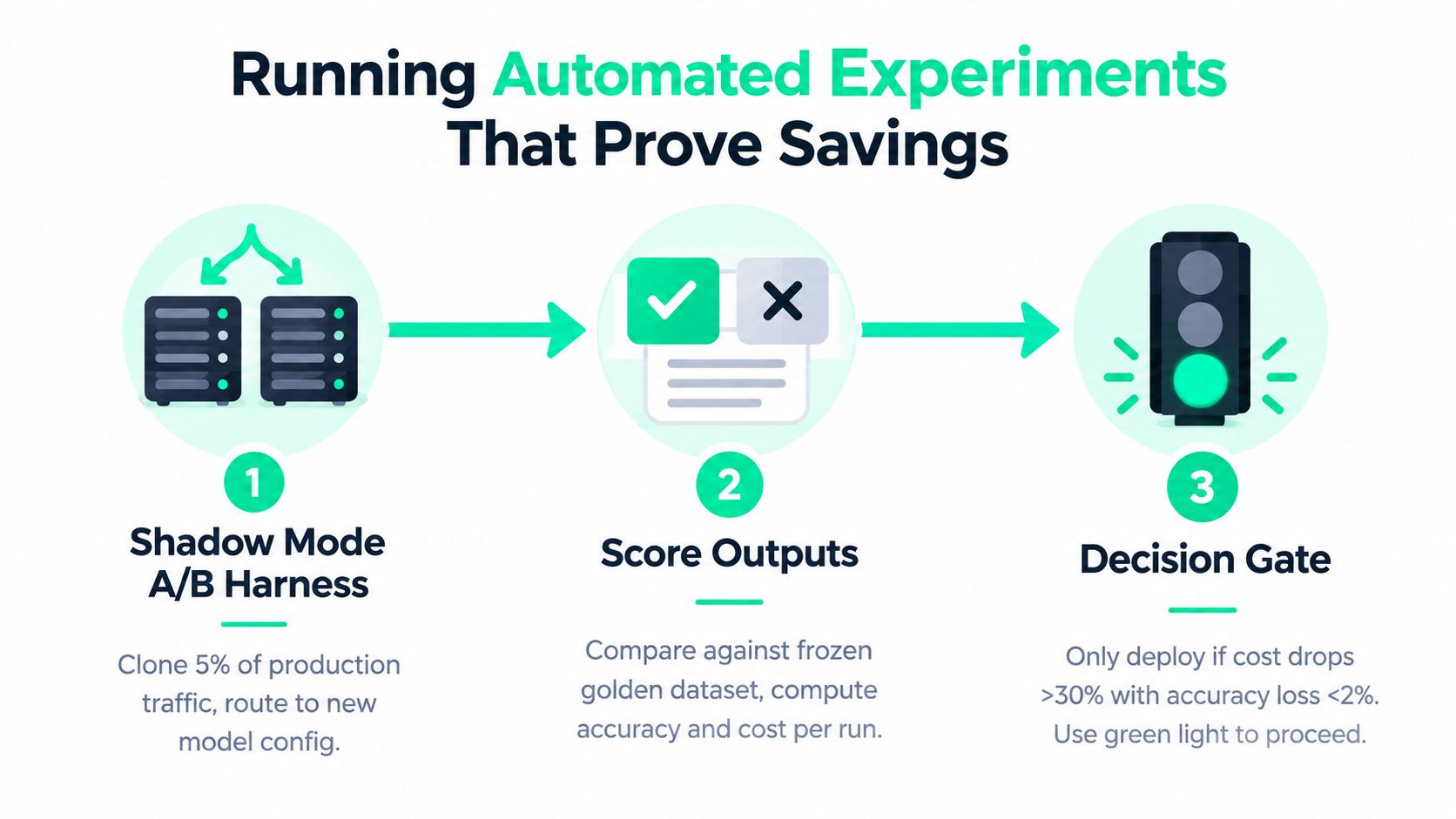
Clone a controlled slice of production traffic into a candidate configuration while the live response continues to serve users. The experiment can compare a prompt rewrite plus Mini-tier routing with the current baseline without exposing every customer to an unverified change.
Log these fields for both paths:
- Task completion: Did the workflow produce an accepted result?
- Quality: Did the output pass the frozen golden set or evaluator?
- Reliability: Did the request require a retry or frontier fallback?
- Latency: Track p95 latency and time-to-first-token where relevant.
- Economics: Calculate dollars per successful task, not merely dollars per request.
Keep the golden set frozen during the experiment. If the evaluation data changes midway, the team can't tell whether the candidate improved or the test moved.
Put rollback in the experiment itself
A two-week comparison can produce a defensible 31% bill reduction when the candidate combines prompt restructuring with Mini-tier routing and maintains the agreed quality guardrails. That result is only useful when the team records the baseline, candidate configuration, traffic assignment, successful-task denominator, and any fallback spend in the same report.
Use a kill switch for quality regressions, define a statistical significance threshold before reading the result, and roll back automatically when cost per success rises. The traffic split should be large enough to expose real edge cases but controlled enough to cap financial risk. The exact allocation belongs in the service's risk policy, while the experiment should preserve a clear comparison between baseline and candidate.
A continuous harness matters because provider pricing, model behavior, prompt templates, and traffic mix change. Run candidate evaluations after releases and prompt edits, not only during quarterly cost reviews. The experiment log becomes the evidence FinOps needs to approve a change and the evidence engineering needs to reverse it.
Monitoring, Governance, and Closing the FinOps Loop
Optimization becomes durable when financial review and deployment practice use the same events. Engineering sees latency, retries, cache reads, and fallbacks. Finance sees spend, ownership, forecast, and budget. Product sees cost per successful outcome. A shared telemetry contract connects those views without forcing every team to maintain a separate spreadsheet.
Open the same dashboards every day
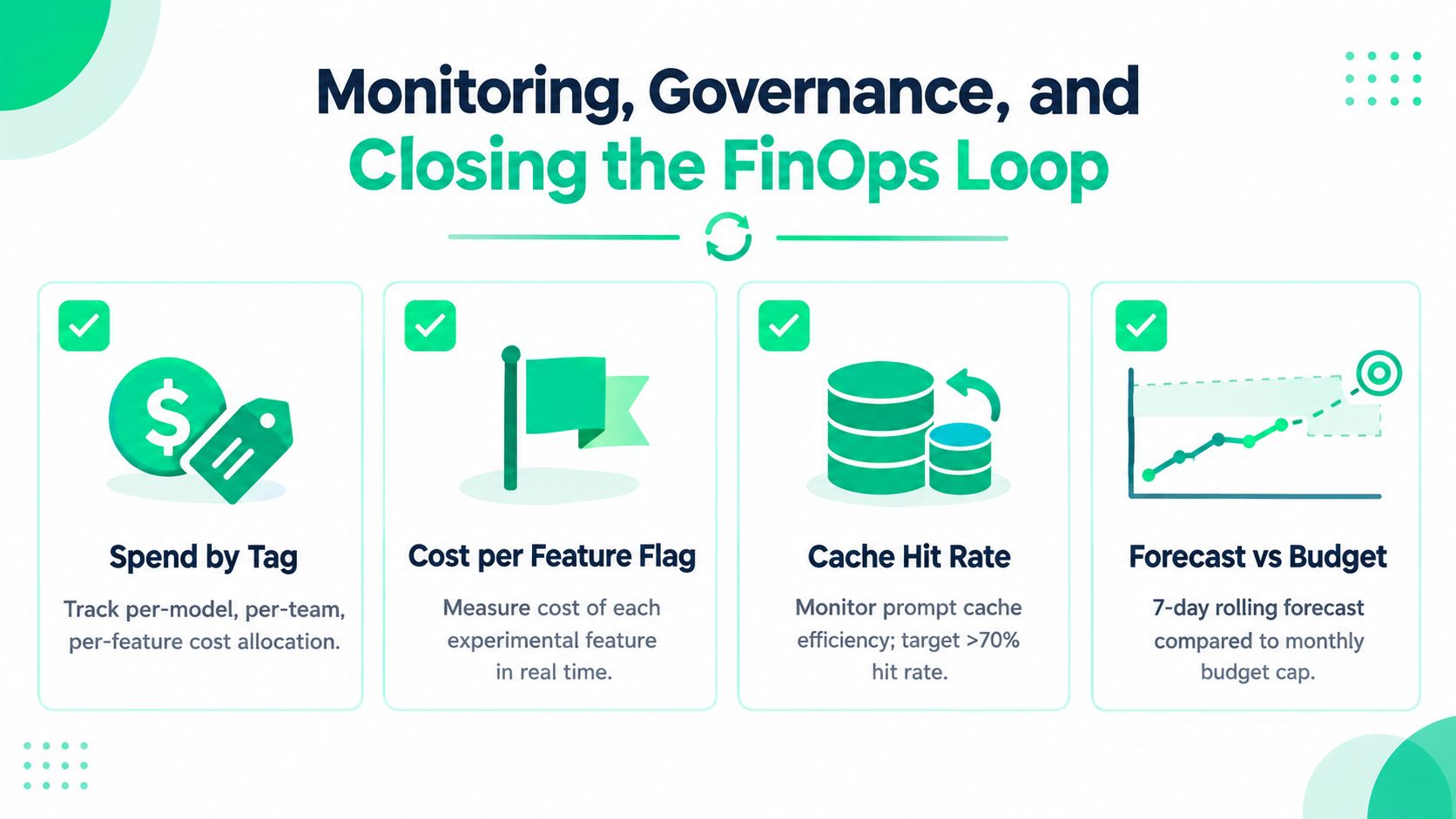
The daily dashboard should answer four questions quickly:
- Spend by tag: Which provider, model, team, feature, tenant, and environment generated the bill?
- Cost per feature flag: Did a new AI feature increase spend before adoption or revenue justified it?
- Cache hit rate: Is reusable context being served from cache, and did a prompt edit break the prefix?
- Forecast versus budget: Is the current run rate likely to exceed the approved monthly cap?
Use alerts as operating controls, not notifications that everyone ignores. A team may configure an alert at 50% of the monthly cap by day 15, then route tenant-level anomalies to the responsible product owner in Slack. The threshold is a governance choice, but the alert must include the tag, model, prompt version, retry pattern, and recent deployment that could explain the change.
Put cost checks into the delivery path
A pull request that raises baseline spend should trigger the same scrutiny as one that increases latency or error rate. Require a cost review for prompt-template changes, model changes, routing rules, new agent tools, and context-window expansion. Enforce model allowlists in the routing layer so an accidental premium-model default can't spread across every tenant.
Keep an exception process for high-value launches. The reviewer should record why the higher cost is justified, which quality or revenue outcome it supports, and when the decision will be revisited. Vendor reviews should also use actual usage data. A quarterly negotiation is more credible when the team can show provider mix, cache-read volume, batch suitability, and predictable workload patterns.
Give executives an outcome-based summary
A useful executive report can fit on one page:
| Measure | Meaning |
|---|---|
| Total spend | What providers billed during the period |
| Optimized spend | What spend remained after measured savings levers |
| Cost per successful outcome | What the organization paid for an accepted task |
Roll those values into product-line chargeback using the same cost-center and feature tags emitted by the wrapper. If one product owns an agent's calls but another team owns the shared retrieval service, define the allocation rule before the invoice arrives.
The FinOps loop closes when every optimization has an owner, a baseline, a measured outcome, and a rollback path. Review dashboards weekly, test routing and prompt changes continuously, investigate retries as waste, and preserve cache telemetry through provider migrations. LLM cost optimization isn't a fire drill after the invoice. It's a release discipline with financial accountability.
SpendLens AI can add metadata-only instrumentation to existing OpenAI and Anthropic SDK usage, then break spend down by project, provider, model, workload, token type, and cache efficiency without proxying model traffic. It also surfaces prompt waste signals and model-switch opportunities with estimated savings, so teams can prioritize experiments and connect their results to FinOps reporting.
Visit SpendLens AI to instrument your current LLM calls, identify the workloads driving spend, and compare model-switch and prompt-efficiency opportunities with evidence from real usage. Start by connecting one production service, establish cost per successful outcome, and use that baseline to run a safer optimization loop.