
Master OpenAI API Cost: Strategies to Save in 2026
Understand your OpenAI API cost for 2026. This guide explains pricing, tokens, and models, offering strategies to forecast bills and effectively reduce your
You open the monthly invoice expecting a familiar infrastructure pattern. Instead, the OpenAI API charge is materially higher than planned, and nobody can answer the obvious follow-up questions: Which feature generated it? Which model was responsible? Did a deployment change prompt size, retry behavior, or workflow volume?
That situation is common because teams often monitor API availability and latency while leaving cost attribution outside the application's observability model. The resulting bill isn't mysterious. It's the accumulated output of model selection, token volume, context design, retries, automation, and ownership gaps. The practical response is to make those drivers visible before finance receives the invoice. A useful starting point is this perspective on why invisible AI usage becomes expensive.
Table of Contents
- That Surprise AI Bill Is a Symptom Not the Problem
- Deconstructing the Bill Core Pricing Concepts
- The Four Key Drivers of Your OpenAI API Cost
- How to Calculate and Forecast Your API Spend
- Actionable Strategies to Reduce Your OpenAI Bill
- From Opaque Costs to Strategic AI Investment
That Surprise AI Bill Is a Symptom Not the Problem
A large bill usually reflects a missing feedback loop, not a single careless engineer. A product team adds a summarization feature, a platform team enables a background evaluation job, and an agent begins making multiple calls for one customer action. Each decision may look reasonable in isolation. Together, they create consumption that no dashboard assigns to a feature owner.
Traditional cloud systems have trained teams to watch compute, storage, and network resources. OpenAI API usage behaves similarly in its variability, but the unit of consumption is tied to what the application sends and generates. A longer conversation, a larger retrieval payload, or an extra agent step changes the cost of an operation without requiring a corresponding increase in headcount or infrastructure capacity.
Practical rule: Treat every model call as a metered product dependency, not as an invisible implementation detail.
The first operational mistake is looking only at the provider total. That number tells you what was spent, but not why. Engineering needs usage by model, endpoint, workflow, environment, and release. Finance needs ownership. Product needs cost per outcome, such as a completed support resolution or processed document. Without those dimensions, optimization becomes guesswork.
Cost control also shouldn't mean blocking experimentation. A team that can identify an expensive workflow can test a smaller model, shorten its context, or move non-urgent work to asynchronous processing. The objective is better economics per useful result, while preserving quality where quality matters.
Deconstructing the Bill Core Pricing Concepts
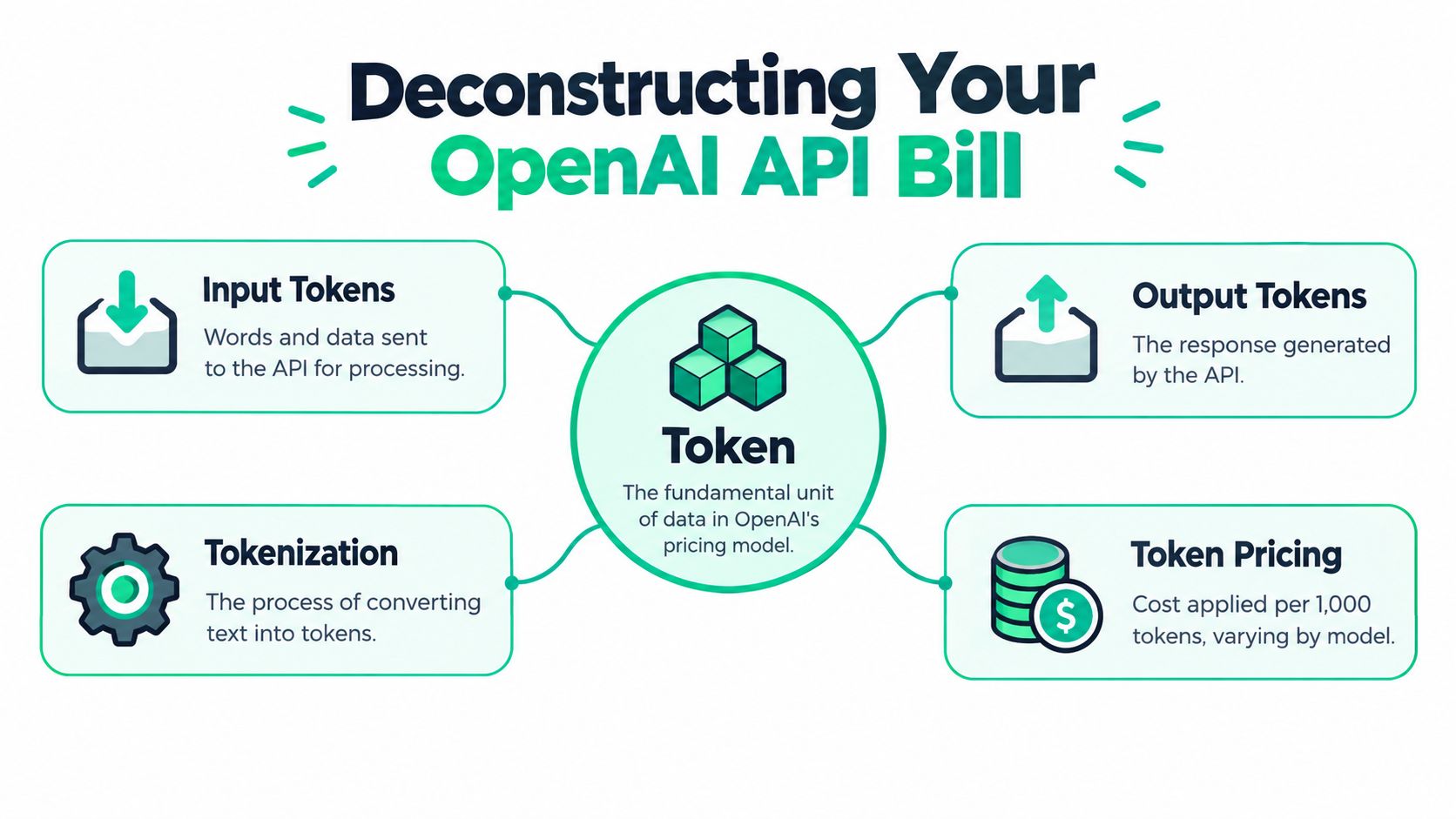
The invoice starts with tokens. A token is a small unit of text processed by the model. It may represent a complete word, part of a word, punctuation, or another fragment, so engineers shouldn't estimate usage by counting words alone. Tokenization converts the request and response into the units used for billing.
A useful analogy is mobile messaging. You don't pay only for opening the messaging app. You pay according to the amount of data transmitted under the applicable plan. With the API, the application sends input tokens, receives output tokens, and the selected model applies separate rates to those two categories.
Input tokens are the request payload
Input tokens include the instructions, user message, conversation history, retrieved documents, formatting requirements, and tool definitions sent with a call. A summarization endpoint might receive a system instruction, a document, and a request for a concise summary. Every part of that payload contributes to input consumption.
Context bloat often takes a subtle form: A developer may append the full conversation history or an entire retrieved collection on every request because it's convenient. The model can process it, but the application is paying to resend information that may be irrelevant or repeated.
For a practical explanation of request and response behavior, see this guide to the OpenAI Completions API.
Output tokens are generated work
Output tokens are the model's response. In a document workflow, they include the summary or structured record returned to the application. Output often has a different price from input, so a prompt that looks small can still become costly if the model produces lengthy answers or repeats information.
A simple call therefore has two accounting lines:
- Input consumption: The instructions and source material sent to the model.
- Output consumption: The generated answer returned by the model.
That distinction matters when diagnosing spend. If input dominates, inspect context assembly, retrieval, and repeated instructions. If output dominates, inspect response limits, verbosity, structured-output design, and whether the workflow asks the model to produce more than the user needs.
The Four Key Drivers of Your OpenAI API Cost
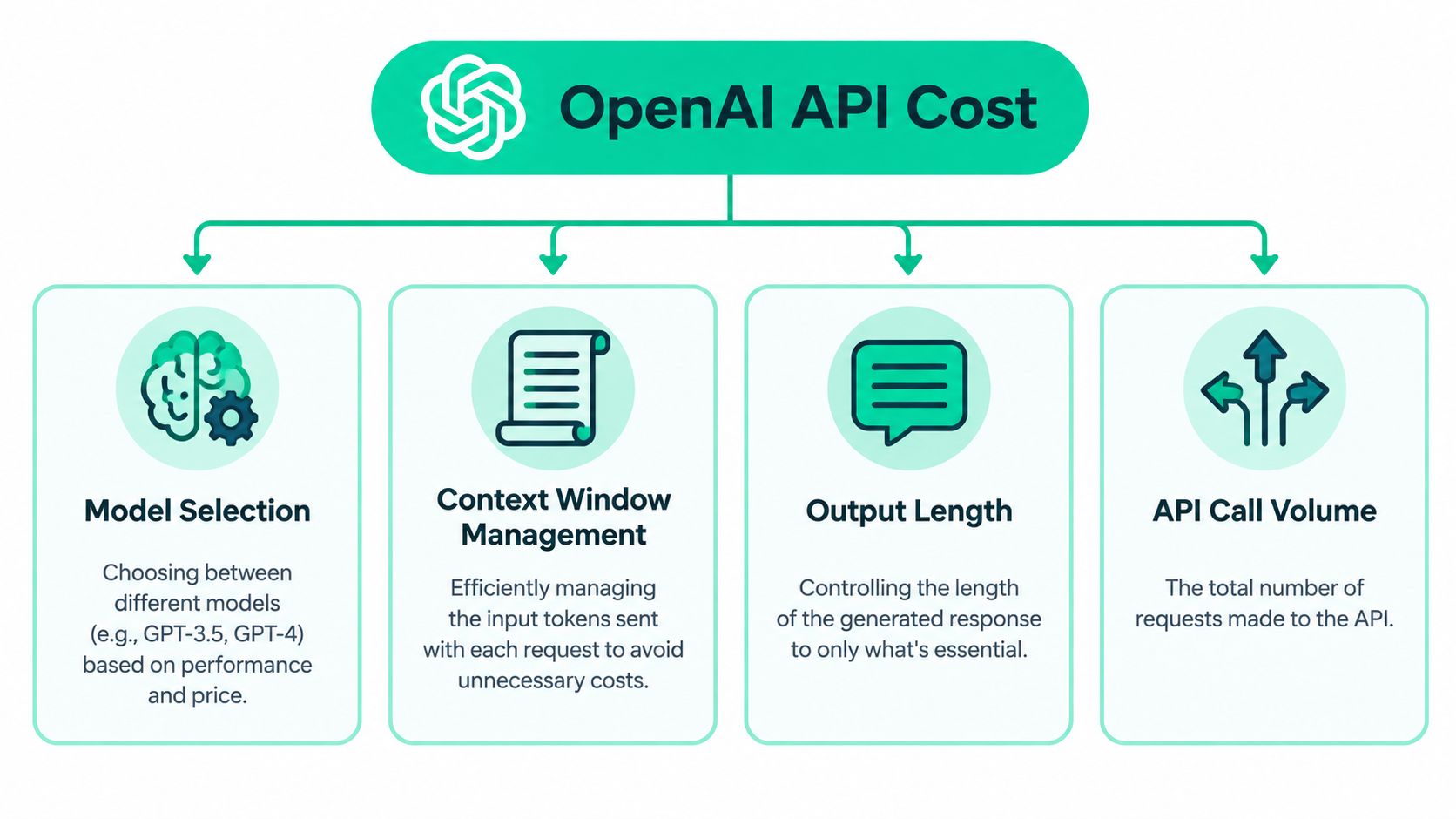
A bill can rise even when user demand is flat. A routing change, an expanding prompt template, an automatic retry, or an agent loop can increase spend without creating a matching feature in the product. Token volume shows the result. Cost control requires tracing the operation that produced it.
Model selection changes the unit economics
Model choice sets the rate for every token and often determines the quality of the first response, the number of retries, and the amount of post-processing required. A complex coding or reasoning workflow may justify a higher-cost model. Classification, routing, short summarization, and routine extraction may not.
The practical question is which model completes the outcome with acceptable quality and the lowest total cost. Compare the full workflow, not only the price per token. A cheaper model that produces invalid structured output or requires repeated calls can cost more than a pricier model that succeeds on the first attempt.
Context window size creates silent input growth
Large context support does not make large prompts economical. Long system instructions, duplicated guidance, full conversation history, and oversized retrieval results raise input consumption on every affected call. They also weaken attribution because one shared template change can expand payloads across several product features.
Keep stable instructions compact and retrieve only relevant passages. Summarize older history once verbatim detail stops affecting the result. Measure input by endpoint and release, not just with an application-wide average that conceals outliers.
Output length is a controllable variable
Verbose responses increase output consumption and can slow downstream processing. Set response constraints that match the job. A classifier may need a label and confidence field. A document extractor may need a validated object. A customer-facing assistant may need natural language, but it does not need an essay for a simple request.
Output limits also improve cost attribution. If a release increases response length, the affected feature and model should be visible in the telemetry rather than appearing as unexplained invoice growth.
Volume includes invisible automation
Call volume includes user actions, retries, scheduled jobs, evaluations, staging environments, and agent loops. One visible customer action can trigger several model calls. Automatic retries are especially easy to miss when monitoring records only successful requests.
Record the workflow identifier, feature, environment, model, release, and retry status with token usage. Those fields connect the provider charge to an internal operation, making it possible to find the trigger instead of treating the invoice as a generic usage problem.
How to Calculate and Forecast Your API Spend
A forecast becomes useful when it connects token usage to the workflow creating the charge. Start with:
Total cost = [(average input tokens × input price) + (average output tokens × output price)] × number of calls
Keep units consistent. If pricing is stated per 1M tokens, convert tokens per request to that unit before multiplying.
For a content generator, build the estimate from measured behavior:
- Sample input tokens for prompts, instructions, and context.
- Sample output tokens for generated results.
- Select the model and its input and output rates.
- Forecast calls for the period.
- Split production, development, testing, retries, and background jobs.
The model choice can change the result sharply. A workload routed to GPT-5.6 Luna uses published rates of $0.20 per 1M input tokens and $1.20 per 1M output tokens. The same workload on GPT-5.6 Sol uses $5.00 and $30.00 per 1M tokens, according to OpenAI's current pricing documentation. Apply those rates to observed token counts. Request volume alone cannot explain the bill.
Why spreadsheets lose accuracy
A spreadsheet can hide the operational triggers behind an average. Conversation history may expand during a session. Tool failures may cause retries. A prompt release may attach retrieved context to every request. A staging test may use production credentials. Each event changes consumption while the original budget remains unchanged.
Pricing also changes the baseline. OpenAI's pricing history records GPT-5.6 Terra moving from $2.50 to $2.00 per 1M input tokens and from $15.00 to $12.00 per 1M output tokens, a 20% reduction on both rates, as shown in the OpenAI pricing history. An old forecast can therefore drift even when application behavior is stable.
Use a spreadsheet for an initial sanity check, then validate it against operational telemetry. Forecast by workload and owner, compare actual token distributions with assumptions, and recalculate after model, prompt, retrieval, or workflow changes. The practical guide to AI cost estimation offers a framework for documenting those assumptions and exposing attribution gaps.
Actionable Strategies to Reduce Your OpenAI Bill
Cost reduction works best when it starts with attribution. Without attribution, teams tend to apply broad restrictions, such as forcing every request onto a cheaper model or shortening every response. Those moves can reduce spend, but they can also damage quality and leave the actual waste untouched.
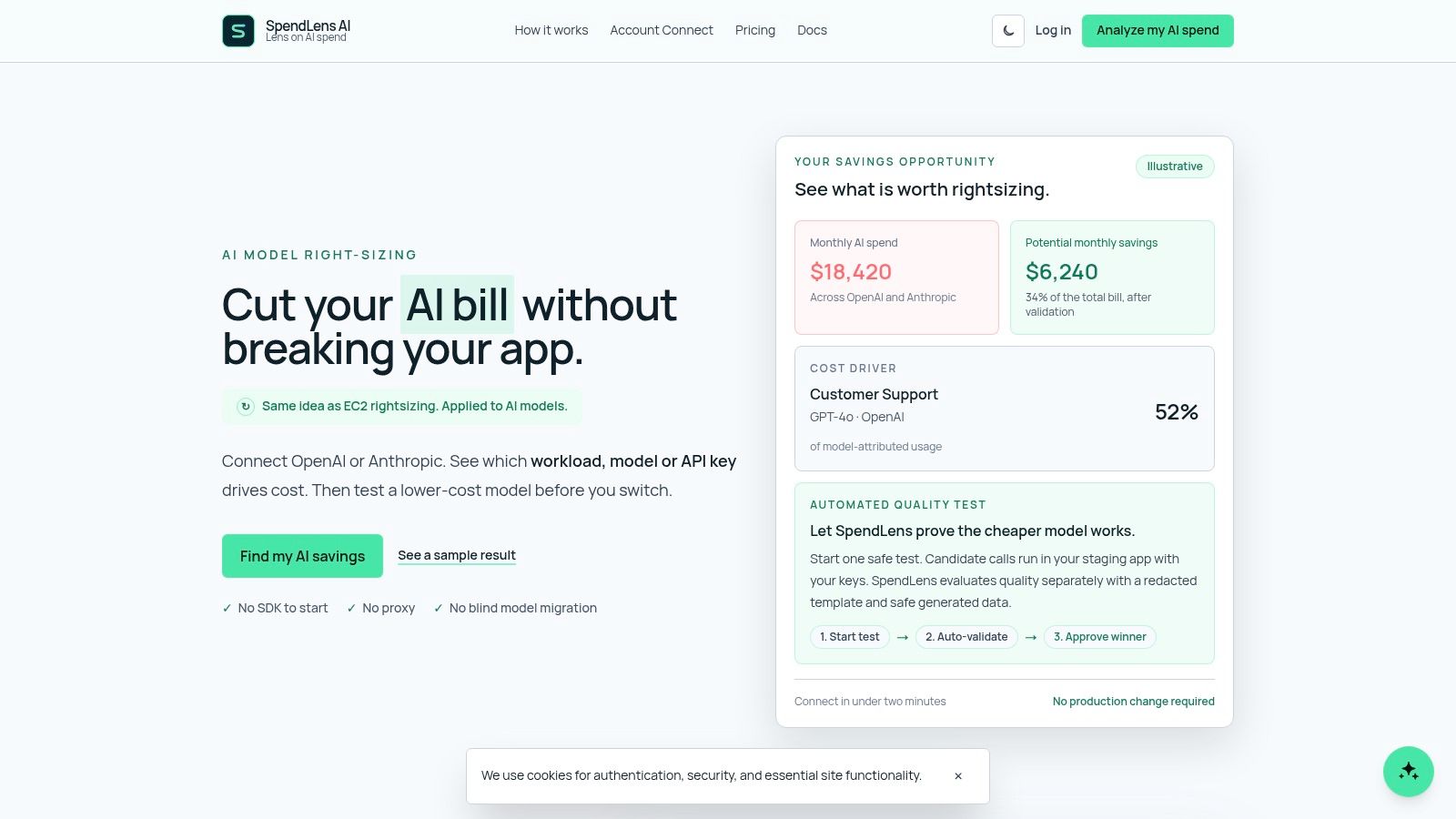
Right-size the model by task
Create a workload inventory before changing model assignments. Group calls into categories such as routing, extraction, summarization, customer support, coding, and agent planning. Then test whether each category needs the reasoning capability and output behavior of its current model.
A useful migration candidate has three properties:
- Stable task definition: The workflow performs a repeatable operation, so quality can be evaluated consistently.
- Clear acceptance criteria: You can check correctness, schema validity, escalation behavior, or human review outcomes.
- Meaningful spend exposure: The workload is large enough that a successful model change produces visible value.
Don't optimize by price alone. A cheaper model that causes retries, manual correction, or additional calls may cost more per completed outcome. Compare quality, latency, error handling, and total workflow consumption together.
Remove prompt waste
Prompt optimization isn't about deleting useful context. It's about removing material the model doesn't need for the current decision.
Inspect the largest templates and payloads first. Look for repeated policy text, duplicated tool descriptions, irrelevant retrieved documents, and conversation history that the application includes by default. Replace broad retrieval with targeted retrieval, and ask for the smallest output that downstream code can use.
A practical example is an invoice extractor. If the parser needs vendor, date, line items, and total, asking for a strict structured response is more economical than requesting a prose explanation followed by a second parsing step. The saving comes from avoiding unnecessary generated text and follow-up processing, not from making the prompt cryptic.
For additional techniques, use this guide to token cost optimization.
Cache repeated work
Caching prevents the application from paying again for identical or reusable work. Store outputs for deterministic transformations, repeated document summaries, stable classifications, and recurring internal queries. Define invalidation rules carefully so the cache doesn't return obsolete business information.
OpenAI's pricing page also lists cached-input rates. GPT-5.6 Sol shows $0.50 per 1M cached input tokens, while GPT-5.6 Luna shows $0.02 per 1M cached input tokens, reinforcing that reusable context can have a lower effective input cost when the workload supports caching. The relevant implementation question is not whether caching exists, but whether the application's prompt structure creates repeatable prefixes and whether telemetry exposes cache efficiency.
Move non-urgent work to Batch
The Batch API is a direct option for asynchronous processing. OpenAI's pricing materials show that Batch cuts both input and output prices by 50% for asynchronous jobs, with coverage describing jobs designed for completion within 24 hours on BenchLM's OpenAI pricing summary.
Suppose an offline evaluation would normally cost $100 in standard token charges. Batch can reduce that to about $50, based on the same pricing example. That makes it suitable for non-urgent evaluations, embedding workloads, and offline document processing where immediate responses aren't required.
Use Batch when the business requirement is eventual completion, not instant completion. Moving the workload changes the cost without forcing the team to reduce the dataset or compromise the evaluation.
The trade-off is operational. Your job needs status tracking, retry handling, result reconciliation, and a clear definition of acceptable completion timing. Don't send interactive user requests to an asynchronous path merely to claim a discount.
Attribute spend before approving optimizations
Every call should carry enough metadata to answer “who used it and why?” Useful dimensions include project, feature, endpoint, workflow, environment, model, customer segment, and deployment version. API keys alone rarely provide enough detail, especially when several services share credentials.
An LLM cost analytics layer can help. SpendLens AI supports lightweight instrumentation for tagging calls by workflows, tasks, features, experiments, or endpoints, then breaks usage down by project, provider, model, and workload. It also surfaces cache efficiency, prompt waste signals, model-switch opportunities, and estimated savings recommendations. Teams can use those findings to prioritize a measured test instead of applying a blanket cost cut.
Build the operating loop around the data:
- Detect: Find the feature, model, or release driving the increase.
- Explain: Separate higher volume from larger prompts, longer outputs, retries, or model changes.
- Test: Run candidate model or prompt changes against representative workloads.
- Validate: Check quality, latency, reliability, and cost per successful outcome.
- Own: Assign the resulting spend and savings to a team or product owner.
That loop saves more time than invoice archaeology. It also turns cost reviews into normal engineering work, alongside reliability and performance reviews.
From Opaque Costs to Strategic AI Investment
Managing OpenAI API cost is an operating discipline, not a one-time cleanup. The provider's token rates matter, but the application determines how many tokens it sends, how often it calls, which model performs the work, and whether the same work is repeated.
Start with attribution. Map spend to features, workflows, models, environments, and owners. Then separate the four practical questions: Is the model appropriate? Is the context necessary? Is the output controlled? Is the workflow making avoidable calls?
The strongest teams don't treat optimization as “use the cheapest model everywhere.” They measure cost per useful outcome, preserve high-capability models for tasks that need them, and move suitable background work to lower-cost paths. They also monitor pricing revisions, cache behavior, retries, and deployment changes so the budget reflects current reality rather than an outdated assumption.
That approach creates value in two ways. It reduces wasted money, and it gives product leaders the confidence to expand AI features because they can see what each feature costs and what it delivers. Visibility turns an unexpected bill into a managed investment.
SpendLens AI helps engineering and FinOps teams attribute OpenAI and Anthropic usage to specific workflows, features, models, and projects, while surfacing token waste, cache efficiency, and model-switch opportunities. Visit SpendLens AI to connect API activity with actionable cost data before the next invoice arrives.