Savings Recommendations That Actually Cut LLM Costs
Learn how SpendLens AI savings recommendations work, how to evaluate impact and risk, and how to run safe experiments that cut LLM costs.
A release goes live on Monday. By Tuesday, the LLM invoice has jumped, but nobody can explain whether the cause is a new feature, longer prompts, a cache regression, or a model selected by one service and not another. Engineers start searching logs manually, finance sees an unattributed total, and the team postpones optimization until the next billing cycle.
That pattern is common because LLM spend is attached to requests, not business context. A token count tells you what was billed, but not whether the request served customer support, document extraction, classification, or an internal experiment. A useful savings recommendation must connect usage to a workload, show the value of changing it, and make the trade-off visible.
The same principle applies outside software. The OECD saving-rate benchmark compares household saving behavior on a common national-accounts basis. It makes differences visible instead of treating every household as identical. LLM cost management needs the same discipline: compare like with like, quantify the opportunity, and avoid moving money or traffic without understanding the consequences.
This guide treats savings recommendations as prioritized experiments ranked by impact, confidence, and migration risk. You'll learn how to find prompt waste, evaluate model-switch opportunities, measure cache efficiency, and turn a promising recommendation into a controlled production test. The practical standard stays consistent throughout: every proposed change should show money saved, tokens removed, latency reduced, or engineering time avoided.
For teams that want the instrumentation model before the optimization workflow, the SpendLens AI implementation overview shows how workload attribution fits around existing provider clients. Teams also often need reliable context from external pages, and an LLM Scrape API can help retrieve structured web content for applications that feed long documents into language models.
Table of Contents
- Introduction to Smarter LLM Savings
- What Automated Savings Recommendations Really Are
- How Impact Confidence and Risk Are Calculated
- Key Types of Savings Opportunities You Will See
- How to Evaluate and Act on Recommendations in SpendLens AI
- Real World Examples With Time and Money Saved
- Best Practices for Safe Migration Experiments
Introduction to Smarter LLM Savings
An LLM bill becomes difficult to manage when it answers only one question, how much did we spend? Engineering leaders need several more answers: which product feature generated the spend, which workload changed, whether the extra tokens produced better results, and what action could lower the bill without damaging user experience.
That last question matters because the cheapest request isn't automatically the best request. A smaller model might classify routine text well but struggle with edge cases. A shorter prompt might remove useful policy context. More aggressive caching can reduce repeated work, but stale or incorrectly scoped context can create correctness problems. Savings recommendations are valuable only when they preserve the decision context around the proposed change.
Start with the workload, not the invoice
Suppose a support chatbot sends a large system prompt with every request. The invoice shows input tokens, output tokens, and model charges, but a finance report won't tell you that the same policy text appears across multiple customer conversations. A workload-level view can identify the repeated template, the affected model, the request volume, cache behavior, and the expected result of trimming or reusing that context.
That distinction separates an experiment from generic advice. “Use a cheaper model” is too broad to approve. “Test a lower-cost model on the ticket-classification workload, preserve the current model for escalation, and compare quality and latency against the existing baseline” gives an engineer something measurable to run.
The Federal Reserve tracks whether adults have at least three months of emergency savings, while Bankrate's 2026 survey found that 30% of U.S. adults said they'd use savings for a $1,000 emergency, compared with 41% a year earlier. The broader lesson for software teams is simple: a target becomes useful when it has a concrete threshold and a measured gap. “Reduce AI spend” is a goal. “Remove this recurring prompt waste and validate the resulting response quality” is an operating plan.
Practical rule: Never approve a savings recommendation that doesn't identify the workload, the baseline, the expected value, and the rollback condition.
SpendLens AI is one developer-first option for connecting model calls to projects, providers, workloads, and experiments. Its Python instrumentation can attribute calls with @spendlensai.observe, track(), and client.tag(), while its dashboard exposes token use, cache signals, and per-call metrics where available. That context lets a team rank opportunities instead of chasing whichever number looks largest on an aggregate bill.
What Automated Savings Recommendations Really Are
A useful recommendation begins with classification. Think of an LLM service as a building that uses electricity. An energy audit doesn't compare the whole building's power bill with another building's bill and immediately recommend replacing every appliance. It identifies rooms, equipment, operating schedules, and repeated patterns before suggesting a change.
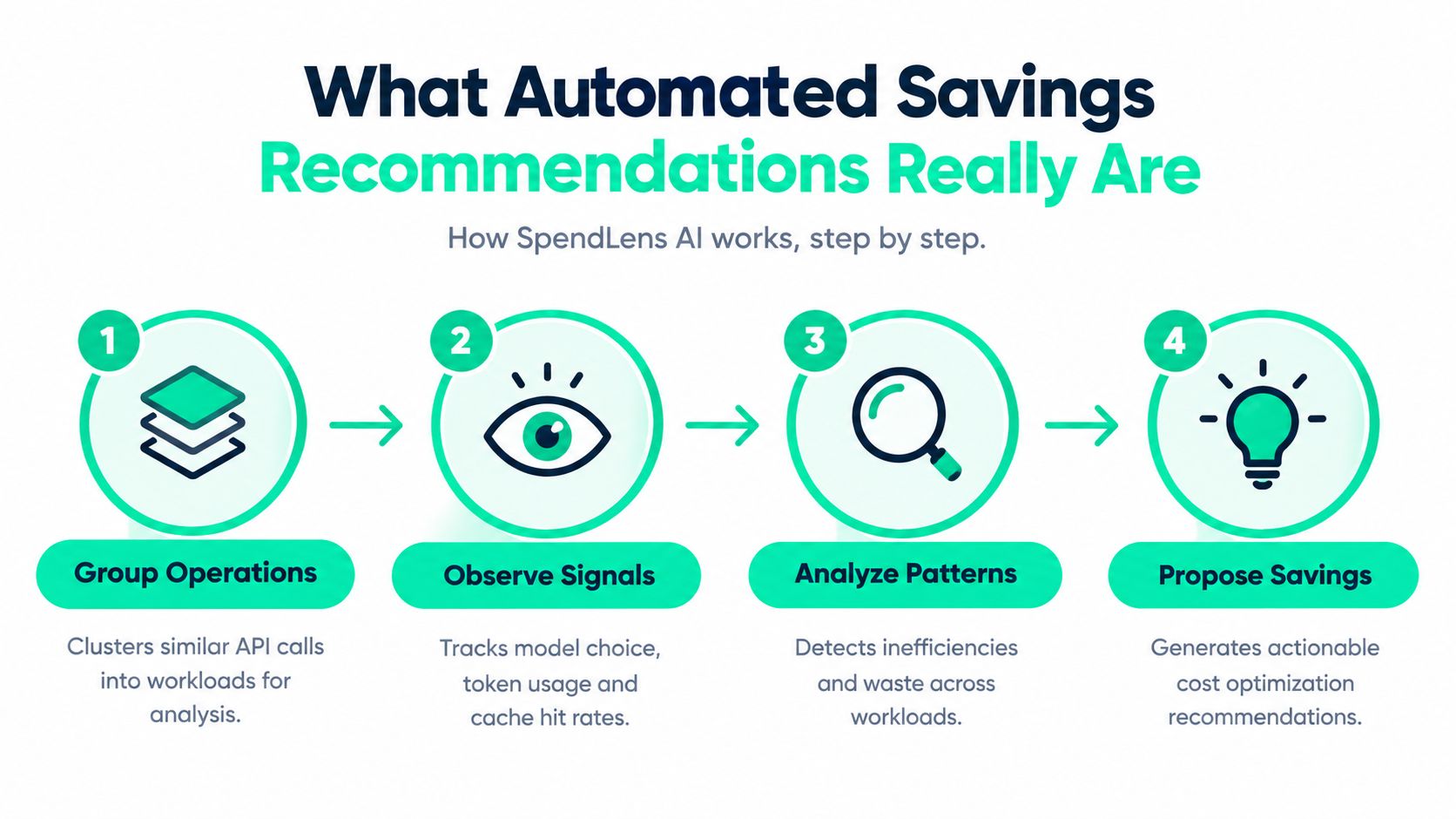
LLM savings recommendations work in a similar sequence.
Group operations into comparable workloads
The first step is grouping similar calls. A document summarizer, a fraud-review assistant, and a customer-support classifier may all call the same provider, but they have different prompts, output requirements, quality tolerances, and traffic patterns. Treating them as one pool creates misleading averages.
A workload can be defined by the feature, endpoint, task, experiment, or client tag that gives the request business meaning. The more consistent the group, the easier it is to compare a baseline with a proposed model, prompt, or caching change.
Observe the signals that create spend
Next, collect the signals that explain cost. Model choice matters, but so do input tokens, output tokens, repeated instructions, cache hits, request frequency, and latency. A prompt that looks modest in isolation can become expensive when a service sends it repeatedly.
Privacy-aware instrumentation should avoid capturing more content than the analysis needs. Metadata-only tracking, template-only prompt sampling, and hashed API keys can preserve attribution while reducing exposure. Direct provider calls also avoid placing a proxy in the request path, which keeps routing and latency behavior closer to the existing service.
Analyze patterns instead of isolated calls
A recommendation becomes credible when it detects a repeated pattern. Examples include a large static template attached to every request, a capable model handling a simple classification task, or reusable context that rarely receives a cache hit. The analysis should compare requests with similar inputs and outcomes, not just select the lowest-priced model in a catalog.
Propose an action with a measurable outcome
The final output should state what to test and why. A strong recommendation might say, “Trim repeated instructions from this workload, then compare input tokens, response quality, and latency.” Another might recommend testing Claude, Gemini, Qwen, Mistral, DeepSeek, or a Llama-family model against an OpenAI workload, provided the comparison uses the same task and evaluation set.
The result isn't a command to switch blindly. It's a bounded experiment with a forecast. The forecast should express value as recurring spend avoided, tokens removed, processing time reduced, or engineering effort saved.
A short video can reinforce the workflow visually:
How Impact Confidence and Risk Are Calculated
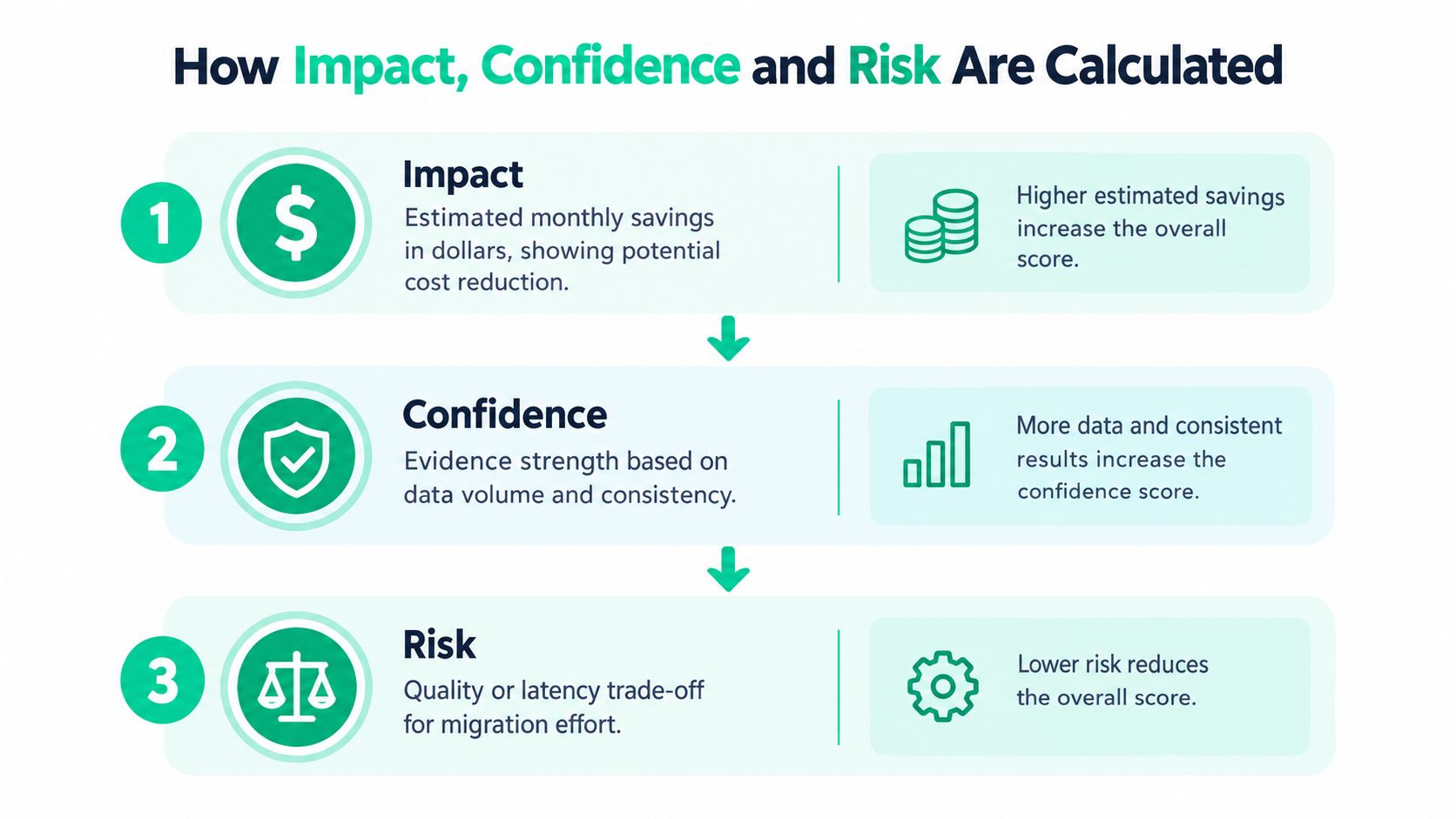
A recommendation earns attention through three separate questions. Impact asks how much value the change could create. Confidence asks how strong the evidence is. Risk asks what could go wrong during migration.
These signals shouldn't collapse into one mysterious score. A high-impact recommendation supported by sparse data deserves a different treatment from a smaller opportunity backed by consistent production behavior.
Impact describes the economic upside
Impact is the estimated monthly savings if the proposed change performs as expected across the affected workload. It can include lower input or output token charges, fewer repeated computations, reduced latency-related infrastructure pressure, or less manual engineering time spent investigating spend.
For example, trimming a prompt that appears in one rarely used endpoint may produce a clean technical improvement but little recurring financial value. The same trim applied to a heavily reused support template can become a priority because every call avoids the same unnecessary context.
Long-context research provides a useful mechanism for this type of calculation. LongLLMLingua achieved about four times fewer tokens on NaturalQuestions, improved performance by up to 21.4% on GPT-3.5-Turbo, and reported a 94.0% cost reduction on the LooGLE benchmark in its study. It also found latency improvements of 1.4x to 2.6x when compressing roughly 10,000-token prompts at 2x to 6x ratios. These figures belong to the cited benchmark, not to every production workload, but they show why token reduction can create both financial and time value. See the cost-savings calculation guide for a practical way to translate workload measurements into a forecast.
Confidence reflects evidence quality
Confidence rises when the workload classification is stable, the traffic sample is representative, the cost pattern repeats, and the proposed alternative has been evaluated on relevant examples. It falls when calls are sparse, prompts vary widely, quality labels are missing, or the workload mixes unrelated tasks.
A recommendation based on a single unusual release should remain provisional. A recommendation supported by recurring calls, consistent token behavior, and a labeled evaluation set can move toward a controlled canary.
Risk covers quality, latency, and migration effort
Migration risk isn't limited to model intelligence. It includes response format changes, tool-calling behavior, timeout patterns, moderation behavior, context limits, and the engineering effort required to roll back. Cross-model comparisons across OpenAI, Claude, Gemini, Qwen, Mistral, DeepSeek, and Llama families can broaden the candidate set, but they don't remove the need for task-specific validation.
Use the ratings to choose the experiment shape. High confidence and low risk can justify a quick canary. High impact with low confidence calls for shadow traffic and better measurement first. High risk may still be worth pursuing, but only when the forecast is large enough to justify deeper evaluation.
Key Types of Savings Opportunities You Will See
Most actionable savings recommendations fall into three groups: model selection, prompt efficiency, and context reuse. They overlap in production, but each requires a different test.
A model-switch recommendation appears when a workload uses more capability than its task requires. A short classification or routing request may not need the same model as a complex reasoning workflow. The right comparison keeps the prompt, expected output, evaluation criteria, and traffic segment stable. Value appears as lower cost per request, shorter response time, or both.
Prompt waste signals target input that contributes little to the answer. Common patterns include repeated instructions, verbose formatting, excessive whitespace, stale examples, and context that applies only to a subset of requests. Production guidance estimates that LLM prompts often carry 20% to 40% unnecessary tokens, and one example reduced a prompt from 800 tokens to 560 tokens, saving roughly $3,400 per month for 50,000 GPT-4o calls per day. The same source calculates that removing 50 tokens from a prompt used 100,000 times daily avoids 5 million tokens per day, worth about $375 to $450 per month, depending on model pricing. See AI FinOps analytics guidance for broader cost-management context.
Caching addresses repeated context and repeated computation. It can be particularly valuable when the same system instructions, documents, or policy material are sent across many calls. A 2024 prompt-compression study reported that a capsule-based method reduced prompt length by 81.4%, cut inference latency by up to 4.5x, and saved 80.1% of budget overheads across its evaluated models and datasets. Another evaluation reported 90.64% computational reduction at 100 output tokens and up to 99.80% initial KV-cache memory reduction for reused prompts. Those results are research findings, so production teams should validate cache scope and freshness rather than assume the same outcome.
| Opportunity Type | Best For | Effort and Risk | Value Signal |
|---|---|---|---|
| Model switch | Simple, stable tasks running on an expensive model | Medium effort, quality and format risk | Lower cost per call, fewer processing seconds |
| Prompt trim | Large templates, repeated instructions, unnecessary context | Low to medium effort, context-loss risk | Fewer input tokens, lower spend, lower latency |
| Caching | Reused instructions, documents, or context | Medium effort, invalidation and freshness risk | Fewer recomputed tokens, faster repeated requests |
| Combined experiment | Workloads with both model overprovisioning and repeated context | Higher effort, attribution becomes harder | Separate token, dollar, and time savings for each change |
Prioritize recurring value over novelty. A tiny prompt improvement applied to a heavily reused workload can beat a dramatic optimization that affects only occasional traffic.
How to Evaluate and Act on Recommendations in SpendLens AI
Start with attribution. Open the dashboard and break spend down by project, provider, model, and workload. The purpose isn't to admire a chart. It's to locate the request family where a change can be isolated, measured, and reversed.
A practical evaluation sequence looks like this:
- Choose the workload. Confirm that the grouped calls serve the same product function and don't mix production traffic with unrelated tests.
- Inspect the baseline. Review model, input and output tokens, cache efficiency, per-call cost where available, latency, and recent release context.
- Read the proposed action. Check the candidate model, prompt change, or caching adjustment. Look for estimated monthly savings and the stated migration risk.
- Check the evidence. Ask whether the recommendation reflects representative traffic, stable classification, and meaningful quality measurements.
- Tag the experiment. Use
client.tagortrack()to distinguish the candidate path from the control path. - Run a bounded test. Use shadow traffic when the candidate should not affect users, or canary traffic when a limited production slice is appropriate.
- Set rollback conditions. Define acceptable quality, latency, error, and cost thresholds before the test starts.
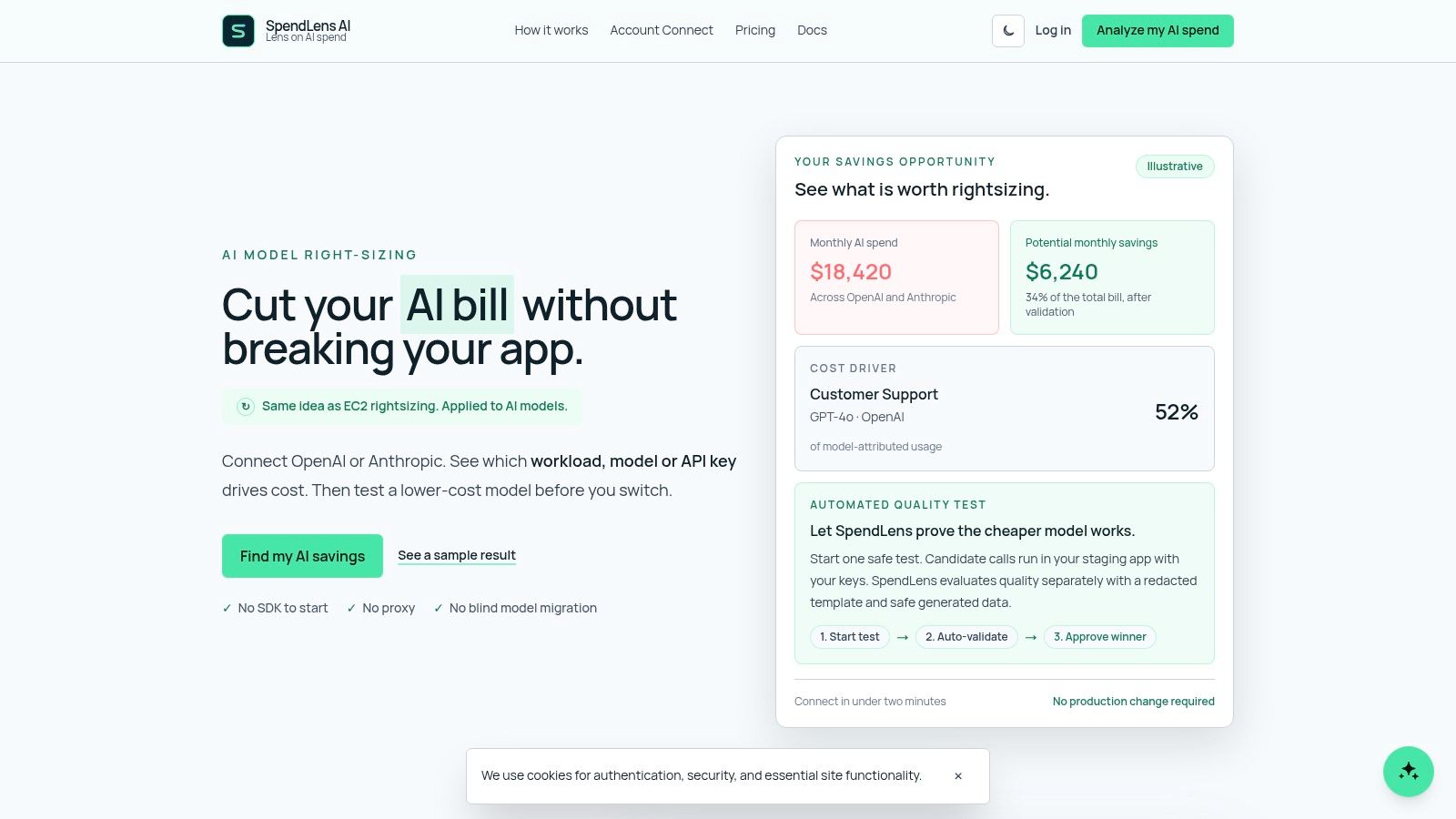
Privacy should be part of the workflow, not an afterthought. Metadata-only tracking, template-only prompt sampling, and hashed API keys can provide workload attribution without storing user prompts or model responses by default. Direct calls from OpenAI and Anthropic clients also preserve existing provider behavior instead of forcing every request through a proxy.
A candidate should earn rollout only after the evaluation shows value in the dimensions that matter. A classification workload might require label agreement and response format checks. A support assistant might need human review, escalation consistency, and latency monitoring. The evaluation campaign documentation provides a place to formalize that comparison.
Daily summaries help keep the result visible. A useful report names yesterday's spend, the top cost driver, and the highest-impact recommendation, so engineering, product, and finance can discuss the same workload rather than separate spreadsheets.
Real World Examples With Time and Money Saved
Consider a support chatbot with a 1,200-token system prompt that could be reduced to 400 tokens. Every request carries 800 unnecessary tokens. At 5,000 daily requests on GPT-4o, that creates 4 million wasted tokens per day, costing about $10 per day, or roughly $300 per month, according to the cited production estimate. The direct value is money saved, while the indirect value is less context for the model to process on every request.
The team shouldn't delete the prompt and hope. It can separate policies that apply to every conversation from examples used only for specific ticket types, remove duplicate instructions, then run the shorter template against a labeled sample. The rollout should compare answer quality, escalation behavior, latency, and input-token usage. If the shorter prompt passes those checks, the team has a defensible business case: recurring monthly savings and time saved through faster processing.
A larger support-chatbot scenario starts with 500,000 requests per month, an average 1,500-token prompt-plus-response, and roughly $0.03 per request, producing about $15,000 per month for one chatbot. The source reports typical blended savings of 30% to 50% when routing, caching, and observability are added. Those percentages are an estimate for that scenario, not a guarantee, but they show why a recommendation that combines several measured changes can be worth prioritizing.
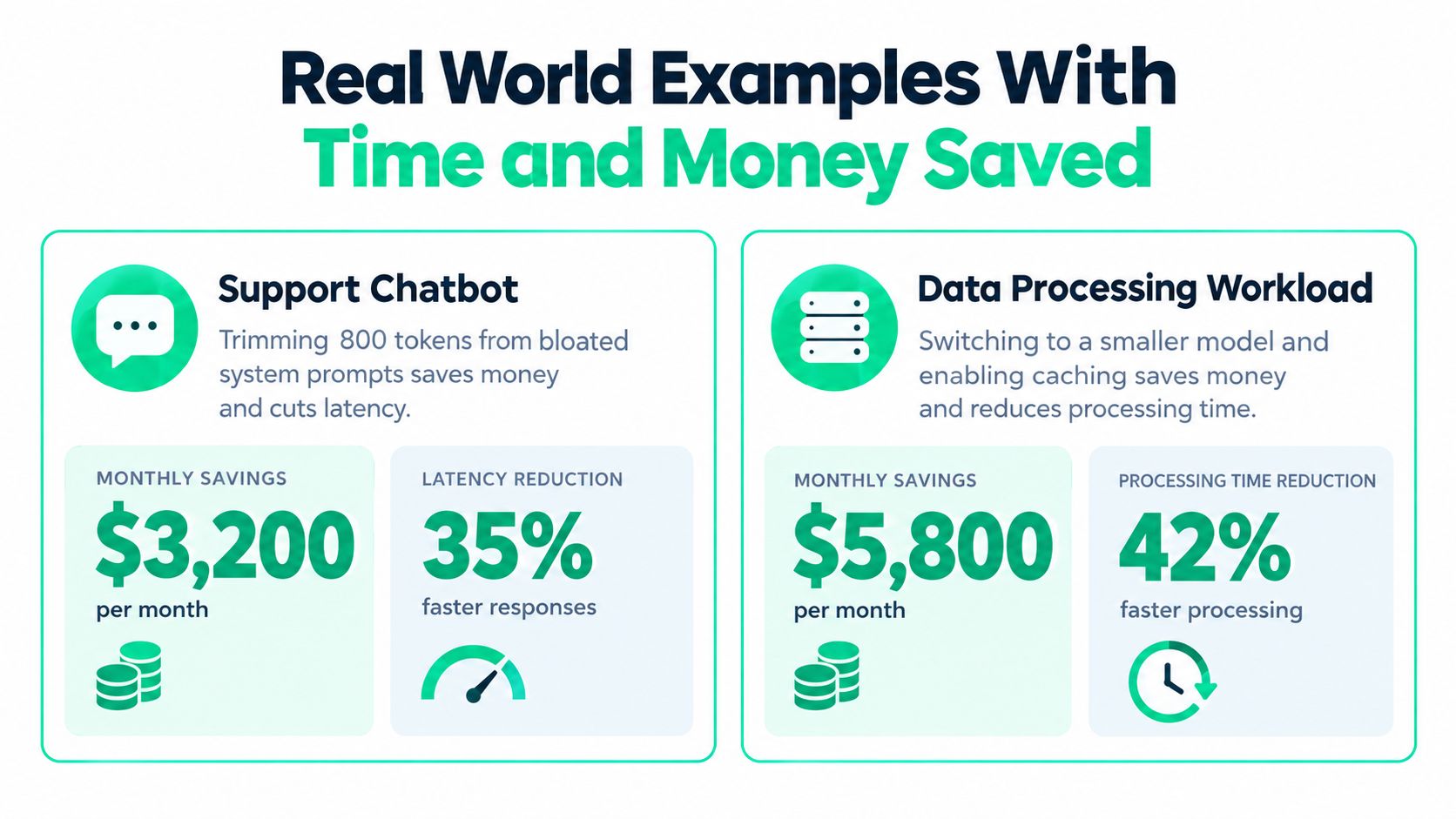
For a classification workload, the calculation is different. A team compares its current frontier model with a smaller alternative using the same inputs, output schema, and acceptance tests. It measures cost per request, input and output tokens, response time, error rate, and label quality. If the smaller model preserves the required result, the monthly value comes from the per-call price difference multiplied by recurring traffic, while the time value comes from faster responses and less capacity pressure.
The recommendation should also identify reusable context. If the classifier receives the same policy text repeatedly, caching can reduce recomputation alongside the model switch. Keep the changes separable at first, otherwise the team won't know whether the savings came from the model, the cache, or a prompt trim.
Best Practices for Safe Migration Experiments
The safest savings program behaves like a sequence of small financial decisions. Start with a high-confidence, low-risk opportunity, especially one that removes repeated prompt waste without changing the model. Then move toward model switches or cache changes after the team has established measurement habits.
Use this pre-flight checklist:
- Define the workload: Confirm the endpoint, feature, task, owner, and traffic boundary.
- Record the baseline: Capture cost, input and output tokens, latency, cache behavior, errors, and quality signals.
- Choose the experiment mode: Use shadow evaluation when user-facing behavior must remain unchanged, or a controlled canary when limited live traffic is appropriate.
- Protect sensitive data: Prefer metadata-only tracking, template-only sampling, and hashed identifiers. The guide to AI security guardrails offers useful context for integrating safety controls into development workflows.
- Set rollback rules: Decide what quality regression, latency increase, error change, or unexpected spend means the test stops.
During the experiment, tag every candidate request so the dashboard can separate control and treatment. Compare like-for-like traffic, not a quiet period against a peak period. Afterward, record tokens removed, dollars avoided, processing time saved, quality impact, and any migration work required.
A daily summary gives executives a compact view without turning every review into a dashboard tour. This makes the top recommendation visible, but the engineering team still owns the evidence and the rollback decision.
Instrument the most expensive attributable workload with @spendlensai.observe, select one recommendation with a clear baseline, and run the first controlled comparison this week. SpendLens AI provides workload-level cost visibility, token and cache signals, ranked recommendations, and experiment-oriented tracking so the result can be reported as measurable money saved and time saved.
Visit SpendLens AI to connect LLM calls to real workloads, surface prompt, cache, and model-switch opportunities, and measure savings before changing production. Start with one high-confidence recommendation, attach a rollback plan, and turn an opaque bill into a tested engineering result.