LLM Costs & Design: Guide to Multi Turn Conversations
Master multi turn conversations for LLMs. Manage context, reduce token costs, and fix hallucinations with practical architectures.
Most advice about multi turn conversations starts in the wrong place. It treats the problem like a prompt-writing exercise, as if a chatbot becomes reliable once you add a few guardrails and a nicer fallback message. That framing overlooks a critical problem: every extra turn is another chance to lose context, waste tokens, drift off task, and turn a cheap interaction into an expensive one.
The practical question for a CTO or platform lead isn't whether the model can answer one prompt well. It's whether the full thread still works after clarification, interruption, correction, and follow-up. That's where conversational systems stop being a UX feature and start becoming an operational line item.
Table of Contents
- Why Your Chatbot Is a Ticking Time Bomb
- The Hidden Challenges of Multi-Turn Conversations
- Architectural Patterns for Reliable Conversational AI
- Optimizing and Monitoring Conversational Spend
- Putting It Into Practice with SpendLens AI
- Building Conversations That Do Not Break the Bank
Why Your Chatbot Is a Ticking Time Bomb
A chatbot that looks fine in a demo can still fail in production for the same reason a race car can fail in traffic, the environment changes, and every added interaction increases surface area for mistakes. One prompt, one response, one success is a comforting fiction. Real users don't behave that way, they clarify, interrupt, backtrack, and expect the system to remember what happened three messages ago.
A 2025 benchmark study found that LLMs lose 39% average accuracy in multi-turn conversations compared with single-turn settings, across six tasks and all tested models, and systems that were above 90% accuracy in single-turn prompts often dropped to about 60% in dialogue (benchmark study, paper summary). That gap matters because the business doesn't pay for a model's best-case response. It pays for the whole interaction, including the turns where the model loses the plot.
Every turn adds a new failure mode
The first message often feels easy. The second turn asks the system to carry state, interpret pronouns, and preserve earlier constraints. By the third or fourth turn, the model can start hallucinating details it should've retained or forget the reason the conversation began.
Practical rule: if a conversation can fail silently, it will fail in production before anyone notices in QA.
That's why the architecture has to treat multi turn conversations as a continuous workflow, not a sequence of isolated completions. A support flow, for example, might begin with an account issue, detour into billing, and then return to the original case. A sales assistant might qualify a lead, answer a pricing objection, then lose track of the original use case if state isn't preserved. Each of those moments affects time-to-resolution and, by extension, cost.
The hidden liability is that success in a single turn can mask failure across the thread. A model can sound confident, answer quickly, and still leave the user no closer to the goal. That's the dangerous part, because the interface looks polished while the system burns budget on useless turns.
The Hidden Challenges of Multi-Turn Conversations
Context, cost, latency, and drift compound together
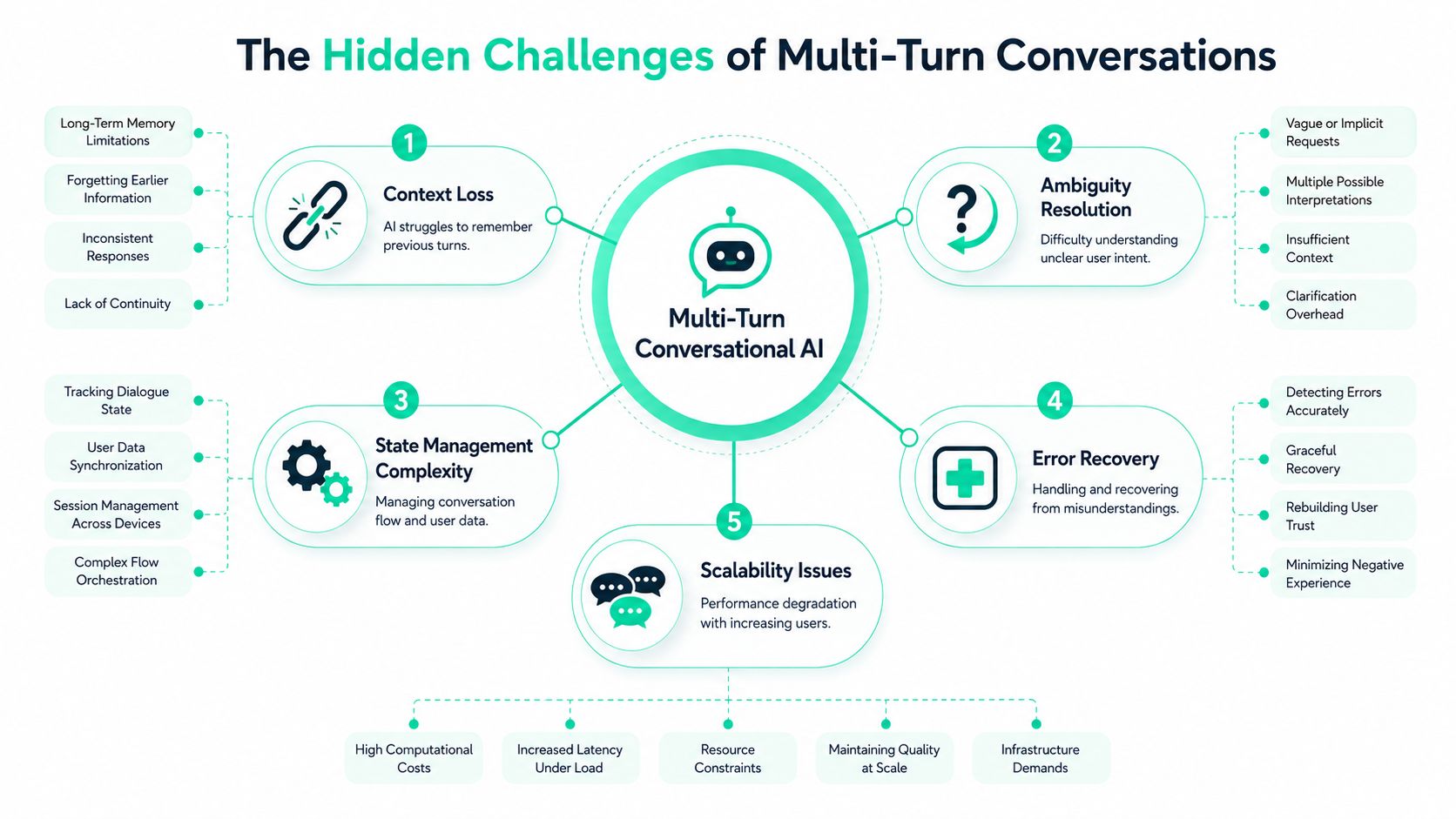
The first problem is context management. If the conversation history is shoved into every new request, the prompt grows, the model has more text to inspect, and the risk of pulling in stale instructions rises. A customer asks to change an order, then уточняет which item, then updates the delivery date. If the system can't distinguish the active task from old chatter, it may update the wrong thing or ask the same question again.
The second problem is spiraling token costs. A simple 3-turn exchange already shows the pattern. Turn one contains the user request. Turn two includes the first answer plus the request again in the history. Turn three includes both previous turns and the new answer, so the context keeps expanding even if the actual task hasn't changed. In practice, the system is paying to resend conversation baggage on every call.
The third problem is latency degradation. Larger prompts take longer to process, which means a chatbot that feels snappy in short tests can become sluggish once the user asks follow-up questions. For support and sales teams, that delay isn't cosmetic. It can break the rhythm of the interaction and push users toward escalation or abandonment.
The fourth problem is conversational drift. The model starts with one instruction, then a follow-up changes the topic slightly, then the system forgets the original goal and answers the latest turn in isolation. The 2026 arXiv study on conversational drift analyzed 4,574 conversational turns across 34 conditions, found that Bipredictability matched structural consistency in 85% of conditions, and reported that its Information Digital Twin detected all tested contradictions, topic shifts, and non-sequiturs with 100% sensitivity (study). That's a reminder that drift is measurable, and if you don't measure it, you'll only see the billing spike.
A chatbot that can't survive a correction is a liability, not an automation asset.
A practical support example makes the risk obvious. A user says, “I need to cancel my order.” The assistant asks for the order number. The user gives it. Then they change their mind and ask for a refund instead. If the system doesn't track the new intent cleanly, it can still execute the wrong workflow or bury the underlying goal under stale state.
The cost mechanics of inference matter here because every redundant turn is both a technical and financial event. If you're paying for context you don't need, you're paying twice, once in latency, once in waste.
Architectural Patterns for Reliable Conversational AI
State management has to be explicit
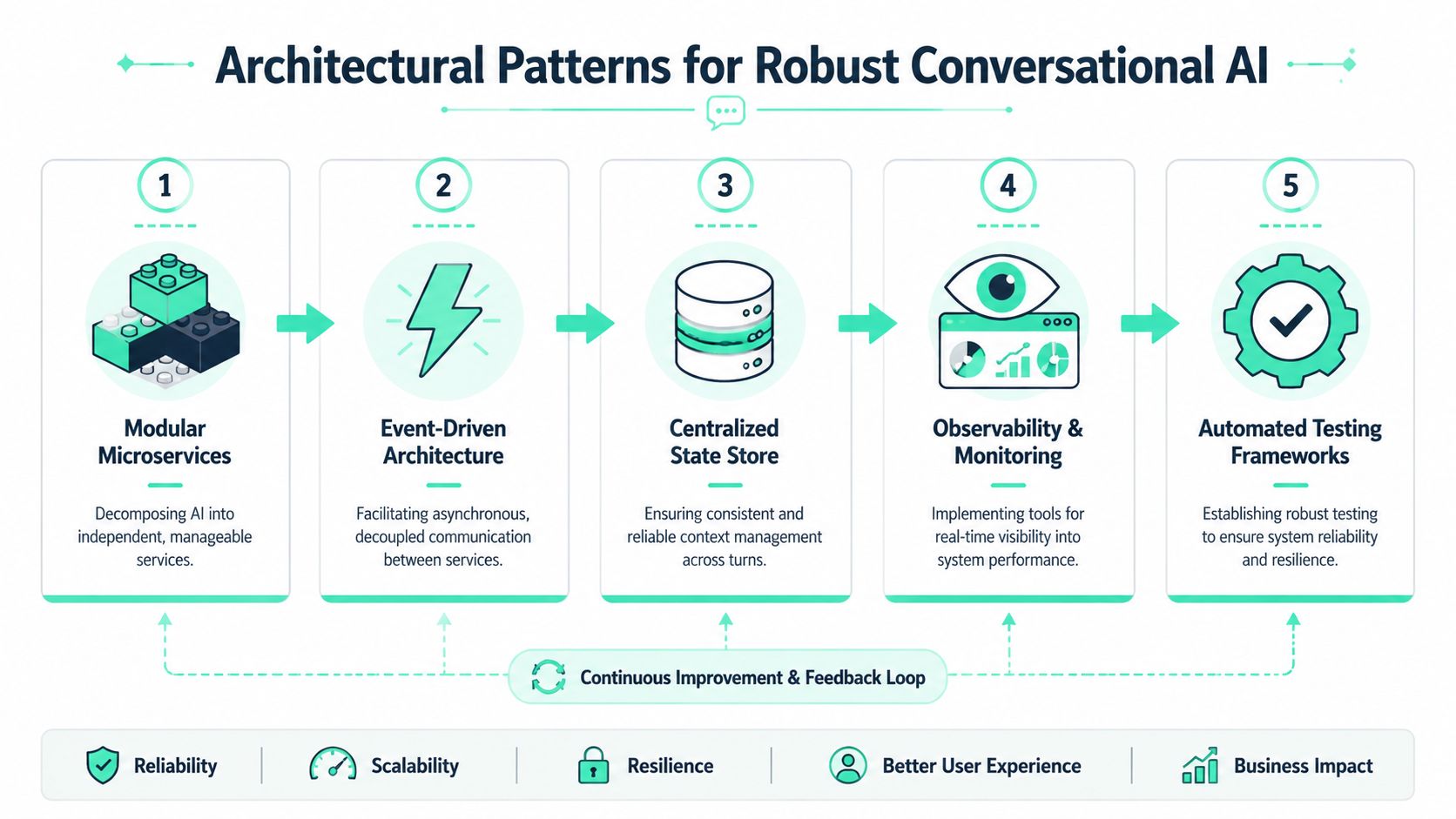
A conversational system needs a durable session layer, not just a chat transcript. Store the current goal, active entities, the last confirmed user intent, and unresolved ambiguity separately from the raw message history. That gives the assistant a reliable thread to follow when the user skips ahead, changes direction, or rewrites the same request in a new way.
Teams often make the wrong trade-off here by stuffing every message into the prompt because it is the fastest path to shipping. It works at first, then latency climbs, context windows fill up, and token costs rise every time the conversation gets longer. Explicit state lets the system reference the right facts without paying to resend the whole history on every call.
Summaries beat endless history
Older turns do not need to stay fully detailed forever. Summarization and memory techniques let you compress settled parts of a conversation while keeping the facts that still matter. That cuts repeated context and lowers inference spend because the model no longer has to reread a bloated thread just to answer the current question.
The key is to summarize only what is stable. For a scheduling assistant, that might mean the appointment type, the confirmed time window, and any special instruction. For support, it might mean the reported issue, what has already been tried, and the next action. Do not summarize unresolved ambiguity away, or you will create a neat-looking failure that is expensive to debug later.
Retrieval grounding reduces hallucination risk
If the assistant needs product facts, policy details, or account-specific context, memory alone is a bad bet. Ground those turns with retrieval so the model can answer from a current source of truth instead of improvising from the thread. That matters most when a conversation moves from generic help into factual commitments that affect trust, refunds, or access.
A practical evaluation workflow can catch these failures before they reach production. The guide recommends defining each test case as a scenario, persona, and expected outcome, then scoring both trace-level and conversation-level metrics to surface context-retention failures before release. That kind of structure makes it easier to see where the assistant loses the thread and where the cost of a bad turn starts to climb.
Route simple turns to cheaper models
Not every turn deserves the same model. A greeting, a basic status check, or a simple clarification can often run on a lower-cost model, while harder turns involving ambiguity, tool use, or policy risk can move to a stronger model. That selective routing is where architecture starts paying for itself, because you reserve expensive inference for the parts of the exchange that require it.
Operational rule: use the smallest model that can safely handle the current turn, not the biggest model available.
A team building a customer workflow can compare approaches in an open source AI agent framework before hard-coding one orchestration style. The architecture choice affects both reliability and bill size, especially as conversations get longer and more varied.
Optimizing and Monitoring Conversational Spend
Cost control starts with attribution
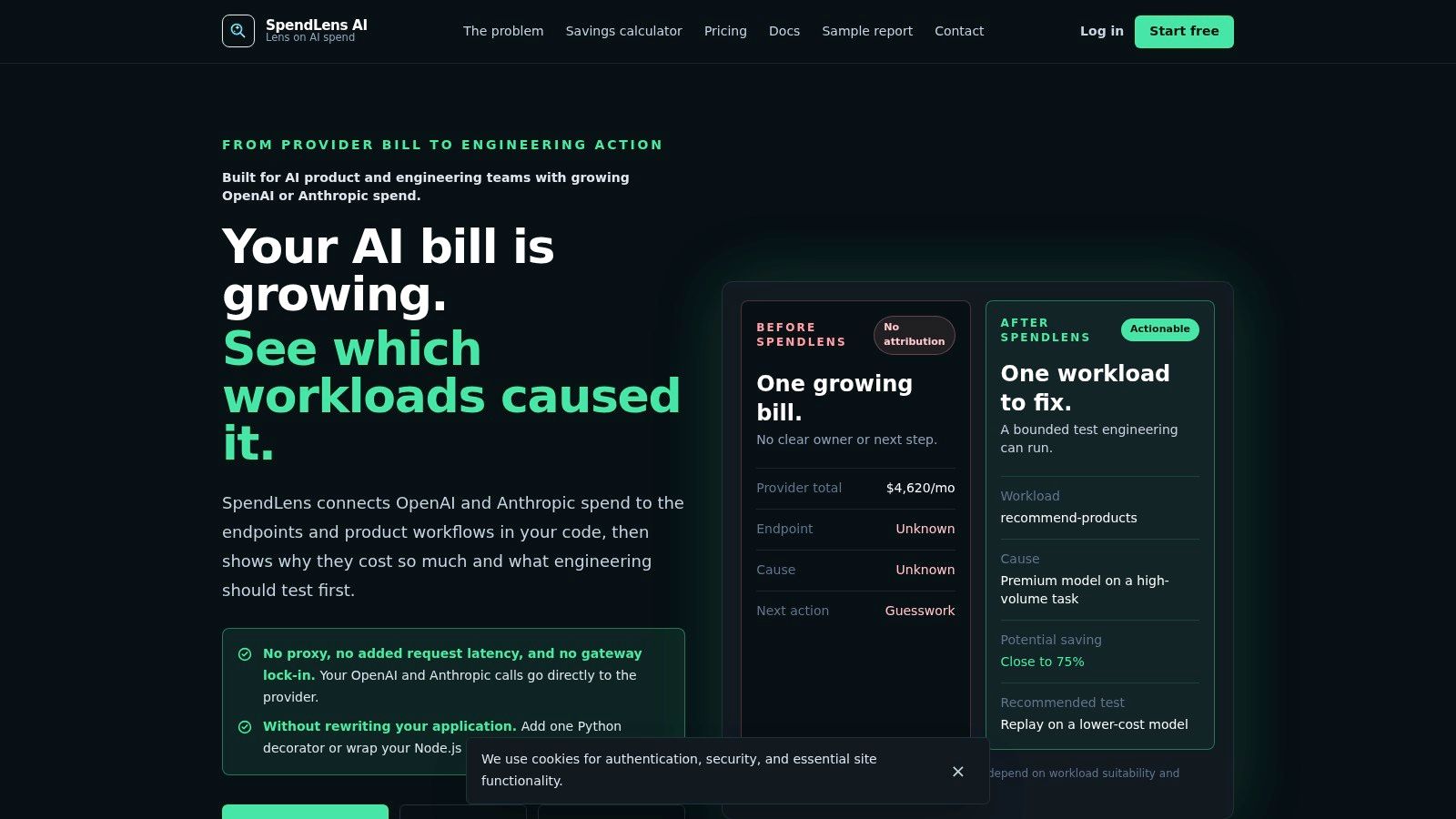
The fastest way to waste money is to know the total bill and still not know which conversation patterns created it. A support bot, a sales assistant, and a product copilot can all run under the same account while producing very different cost profiles. If spend is not tied back to workflow, it is impossible to tell whether a higher bill came from a new feature, a prompt change, or a broken fallback loop.
That is why developer-first observability matters. Teams need per-turn visibility, not just monthly totals. If a specific branch of a dialogue keeps calling the expensive model, or a prompt template keeps dragging in redundant context, the problem becomes visible enough to fix instead of just absorb.
Prompt waste is usually structural
Spend often rises because usage increased, but the underlying cause is usually simpler. Repeated instructions, oversized templates, and conversation history that should have been trimmed earlier are design problems, not demand problems.
A useful optimization pattern is to tag a conversation with a session_id, then inspect where the cost spikes happen. That shows the exact turn where the assistant started repeating itself, pulling back too much context, or making unnecessary model calls. Once that is visible, teams can trim the prompt, cache repeated lookups, or route the turn differently.
The business value shows up in two places. Fewer useless tokens mean lower bills. Shorter and cleaner threads also reduce latency, which makes the assistant feel faster and lowers the odds of a human handoff.
Monitoring changes behavior, not just reports
A dashboard that only shows spend after the fact helps finance, but it is too late for engineering. Teams need alerts, workload breakdowns, and comparison views that show whether a new release changed the economics of a conversation. If a new instruction causes the thread to loop, the billing trail will show it.
The same applies to cache-aware retrieval and model switching. If the system uses a cache well, the hit rate should be visible in the context of real conversations, not as an abstract metric. If the assistant moves from a larger model to a smaller one for routine turns, teams should confirm that quality held while cost dropped.
Endpoint-level detail matters here too. A guide to endpoint monitoring can help teams separate model calls, tool calls, and retries, which is how hidden cost centers surface before they spread across the stack.
Executives need a shorter readout
Leadership does not need every token-level detail, but it does need a clear answer to three questions, what drove spend, what changed, and what should we do next. Daily summaries are more useful than ad hoc screenshots because they turn a technical problem into a budget conversation before the invoice does it for you.
The practical payoff is straightforward. When observability catches waste early, teams avoid shipping expensive conversation patterns into production. That can save real money by preventing a bad prompt, a looping fallback, or an overused premium model from becoming the default path.
Putting It Into Practice with SpendLens AI
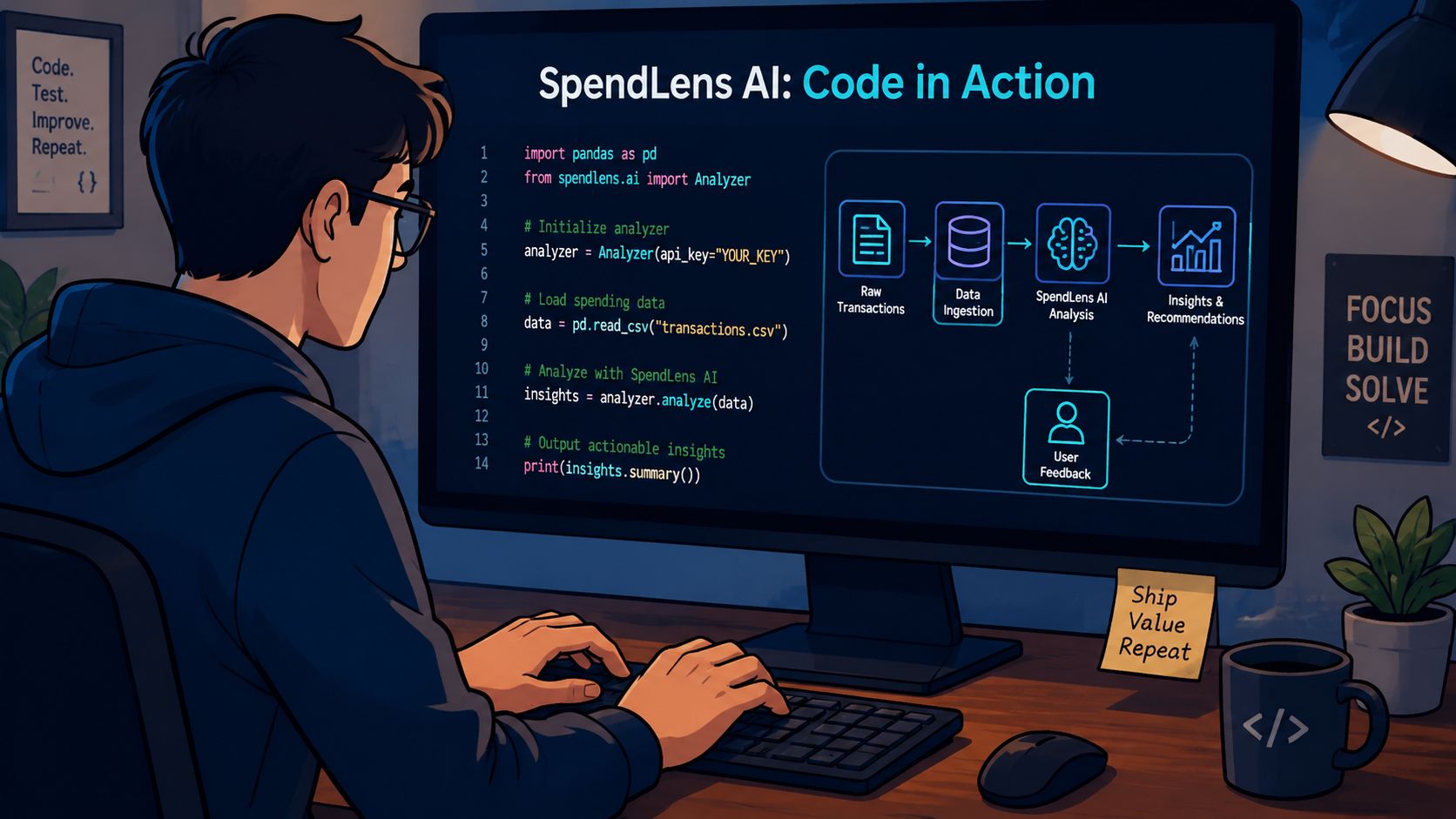
A simple loop becomes useful only after it's instrumented
A plain conversation loop is easy to write and hard to operate. The code can keep sending messages to the model, but without instrumentation, you won't know which turns are expensive, which ones are slow, or where the thread went off course.
That's the gap a decorator-based approach closes. The idea is to wrap the conversation handler, assign a session_id, and let every related call roll up into one visible thread. Once the system has that identifier, you can inspect total spend, token usage, and latency for the entire conversation instead of treating each API call as a mystery.
from spendlensai import observe

@observe()
def handle_chat(session_id, messages):
    response = client.chat.completions.create(
        model="gpt-4.1-mini",
        messages=messages,
    )
    return response
The value isn't the decorator itself. The value is that the conversation stops being a pile of disconnected calls and starts behaving like an analyzable unit. That makes it much easier to see when the assistant keeps re-sending context, calls the wrong model, or inflates the thread with redundant instructions.
The dashboard turns guesswork into diagnosis
Once the conversation is tagged, the dashboard can group the calls by session and reveal which threads are costing the most. That's useful for debugging a single failure and for spotting recurring patterns across many conversations. A support flow that drags the same context into every turn will stand out quickly, as will a workflow that routes simple questions to an expensive model.
A practical next step is to compare a normal thread with a traced one using the sample report. That kind of report gives teams a concrete way to discuss spend with engineering, product, and finance without hand-waving about “AI usage” in the abstract.
You can also tighten the implementation by adding tags for workflow, feature, or endpoint. That makes it much easier to answer questions like which assistant branch is expensive, which model switch is worth it, and whether a recent prompt change caused the bill to jump.
Before and after is the right mental model
Before instrumentation, you only know the request succeeded or failed. After instrumentation, you know whether the conversation was economical, whether context retention held, and whether the user got the result with minimal waste. That difference matters because multi-turn systems don't fail in one place, they fail across the thread.
For a CTO, that means less blind spending. For a platform lead, it means faster root-cause analysis. For the team shipping the assistant, it means fewer release surprises and a cleaner path to optimization.
Building Conversations That Do Not Break the Bank
A common mistake is treating conversational AI like a thin UI layer on top of an LLM. That's how they end up with brittle threads, rising bills, and no explanation for why a feature that looked cheap in staging became expensive in production. Multi turn conversations need to be designed as stateful systems, not as repeated API calls.
The winning pattern is simple to state and hard to ignore. First, acknowledge the hidden technical risk, especially context loss and drift. Second, use architectural patterns that preserve state, compress history, ground facts, and route work to the right model. Third, keep constant visibility into what each thread is doing so cost and quality stay linked.
That's how teams avoid paying premium prices for basic conversation. It's also how they stop shipping assistants that sound helpful but waste time and money on every follow-up.
SpendLens AI gives engineering teams the visibility they need to understand multi-turn conversation costs before they get out of hand. If you're trying to keep context, quality, and spend under control, visit SpendLens AI and see how developer-first observability can make your assistant cheaper to run and easier to trust.